
Uncertainty Quantification in Mathematical Analysis
Uncertainty quantification, or UQ, deals with variability and unknown factors in mathematical models. The goal is to produce reliable predictions and support sound engineering decisions. SysMathx offers UQ services that look at how parameter uncertainty, model assumptions, and external disturbances affect system behavior. Our methods give confidence bounds, risk assessments, and probabilistic insights that help with design, optimization, and performance evaluation.
Uncertainty Quantification in Mathematical Analysis for Engineering and Physical Systems
Variability in engineering comes from manufacturing tolerances, environmental conditions, or incomplete knowledge. Quantifying this uncertainty is key to robust performance, risk reduction, and better decisions.
- Probabilistic performance estimates help anticipate failures before they occur.
- The analysis pinpoints which parameters or components drive outputs the most, enabling targeted improvements.
- Design, optimization, and operational planning are supported for stronger long-term outcomes.
- System safety, resilience, and performance can be evaluated confidently under diverse conditions.
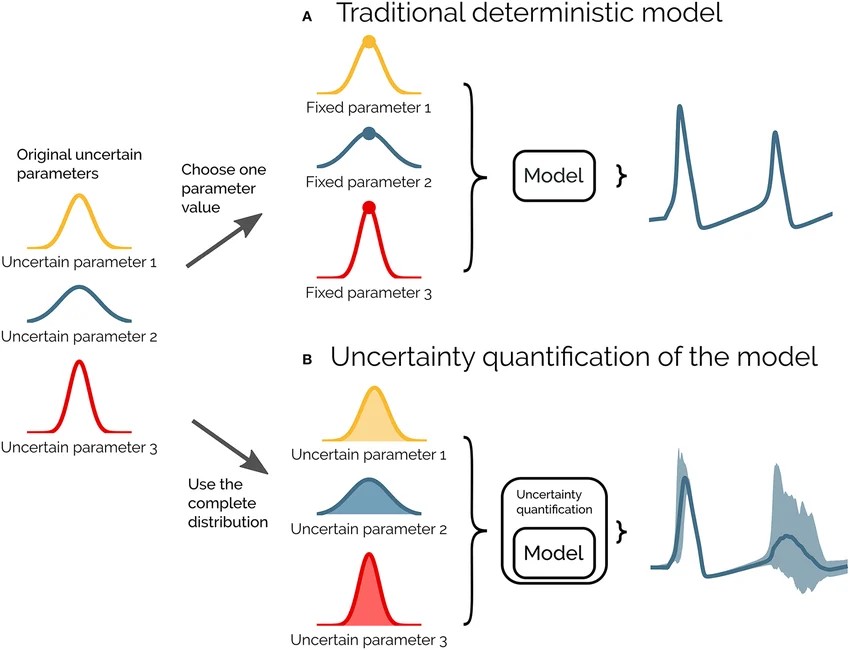 Fig.1 Illustration of uncertainty quantification of a deterministic model. (Tennøe S, et al., 2018)
SysMathx provides end-to-end uncertainty quantification services that transform complex system representations into probabilistic frameworks for actionable engineering insights. Our services encompass probabilistic modeling, sensitivity and variance evaluation, surrogate-based methods, and reliability assessment. By combining advanced mathematical and computational techniques, we enable engineers to quantify risk, assess system robustness, and make informed design and operational decisions.
Probabilistic Model Assessment
We construct probabilistic representations of uncertain system parameters and inputs, enabling rigorous evaluation of performance variability. Our analysts employ advanced sampling techniques and probabilistic simulations to predict outcomes under diverse operational scenarios, providing insights into reliability, variability, and system risks.
- Monte Carlo simulation for evaluating risk, variability, and extreme scenarios
- Parameter distribution modeling with advanced sampling strategies for realistic input representation
- Time-dependent and steady-state uncertainty evaluation to capture dynamic system behavior
- Scenario-based prediction to anticipate system performance under variable operational and environmental conditions
- Quantitative assessment of the probability of deviations from expected performance
Surrogate-Based Uncertainty Estimation
We develop surrogate models to efficiently evaluate uncertainty in high-dimensional or computationally expensive systems. These methods provide fast, accurate approximations of complex system behavior and allow engineers to explore multiple design and operational scenarios without excessive computation.
- Response surface methods to model the impact of parameter variations on outputs
- Reduced-order modeling for complex systems, enabling computationally efficient analysis
- Acceleration of Monte Carlo or stochastic simulations for faster decision-making
- Integration of surrogate outputs into broader risk assessment and optimization workflows
Robustness and Reliability Evaluation
Our UQ techniques quantify system reliability, failure probabilities, and performance limits under uncertain conditions. These evaluations help identify weaknesses, assess operational risks, and inform robust design and maintenance strategies.
- Reliability analysis to evaluate system performance under uncertain inputs
- Failure probability estimation and risk assessment to anticipate potential breakdowns
- Sensitivity-informed design optimization to improve system robustness and resilience
- Guidance for implementing resilient operational strategies in engineering applications
- Identification of critical system components that most influence overall reliability
Scenario-Based Uncertainty Evaluation
We simulate realistic operational and environmental conditions to assess how uncertainties affect system behavior. This scenario-driven approach provides engineers with actionable insights to plan for extreme events, rare occurrences, or unexpected interactions between system components.
- Simulation of variable operational and environmental scenarios to understand real-world performance
- Analysis of performance under rare / extreme / untested conditions
- Identification of critical vulnerabilities, bottlenecks, and potential failure points
- Recommendations for proactive risk mitigation, design improvement, and adaptive operational strategies
- Evaluation of cascading effects of local changes on overall system performance
Risk-Informed Decision Support
Our UQ methods integrate probabilistic and scenario-based assessments to support informed, data-driven engineering decisions. By combining statistical insights with operational context, we help clients prioritize critical factors and optimize design and performance under uncertainty.
- Probabilistic risk assessment to guide decision-making with quantitative confidence
- Prioritization of parameters or components that significantly affect system performance
- Integration of scenario-based outcomes into operational planning and system design
- Support for robust decision-making under uncertainty, including cost-benefit analysis
- Insights for performance optimization and risk mitigation strategies
Our Methods of Uncertainty Quantification in Mathematical Analysis
At SysMathx, we use advanced mathematical, statistical, and computational techniques to quantify uncertainty in complex engineering and physical systems. These methods show how variability affects system performance, reliability, and operational risk. By combining multiple approaches, we provide insights that support robust design, better performance, and informed decision-making.
Applications of Uncertainty Quantification in Mathematical Analysis
Our uncertainty quantification services are applied across diverse engineering and physical systems to enhance reliability, reduce operational risk, and guide evidence-based decision-making. By integrating probabilistic insights, we help engineers and researchers understand variability, optimize designs, and improve system performance under uncertainty.
Mechanical Systems
We analyze how variations in material properties and loading conditions influence structural integrity and fatigue life. Using these insights, our team can develop strategies to prevent failures and extend the service life of mechanical components.
Thermal and Electrical Systems
Our services assess the effects of environmental fluctuations and operational variability on system efficiency and stability. We use these analyses to identify potential performance bottlenecks and recommend solutions to enhance energy management and reliability.
Control and Process Engineering
We investigate which parameters most significantly impact process stability and safety. By applying UQ, our analysts support the design of robust control strategies and optimize operational workflows under uncertain conditions.
Multiphysics Systems
We evaluate interactions between multiple physical domains, such as mechanical, thermal, and electrical systems, under uncertainty. Our analyses uncover critical dependencies and provide guidance for system-level improvements to ensure predictable performance.
How We Work?
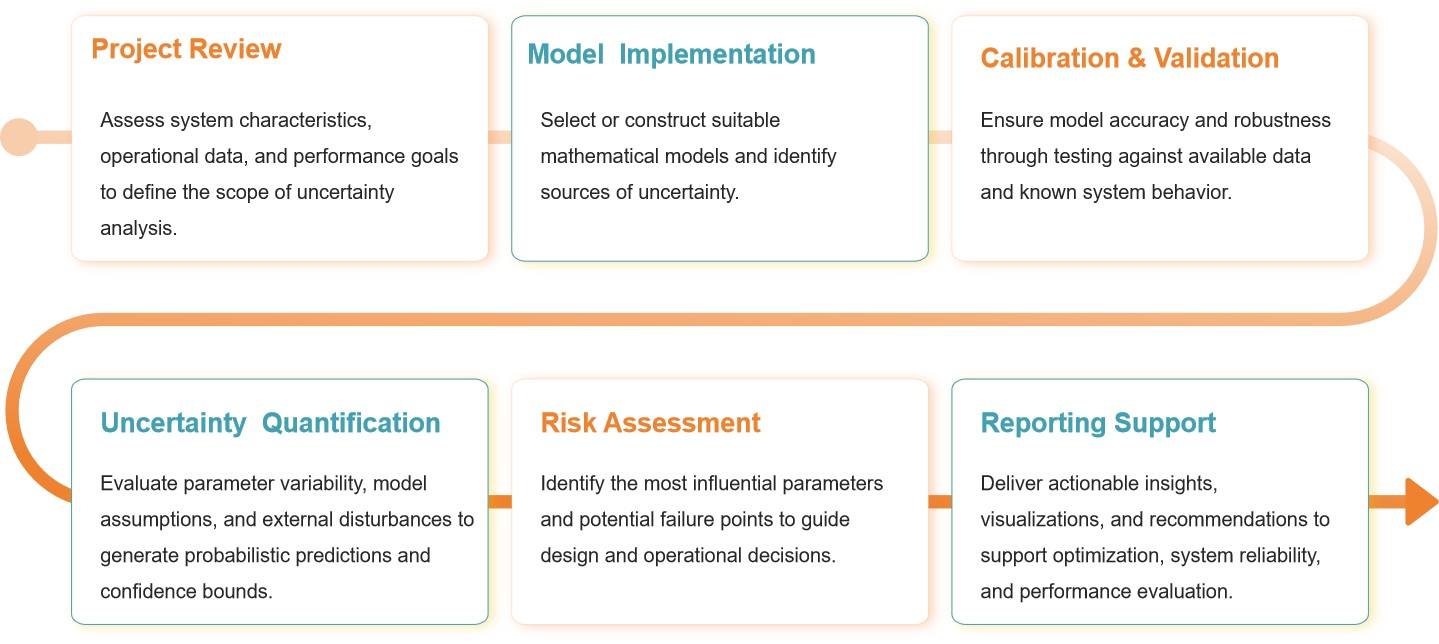
At SysMathx, we adjust uncertainty quantification to fit each system, the available data, and the performance targets. Our team uses probabilistic modeling, stochastic simulations, and surrogate methods to evaluate variability and pinpoint key risks. The insights we deliver support robust design, optimization, and dependable engineering decisions.
Start Your UQ Project Today!
SysMathx offers tailored uncertainty quantification services to evaluate risk, improve system reliability, and optimize engineering performance. System specifications, operational data, or performance objectives can be shared. A comprehensive UQ framework customized to the project's needs will then be delivered. Contact our team to discuss the project and learn how this expertise supports reliable, optimized system performance.
FAQs
What types of systems benefit from uncertainty quantification?
Uncertainty quantification is highly beneficial for engineering, physical, and industrial systems with measurable inputs and outputs. Systems that experience variability in material properties, manufacturing tolerances, environmental conditions, operational loads, or control parameters gain the most from UQ.
Do these analyses require complete system knowledge?
Not necessarily. Our UQ methods can start with partial or limited system information, and models can be progressively refined as more data or measurements become available. This iterative approach ensures that predictions improve over time while still providing actionable insights early in the design or operational process.
Can nonlinear or complex systems be evaluated?
Yes, our techniques fully support nonlinear dynamics, multi-domain interactions, and complex coupled systems. We can assess systems with feedback loops, state-dependent behavior, and stochastic influences, providing realistic and robust insights into how uncertainties affect performance across all operational scenarios.
How are the results validated?
We validate probabilistic and surrogate models using a combination of analytical verification, cross-validation, and comparison with experimental or operational data. These validation steps ensure that predictions are reliable, discrepancies are identified, and actionable insights are accurate for risk-informed decision-making.
Can UQ results guide design or operational decisions?
Absolutely. Our analyses provide quantitative evaluations of risk, sensitivity, and reliability, helping engineers optimize designs, improve control strategies, and plan operations more confidently. By integrating UQ insights, stakeholders can prioritize interventions, reduce uncertainty-driven failures, and achieve higher overall system performance.
Reference
- Tennøe S, et al. Uncertainpy: a python toolbox for uncertainty quantification and sensitivity analysis in computational neuroscience. Frontiers in neuroinformatics. 2018. 12: 370145.