
Artificial Intelligence (AI) & Machine Learning Capabilities
Artificial intelligence and machine learning capabilities refer to computational methods that enable systems to learn from data, identify patterns, and support intelligent decision-making. These capabilities are widely used for prediction, classification, optimization, and automated analysis in complex engineering and scientific environments. SysMathx provides AI and machine learning capabilities that integrate data-driven modeling with physics-based and optimization-driven frameworks. These capabilities support intelligent simulation, predictive modeling, and scalable learning systems for complex engineering and computational applications.
Why AI & Machine Learning are Imperative
Modern engineering has reached a tipping point where traditional computational methods can no longer keep pace with exponential data growth and extreme system complexity. As industrial environments become defined by massive datasets, highly nonlinear behaviors, and hyper-dense variables, artificial intelligence and machine learning have evolved into the foundational infrastructure required to navigate these challenges.
- Decoding Nonlinear Complexity
Modern engineering environments generate datasets too vast for human analysis. Machine learning steps in to decode hidden physical structures and nonlinear interactions, resolving the blind spots where classic physics-based equations become too computationally expensive. - Driving Adaptive Decisions
As interconnected systems grow more volatile, static, rule-based logic fails. AI introduces adaptive frameworks that process real-time inference and pattern recognition, eliminating latency and guesswork in complex trade-offs. - Overcoming Simulation Bottlenecks
Traditional computational workflows are plagued by manual overhead and slow engineering cycles. AI directly addresses this bottleneck by automating feature extraction, model generation, and mathematical evaluations, compressing weeks of simulation into immediate insights. - Unifying Scientific Computing
Historically, data science and structural simulation existed in isolation. The modern landscape requires combining AI methods directly with simulation and optimization pipelines to solve multi-physics, large-scale computational challenges.
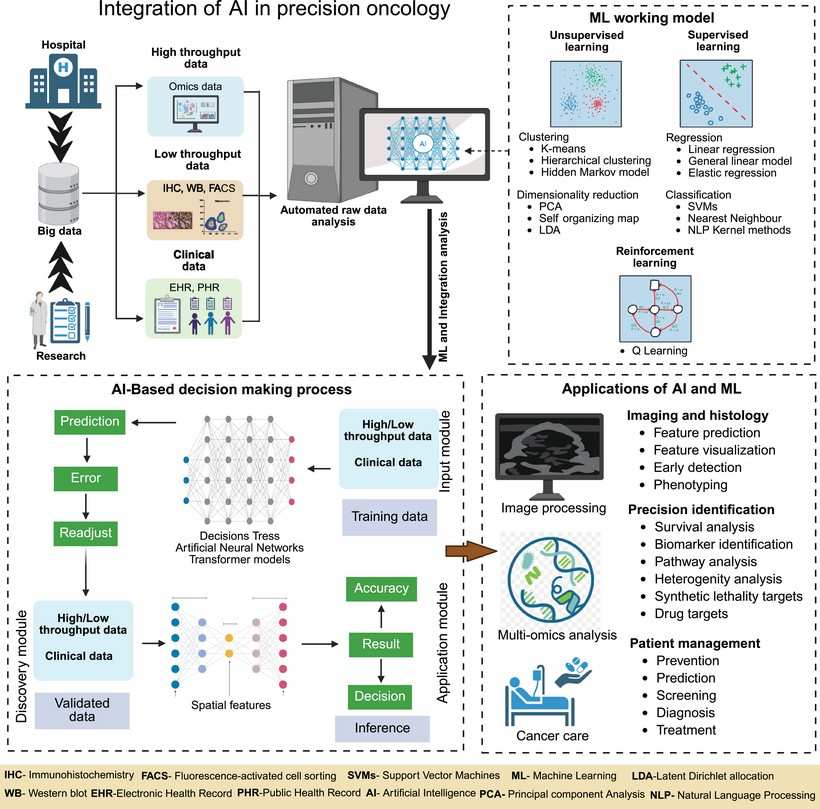 Fig.1 Integrating AI and machine learning into precision oncology enables personalized cancer treatment through advanced data analysis. (Wolde T, et al., 2025)
SysMathx develops AI and machine learning capabilities across data-driven modeling, physics-informed learning, intelligent optimization, and large-scale computational intelligence systems. Our methods are designed to support scalable, reliable, and interpretable AI solutions for engineering and scientific applications. These capabilities enable the handling of complex, high-dimensional, and uncertain systems, supporting advanced computational analysis and decision-making across diverse engineering and scientific domains.
Data-Driven Modeling Capability
Machine learning-based data-driven modeling extracts hidden structures and evolutionary patterns from complex datasets, enabling computational representations of real engineering and scientific systems, a direction strongly supported by our capability framework. This approach is particularly effective when physical mechanisms are incomplete or difficult to explicitly define.
Capability features include:
- Automatically extracting system structures and latent dynamics from high-dimensional and multi-source heterogeneous data
- Constructing stable and interpretable computational models without complete physical descriptions
- Supporting modeling of highly nonlinear, multivariable, and strongly coupled dynamic systems
- Transforming raw data into mathematical representations suitable for simulation, prediction, and optimization
Intelligent Prediction and Inference Capability
Statistical learning and AI-driven inference are used in this capability to estimate future system states, behavioral trends, and probabilistic outcomes under uncertainty, forming a key part of our analytical capability. It enables robust forecasting for complex engineering systems where variability and incomplete information are common.
Capability features include:
- Supporting multi-scale and multi-variable forecasting across short-term and long-term horizons
- Providing probabilistic predictions rather than single deterministic outputs under uncertainty
- Enabling early detection of abnormal behavior, system transitions, and critical states
- Supporting adaptive prediction mechanisms that evolve with changing system conditions
Pattern Recognition and Feature Learning Capability
High-dimensional data is processed through pattern recognition and feature learning techniques to automatically uncover meaningful structures and latent representations within our computational capability framework. This improves interpretation of complex datasets by identifying key patterns that are not directly observable.
Capability features include:
- Learning compact feature representations from high-dimensional datasets
- Supporting unified analysis of images, signals, networks, and time-series data
- Detecting abnormal patterns, structural changes, and system degradation behaviors
- Improving efficiency in data representation and information compression
Nonlinear System Learning Capability
Complex nonlinear relationships and strongly coupled system dynamics are modeled through advanced learning methods designed for high-complexity engineering systems, which is a core focus of our capability development. This becomes essential when traditional analytical modeling approaches are insufficient.
Capability features include:
- Capturing highly nonlinear mappings between inputs and system responses
- Supporting multi-scale and multi-variable coupled system representation
- Modeling systems with feedback loops and complex dynamic evolution behaviors
- Providing high-fidelity approximations for systems without closed-form solutions
AI and Simulation Integration Capability
AI and simulation integration capability combines machine learning methods with mathematical simulation and physics-based modeling to improve computational efficiency and predictive performance. Our computational framework reduces simulation cost while maintaining accuracy and reliability.
Capability features include:
- Replacing computationally expensive simulations with AI-based surrogate models
- Integrating physical constraints with data-driven learning frameworks
- Improving efficiency in multi-physics and multi-scale simulation systems
- Reducing simulation time while preserving model accuracy and stability
Intelligent Optimization and Decision Capability
We apply optimization algorithms enhanced by machine learning to support adaptive decision-making and multi-objective system optimization within our capability system. This capability is widely used in complex engineering scenarios involving competing objectives and constraints.
Capability features include:
- Solving high-dimensional, multi-constraint, and multi-objective optimization problems
- Continuously updating optimization strategies through learning mechanisms
- Supporting dynamic and real-time decision-making environments
- Balancing global exploration and local refinement in optimization processes
Automated Computational Capability
Automated computational capability enables end-to-end automation of data processing, model training, and analytical computation using artificial intelligence techniques. Our capability improves efficiency and consistency in large-scale computational workflows.
Capability features include:
- Automating complete workflows from data preprocessing to model training
- Supporting automated parameter tuning, model selection, and evaluation
- Reducing human intervention while improving computational consistency
- Suitable for repetitive, large-scale engineering and scientific tasks
Large-Scale AI Computing Capability
We support large-scale AI computing capability for training and execution of complex machine learning models on GPU-accelerated and distributed computing systems. This capability is designed for high-dimensional data processing and computationally intensive AI applications.
Capability features include:
- Supporting large-scale parallel training on GPU clusters and distributed architectures
- Processing ultra-high-dimensional datasets and massive-scale data volumes
- Enabling large model training, deep learning, and complex AI system development
- Supporting scalable deployment across cloud and high-performance computing environments
Where Our Capabilities Are Applied
Our computational capabilities are applied across mathematical modeling, system analysis, and dynamic simulation tasks involving complex engineering and scientific systems. These capabilities are designed to handle nonlinear behavior, high-dimensional data, uncertainty, and large-scale computational demands in both physical and data-driven environments.
Solutions of Artificial Intelligence & Machine Learning Capabilities
Engineering and Manufacturing
We apply AI and machine learning capabilities to optimize production processes, improve system design, and predict equipment performance. Our methods help reduce operational costs, enhance efficiency, and support complex engineering decision-making.
Energy and Infrastructure
Our AI frameworks support predictive maintenance, resource allocation, and operational optimization in energy and infrastructure systems. We enable smarter management of large-scale networks, including electricity grids, transportation, and water distribution systems.
Healthcare and Life Sciences
We leverage AI capabilities to analyze medical data, model biological systems, and assist in diagnostic or therapeutic decision-making. Our methods help improve patient outcomes, accelerate research, and enhance system-level understanding of complex biological processes.
Finance and Business Systems
Our machine learning techniques are applied to risk assessment, market forecasting, and resource optimization in financial and business systems. We support data-driven decision-making, operational efficiency, and adaptive strategies for dynamic business environments.
Get Started Today!
Discover how AI and machine learning capabilities from SysMathx can transform your engineering, scientific, and business workflows. Contact us to explore scalable solutions, predictive insights, and intelligent decision-making tools tailored to your complex systems.
FAQs
What types of problems are suitable for AI and machine learning?
AI and machine learning are suitable for prediction, classification, system identification, pattern recognition, and decision-making tasks involving complex and data-rich systems. These methods can handle nonlinear relationships, high-dimensional data, and uncertainty, making them effective for challenging scientific and engineering problems.
Can AI models be used with physical simulation?
Yes, AI models can be combined with physical simulation to improve prediction speed, accuracy, and system understanding. This integration allows for more efficient exploration of system behaviors while reducing computational costs and maintaining model reliability.
Do these methods work for small and large datasets?
Yes, they can be applied to both small-scale datasets and large-scale distributed data environments depending on the problem requirements. The flexibility of AI and machine learning enables robust performance across varying data sizes and computational constraints.
Is machine learning useful for dynamic systems?
Yes, machine learning is widely used for modeling time-dependent and dynamic system behaviors. These approaches can capture evolving patterns, predict future states, and assist in adaptive control or optimization of complex dynamic systems.
Can AI models be deployed in real systems?
Yes, trained models can be deployed in simulation environments, decision systems, and real-time applications depending on the use case. Deployment of AI models enables actionable insights, automated decision-making, and operational improvements across engineering and industrial systems.
Reference
- Wolde T, et al. Current bioinformatics tools in precision oncology. MedComm. 2025, 6(7): e70243.