
Controllability and Observability Analysis in Mathematical Systems
Controllability and observability analysis evaluates how effectively a system can be controlled and monitored. SysMathx offers specialized services to determine the controllability of system states, the observability of outputs, and the robustness of steady-state control margins. Our approach transforms complex mathematical systems into actionable insights for system design, optimization, and operational reliability.
How Controllability and Observability Analysis Works and Why It Matters
In modern engineering and physical systems, understanding which internal states can be controlled and which outputs can be accurately observed is fundamental for ensuring optimal system performance, stability, and operational safety. Controllability and observability analysis provides a rigorous mathematical and computational framework that helps engineers evaluate and predict system behavior under a wide range of operational conditions, including uncertainties and external disturbances.
- Control insight: Identifies which system states can be influenced through available inputs across dynamic operating conditions effectively.
- Monitoring support: Determines which outputs reliably reflect internal system states for accurate observation in real time system environments.
- Robust control design: Helps design systems that maintain performance despite disturbances and parameter variations under uncertain operational conditions consistently.
- Decision guidance: Supports engineering choices for feedback control, optimization, and operational safety in complex multi-domain engineering systems.
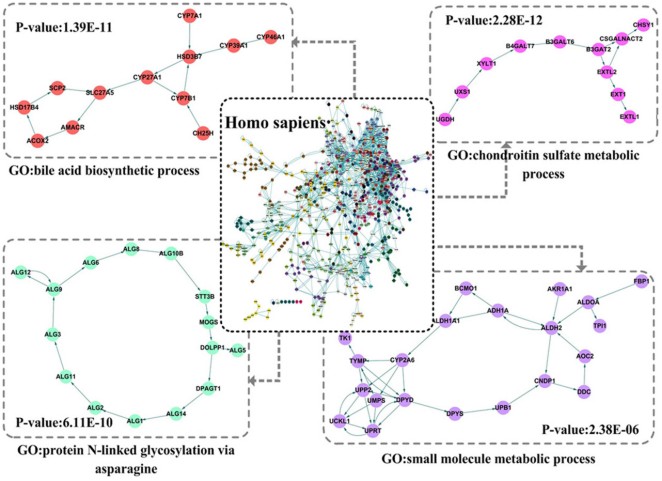 Fig.1 Module-detection results in the Homo sapiens network. (Wang B, et al., 2014)
SysMathx delivers comprehensive controllability and observability services by integrating mathematical modeling, linear and nonlinear system analysis, and computational evaluation methods. Our services focus on detecting critical system modes, evaluating control and observation limitations, and providing actionable recommendations for robust design and operational decision-making. We ensure that engineers gain clear insights into system behavior for improved performance and reliability.
Controllability Matrix Evaluation
We assess controllability by constructing and thoroughly analyzing the system's controllability matrix, which reveals how system states respond to available inputs. This in-depth analysis helps identify which states can be effectively reached through input manipulation, allowing engineers to detect inaccessible or weakly controllable modes that could compromise system performance. By understanding these limitations, we guide strategic actuator placement, improve system responsiveness, and support robust control design tailored to real-world operating conditions.
- Systematic evaluation of state reachability under input constraints in complex dynamic engineering systems operating conditions.
- Identification of uncontrollable modes that may limit performance and reduce overall system stability robustness significantly.
- Guidance for actuator design and placement based on controllability analysis results for optimal system performance efficiency.
- Support for robust control system optimization under uncertainties, disturbances, and varying operational environments continuously over time.
Observability Analysis
SysMathx examines system observability to determine which internal states can be inferred from measured outputs under realistic sensing conditions. This service ensures that monitoring strategies capture critical system information necessary for effective control, fault detection, diagnostics, and operational reliability in complex engineering environments. By evaluating how output signals relate to internal dynamics, we help identify limitations in measurement structures and improve overall system visibility for robust decision-making.
- Analysis of output-to-state mappings using observability matrices across linear and nonlinear systems under sensing constraints.
- Detection of unobservable states affecting monitoring accuracy, diagnostics, fault isolation, and state estimation.
- Support for sensor placement and measurement strategy optimization to improve information capture, observability, and reconstruction.
- Enhancement of system reliability and control effectiveness through observability-driven design for stable and resilient operations.
Steady-State Control Margin Analysis
SysMathx examines system observability to determine which internal states can be reliably inferred from measured outputs under realistic sensing conditions and operational uncertainties. This service ensures that monitoring strategies capture essential system information required for effective control design, fault detection, system diagnostics, and operational reliability in complex engineering environments. By rigorously evaluating the relationship between output signals and internal system dynamics, we identify structural and measurement limitations that may reduce visibility, and provide guidance to improve state estimation accuracy and system interpretability for decision-making.
- Analysis of output-to-state mappings using observability matrices across linear and nonlinear systems under sensing and noise constraints.
- Detection of unobservable states affecting monitoring accuracy, diagnostics, fault isolation, and internal state estimation.
- Support for sensor placement and measurement strategy optimization to improve information capture, observability, and state reconstruction.
- Enhancement of system reliability and control effectiveness through observability-driven design for stable, accurate, resilient operations.
Our Methods for Controllability and Observability Analysis
At SysMathx, we use advanced mathematical, computational, and model-based techniques to evaluate system controllability and observability. These methods support the identification of key system states and the detection of critical dynamic modes. They also enable the development of robust and reliable control strategies for complex engineering systems.
Controllability and Observability Analysis of Mathematical Models
At SysMathx, controllability and observability analysis evaluates how system states respond to inputs and outputs. We use physics-based, data-driven, hybrid, and multi-domain models to identify key system structures.
| Items | Descriptions |
|---|---|
| Physics-Guided System Models | We performed deterministic controllability and observability analysis on our physics-guided system models using state-space and differential equation representations. |
| Data-Driven System Models | We conducted deterministic controllability and observability analysis on our data-driven system models directly from measurement data. |
| Hybrid & Physics-Informed Models | We applied deterministic controllability and observability analysis to our hybrid and physics-informed models by integrating physical laws with data-driven components. |
| Reduced-Order & Surrogate Models | We performed deterministic controllability and observability analysis on our reduced-order and surrogate models efficiently. |
| Complex Multi-Domain Models | We conducted deterministic controllability and observability analysis on our complex multi-domain models across interacting subsystems. |
| Functional and Structural Models | We applied deterministic controllability and observability analysis to our functional and structural models focusing on system structure, causal pathways, and energy flows. |
Applications of Controllability and Observability Analysis
SysMathx applies controllability and observability analysis across mechanical, electrical, chemical, and multi-physics systems to guide control design, optimize monitoring strategies, and improve operational resilience. Our services help engineers make informed decisions, reduce risk, and ensure robust performance under uncertainty.
Mechanical Systems
Our analysis in mechanical systems focuses on understanding how motion and dynamic states respond to available inputs and how well they can be inferred from measurements. This leads to improved control allocation and more stable mechanical performance under real operating conditions.
Electrical Systems
We apply our analysis to electrical systems to examine how internal electrical states evolve and how effectively they can be reconstructed from output signals. This improves monitoring reliability and strengthens control of dynamic electrical behaviors in circuits and networks.
Chemical Processes
Within chemical processes, our analysis helps determine the extent to which process variables can be influenced and observed during operation. It supports safer operation, improved stability, and more efficient control under varying process conditions.
Multi-Physics Systems
For multi-physics systems, our analysis addresses the interaction of coupled physical domains and their controllability and observability characteristics. This enables more accurate system-level coordination and enhances robustness across interconnected dynamics.
How We Work?
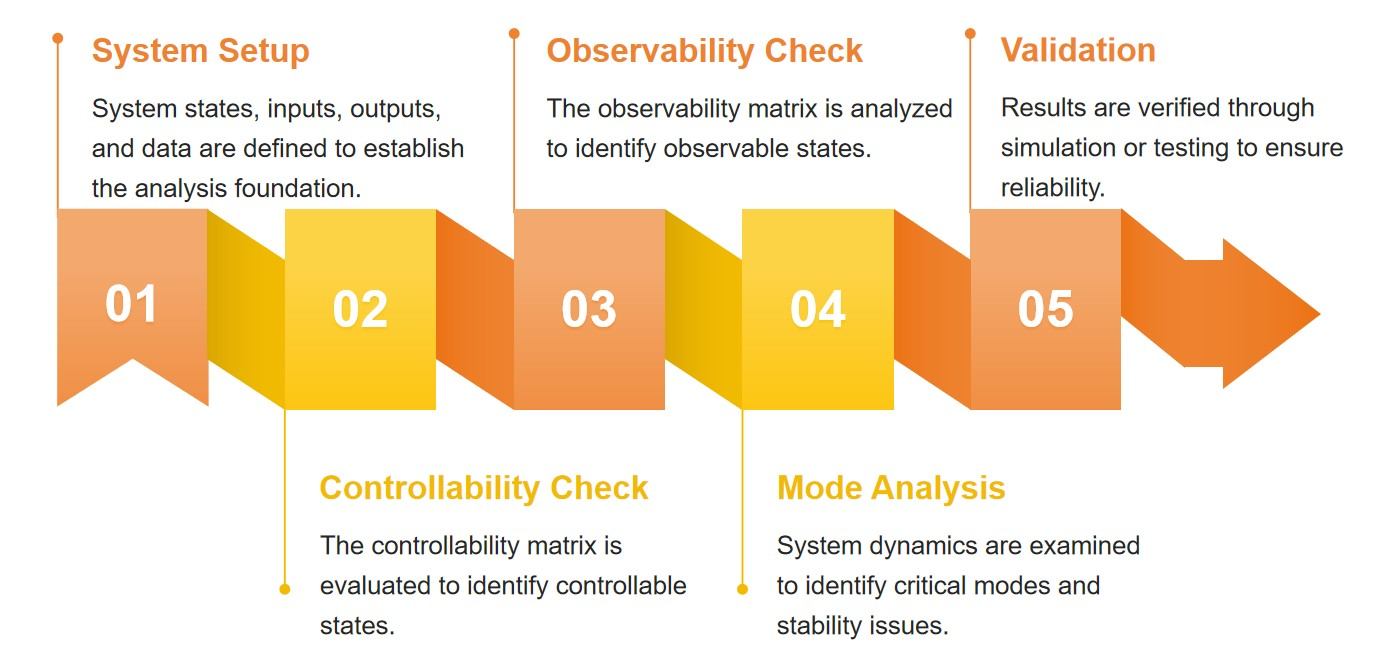
At SysMathx, we design, implement, and validate controllability and observability workflows tailored to system specifications, available measurements, and performance objectives. Our team integrates matrix evaluation, dynamic analysis, and control margin assessment to identify critical states, detect monitoring gaps, and support robust control strategies for practical engineering applications.
Start Your Controllability and Observability Analysis Today!
SysMathx provides tailored controllability and observability analysis services to help you understand system dynamics, identify key controllable and observable states, and improve overall control performance. Share your system model, design objectives, or operational data, and our team will develop a comprehensive analysis framework customized to your engineering needs. Get in touch with us today to explore how our expertise can enhance system reliability, optimize control design, and strengthen monitoring strategies.
FAQs
What is controllability and observability analysis?
Controllability and observability analysis is a mathematical framework used to study dynamic systems. It evaluates whether system states can be influenced through inputs. It also determines whether internal states can be inferred from outputs. This analysis is based on state-space representations and system equations. It helps reveal hidden structural properties of complex systems. Engineers use it to understand system behavior more clearly. It is fundamental for modern control system design.
Why are controllability and observability important in engineering systems?
They ensure that a system can be both effectively controlled and accurately monitored. Without controllability, certain states cannot be influenced by inputs. Without observability, internal states cannot be reliably measured or estimated. This can lead to instability or poor performance in practical applications. These properties are critical for safety and reliability. They also support efficient system design and operation.
What types of systems can be analyzed?
These methods can be applied to mechanical, electrical, chemical, and multi-physics systems. They are suitable for both linear and nonlinear dynamic systems. They also work for coupled and multi-domain systems with interacting components. The approach is flexible across different engineering disciplines. It can be used in both theoretical and practical applications. Complex industrial systems can also be analyzed effectively.
Do I need a complete system model to perform this analysis?
A complete and accurate system model is helpful for classical methods. However, it is not always required in practical applications. Data-driven methods can extract system behavior directly from measurements. Hybrid approaches can combine partial models with observed data. This allows analysis even under uncertainty or incomplete information. The flexibility improves usability in real engineering systems.
What results can I expect from this analysis?
You can expect identification of controllable and observable system states. The analysis highlights system limitations and hidden dynamic modes. It provides insight into how inputs affect system behavior. It also shows how well outputs reflect internal states. These results help improve control system design. They support better monitoring and fault detection strategies. Overall, they enhance system reliability and performance.
Reference
- Wang B, et al. Controllability and observability analysis for vertex domination centrality in directed networks. Scientific reports. 2014, 4(1): 5399.