
Proper Orthogonal Decomposition (POD) Services
SysMathx provides proper orthogonal decomposition (POD) services that transform high-dimensional simulation data such as temperature, stress, velocity, or pressure fields into efficient reduced-order models. Supporting the full workflow from snapshot processing and mode extraction to model construction and deployment, the services also include Galerkin projection, error estimation, and integration with digital twin systems.
What Problems Does Proper Orthogonal Decomposition Solve?
Complex systems in simulation, fluid dynamics, structural analysis, and materials engineering are often limited by high dimensionality, high computational cost, and unclear dominant behavior. POD addresses these issues by extracting dominant energetic modes and building compact reduced-order representations.
- Reduce complexity by extracting dominant modes while preserving key behavior
- Improve structural clarity through multi-modal analysis
- Enhance stability and reproducibility via controlled interfaces
- Increase performance through more selective, predictable responses
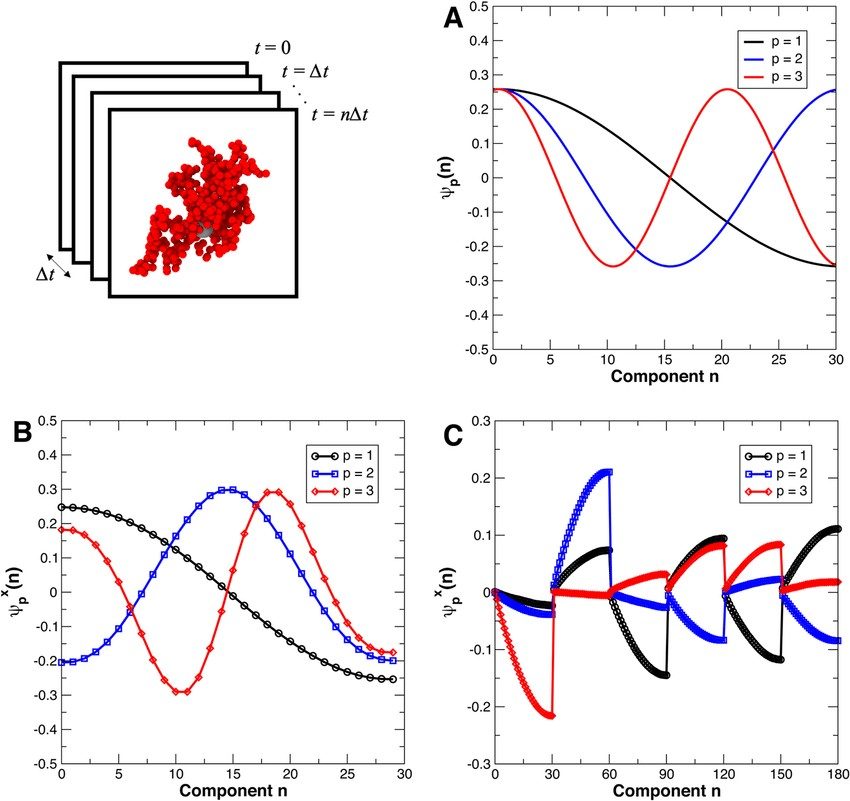 Fig.1 Proper orthogonal decomposition computes relaxation modes from monomer position snapshots. (Miller C A, et al., 2021)
SysMathx provides comprehensive POD solutions tailored to your specific high-dimensional simulation or experimental data—from snapshot design and basis extraction to reduced-order model (ROM) construction, error estimation, and real-time deployment. We translate your full-field simulation outputs into rigorous reduced-order models and deliver a runnable, maintainable, and trustworthy computational tool. Our focus is on methodological rigor, approximation accuracy, and real-time performance.
Snapshot Collection and Data Preparation Services
For POD to work effectively, snapshot data must properly capture the dynamical or parametric behavior of the system. We support the design of efficient sampling strategies that balance accuracy and computational cost.

- Time snapshot design for transient simulations using uniform adaptive or interpolation based approaches
- Parameter snapshot design for reduced order modeling using Latin hypercube sparse grids or greedy sampling methods
- Data preprocessing including centering scaling outlier removal and noise reduction
- Handling of moving boundaries deforming meshes and non uniform grids

- Snapshot collection plan with sampling strategy justification
- Preprocessed snapshot matrix ready for decomposition
- Data quality assessment report
- Documentation of preprocessing steps and assumptions
POD Basis Extraction and Mode Selection Services
After snapshot preparation, we extract POD bases using stable and efficient numerical methods. We guide mode selection based on energy content and reconstruction accuracy to ensure reliable reduced-order models.
- Singular value decomposition for moderate scale problems
- Method of snapshots for large scale cases
- Randomized decomposition for very large datasets
- Mode selection based on energy decay or cross validation
- Frequency domain POD for wave or oscillatory systems
- POD modes in required format
- Singular value and energy distribution results
- Mode selection recommendation
- Orthogonality verification report
Galerkin Projection and Reduced Order Model Construction Services
We use Galerkin projection and reduced order model construction to project governing equations onto a POD basis, forming low-dimensional systems for fast simulation and analysis.
- Projection for linear and nonlinear systems
- Treatment of quadratic nonlinearities using precomputed terms
- Projection methods for convection dominated systems
- Efficient nonlinear evaluation techniques
- Time integration for reduced models
- Reduced order model code
- Projection matrices and precomputed operators
- Time stepping implementation
- Comparison between reduced and full order results
Error Estimation and Model Validation Services
We perform error estimation and model validation to ensure that our reduced models remain reliable within their intended operating range.
- Residual based error estimation
- Cross validation using unseen snapshots
- Sensitivity analysis with respect to parameters
- Assessment of extrapolation limits
- Real time error indicators for deployment
- Error analysis report
- Error bounds and uncertainty estimates
- Validity range definition
- Comparison plots between reduced and full models
Proper Orthogonal Decomposition Modeling Methods
SysMathx's POD modeling service is based on numerical linear algebra and reduced-order modeling techniques to extract dominant structures from complex datasets. By processing snapshot data and constructing optimal basis functions, we build compact, stable, and interpretable reduced-order models that capture essential system dynamics through a structured modeling workflow.
Applications of Our POD Services
Aerodynamic Flow Control
By implementing proper orthogonal decomposition, we derive reduced-order models from flight-condition snapshots to estimate pressure and velocity fields rapidly. This approach facilitates instantaneous while maintaining the high-fidelity dynamics essential for aerospace systems.
Structural Health Monitoring
We use proper orthogonal decomposition to compress multi-load response data into key modal coefficients for infrastructure such as bridges. This allows us to accelerate simulations while maintaining high structural accuracy across various loading conditions.
Heat Exchanger Digital Twin
In industrial thermal systems, we employ POD-based reduced-order models derived from operating snapshots to efficiently forecast temperature and flow fields. This allows us to monitor systems in real time and support predictive maintenance while minimizing computational cost.
Additive Manufacturing Thermal Prediction
In metal additive manufacturing, we apply POD-based reduced-order models built from parametric process snapshots to predict temperature evolution during fabrication. This enables us to assess and manage residual stress and deformation while lowering computational cost.
Wind Turbine Wake Simulation
In wind farm design, we use POD-based reduced-order models to capture turbine wake behavior under varying inflow conditions and rapidly estimate wake interactions across turbine arrays. This enables us to evaluate system-wide flow effects efficiently while reducing computational cost.
Biomedical Flow Modeling
In blood flow analysis, we leverage POD-based reduced-order models from prior simulations to reconstruct and predict hemodynamic behavior in near real time using limited measurement data. This enables fast and efficient flow dynamics estimation while reducing computational cost.
Why Choose Our POD Services?
- Optimal Representation: POD extracts low-rank structures that capture maximum system energy with minimal modes.
- Real-Time Speedup: Reduced-order models enable fast prediction, optimization, and control.
- Reliable Accuracy: Models include validation and error metrics defining accuracy limits and conditions.
- Easy Deployment: Delivered models integrate directly into simulation, control, or edge systems.
- Extended Capability: Supports parametric and nonlinear systems via projection and interpolation methods.
Start Your POD Reduced-Order Modeling Project Today!
SysMathx transforms high-dimensional simulation data into fast reduced-order models for real-time prediction, digital twins, and optimization using POD and related surrogate modeling methods. Contact us to discuss your project, and we will design a tailored modeling solution or recommend the most suitable alternative approach for your system.
FAQs
What is Proper Orthogonal Decomposition used for?
It is used to reduce high-dimensional simulation or experimental data into compact models for fast prediction, analysis, and control.
What types of data can be used in POD?
POD can process field data such as temperature, pressure, velocity, stress distributions, and other simulation outputs.
How is a reduced-order model built in POD?
It is built by extracting dominant modes from snapshot data and projecting the governing equations onto a low-dimensional space.
Can POD be used for real-time simulation?
Yes, POD-based reduced models significantly reduce computation time and can support real-time or near real-time simulation.
How is model accuracy ensured in POD services?
Accuracy is evaluated through error estimation, validation against full-scale data, and mode energy contribution analysis.
What if POD is not suitable for a problem?
Alternative methods such as Gaussian process surrogate modeling or response surface methodology can be recommended based on the system characteristics.
Reference
- Miller C A, et al. Simulation of the coronal dynamics of polymer-grafted nanoparticles. ACS Polymers Au. 2021, 2(3): 157-168.