
Bifurcation Analysis Services
Bifurcation analysis services focus on understanding how dynamic systems change behavior as parameters vary. These transitions often lead to qualitative shifts such as stability loss, oscillation emergence, or chaotic dynamics. By identifying critical thresholds and structural changes, bifurcation analysis provides deep insight into nonlinear system behavior. SysMathx provides bifurcation analysis services to detect system transitions, evaluate stability changes, and interpret parameter-driven dynamic evolution in complex systems.
Why Perform Bifurcation Analysis Services
Dynamic systems often undergo sudden qualitative changes when parameters cross critical thresholds. These transitions cannot be fully captured through standard simulation alone and require structural analysis of system behavior. Bifurcation analysis reveals how stability, equilibrium, and dynamic patterns evolve under parameter variation, enabling deeper understanding of nonlinear systems.
- System behavior may change abruptly when parameters reach critical values
- Stability loss and dynamic transitions are governed by bifurcation structures
- Nonlinear interactions often lead to multiple solution branches and behaviors
- Oscillations and complex dynamics can emerge from simple system changes
- Global system behavior depends strongly on parameter-dependent structure
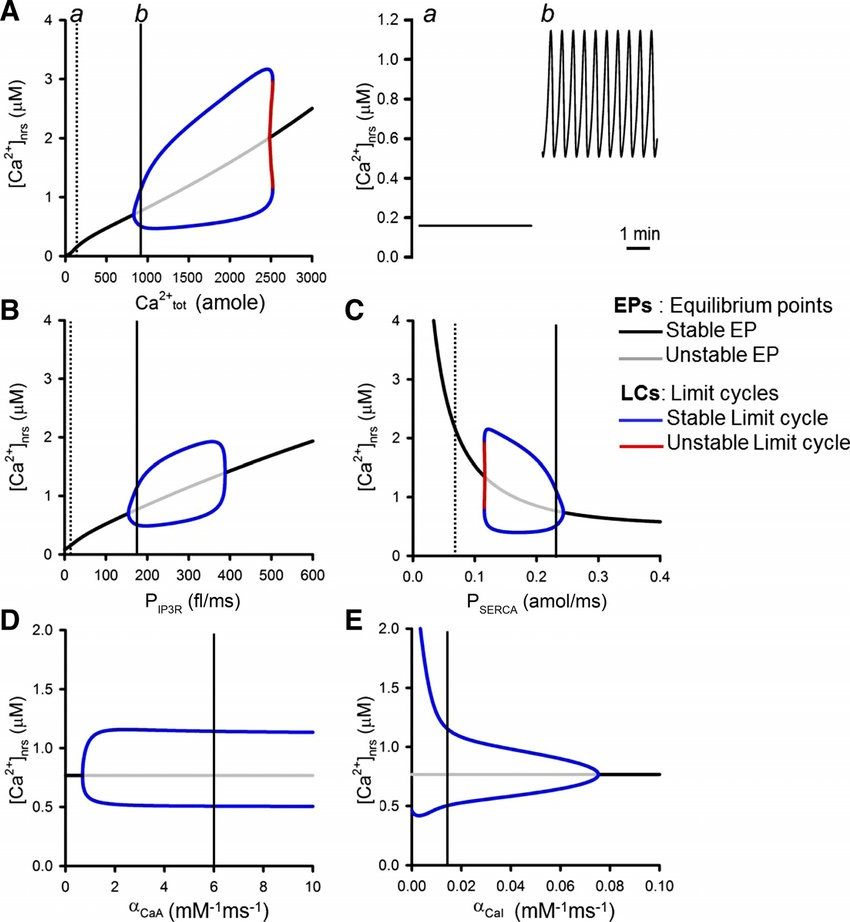 Fig.1 Bifurcation analysis demonstrated how model parameters alter oscillatory behavior. (Takeda Y, et al., 2016)
SysMathx delivers end-to-end bifurcation analysis services that transform dynamic system models into structured representations of parameter-dependent behavior. The focus is on identifying critical transition points, stability changes, and emerging dynamic patterns under varying conditions. These services support system design, stability assessment, and nonlinear behavior interpretation across engineering and scientific applications.
Parameter-Dependent Bifurcation Analysis
We provide parameter-dependent bifurcation analysis service to evaluate how system behavior changes as key parameters vary. It enables identification of critical thresholds where qualitative transitions occur. This service reveals how equilibrium states and solution structures evolve under different parameter conditions. It supports understanding of sensitivity, robustness, and system response to parameter variation.
- Identification of bifurcation points where system behavior changes qualitatively
- Analysis of solution branches as parameters vary across defined ranges
- Evaluation of parameter sensitivity and its impact on system dynamics
- Detection of critical thresholds leading to stability loss or behavior transition
- Mapping of parameter spaces to identify stable and unstable operating regions
Limit Cycle & Periodic Behavior Evaluation
SysMathx provides limit cycle and periodic behavior evaluation service to analyze oscillatory dynamics and recurring system behavior. It focuses on identifying conditions under which periodic motion emerges or disappears. This service helps characterize sustained oscillations and their dependence on system parameters. It supports understanding of dynamic stability and cyclic behavior in nonlinear systems.
- Detection and analysis of limit cycles in nonlinear dynamic systems
- Evaluation of periodic trajectories and oscillation characteristics
- Identification of conditions leading to onset or disappearance of oscillations
- Analysis of amplitude, frequency, and stability of periodic behavior
- Assessment of robustness of oscillatory dynamics under parameter variation
Bifurcation Classification & Stability Transition Detection
We provide bifurcation classification and stability transition detection service to identify different types of bifurcations and their effects on system behavior. It focuses on understanding how stability changes occur and how system structure evolves. This service supports classification of dynamic transitions and interpretation of system behavior near critical points. It is essential for identifying risks and predicting system instability.
- Classification of bifurcation types such as saddle-node and pitchfork
- Detection of stability transitions associated with parameter variation
- Analysis of changes in equilibrium structure and dynamic behavior
- Identification of critical points leading to qualitative system changes
- Evaluation of system response near bifurcation thresholds
Our Methods for Bifurcation Analysis Services
At SysMathx, our methods are designed to capture how system behavior evolves under parameter variation using structured computational and mathematical procedures. These approaches focus on detecting transition points, tracking solution changes, and representing nonlinear system structures in a systematic way. By integrating parameter progression, state evaluation, and dynamic pattern extraction, our methods ensure consistent and interpretable results. This provides a reliable foundation for identifying qualitative changes and supporting engineering applications.
Applications of Bifurcation Analysis Services
Bifurcation analysis services are applied to explore how dynamic systems change behavior when key parameters vary across operating conditions. These services are particularly useful for detecting stability shifts, transition thresholds, and nonlinear response patterns. Across different engineering fields, SysMathx's services help reveal structural changes in system behavior that are not visible through standard simulation alone. This supports more reliable system design, evaluation, and optimization.
Mechanical and Structural Systems
In mechanical and structural applications, our services help reveal how load variation influences deformation patterns and stability limits. Critical conditions associated with buckling, resonance shifts, or sudden structural changes can be identified. This enables safer structural design and improved resilience under varying operating conditions.
Electrical and Power Systems
For electrical and power systems, our services are used to understand how system stability evolves under changes in voltage, load demand, or network parameters. Instability zones and oscillatory regimes can be detected before system failure occurs. This improves grid reliability and operational security.
Thermal and Energy Systems
For thermal and energy systems, our services help characterize how energy input and transfer conditions influence system equilibrium. Shifts from stable temperature distribution to unstable or oscillatory states can be identified. This supports improved energy efficiency and thermal stability management.
Control and Automation Systems
In control and automation, our services support evaluation of how tuning parameters affect closed-loop behavior. Transitions between stable control, oscillations, and instability can be systematically identified. This provides a clearer basis for controller adjustment and system robustness improvement.
Industrial and Process Systems
For industrial and process systems, our services help identify how operational parameters influence process stability and efficiency. Critical thresholds leading to performance degradation or instability can be detected early. This supports safer operations and more efficient process control strategies.
Multi-Domain Engineering Systems
In multi-domain systems, our services are applied to capture how coupled physical interactions affect overall system stability. Changes in one domain can trigger global behavioral transitions across the system. This enables integrated analysis of complex engineering systems with interacting physical fields.
Why Choose SysMathx for Bifurcation Analysis Services?
- Physics-consistent nonlinear modeling improves reliability of bifurcation, transition, and stability prediction in engineering systems.
- Global behavior across multiple equilibria and solution branches provides structured interpretation of nonlinear dynamic evolution.
- Constraint-aware formulations ensure physically feasible states and transitions for realistic engineering applications.
- High-resolution parameter exploration enables accurate detection of critical thresholds and bifurcation behavior.
- The results integrate directly with simulation, validation, and engineering optimization workflows.
Start Your Bifurcation Analysis Project!
SysMathx provides end-to-end bifurcation analysis services to help you understand nonlinear transitions, stability changes, and parameter-dependent system behavior. These services support accurate identification of critical thresholds and dynamic regime shifts in complex systems. By combining structured mathematical modeling with systematic parameter exploration, we deliver clear and actionable insights for engineering analysis and system design. Contact us today to define your system requirements and begin your bifurcation analysis project.
FAQs
What types of systems are suitable for bifurcation analysis?
Bifurcation analysis is suitable for nonlinear dynamic systems that can be described using mathematical models with varying parameters. It is commonly applied to mechanical, electrical, thermal, control, and multi-domain engineering systems. These systems often exhibit multiple equilibrium states and complex transition behavior under changing conditions.
Do I need a fully defined model to perform bifurcation analysis?
A fully detailed model improves accuracy, but bifurcation analysis can also be performed using simplified or partially defined system representations. The key requirement is a structured mathematical description of system dynamics. Models can be refined progressively as more data becomes available.
Can bifurcation analysis identify system instability?
Yes, bifurcation analysis is specifically designed to detect stability changes as system parameters vary. It can identify critical points where stable behavior transitions into oscillatory or unstable regimes. This helps in predicting potential system risks before they occur.
How is bifurcation information obtained from a system?
Bifurcation information is obtained by systematically varying parameters and observing changes in equilibrium and dynamic structure. Techniques such as continuation methods and stability evaluation are commonly used. This allows mapping of how system behavior evolves across parameter space.
Can bifurcation analysis be used together with simulation?
Yes, bifurcation analysis is often combined with numerical simulation for validation and deeper insight. Simulation helps confirm predicted transitions and dynamic behaviors. Together, they provide a more complete understanding of system evolution.
Reference
- Takeda Y, et al. Modeling analysis of inositol 1, 4, 5-trisphosphate receptor-mediated Ca2+ mobilization under the control of glucagon-like peptide-1 in mouse pancreatic β-cells. American Journal of Physiology-Cell Physiology. 2016, 310(5): C337-C347.