
Multiphysics Modeling Services
SysMathx provides advanced multiphysics modeling services that translate complex real-world physical interactions into structured computational models, combining differential equation and dynamic system modeling with coupled thermal, fluid, structural, and electromagnetic analysis to deliver reliable simulation frameworks, numerical solutions, and engineering insights for design, validation, and optimization workflows.
How Multiphysics Modeling Describes Coupled Physical Systems
In real-world systems, physics don't act alone. Heat changes structure, structure affects fluid flow, and flow alters temperature. Running single-physics simulations separately misses these interactions entirely — and that leads to inaccurate predictions and design flaws.
Multiphysics modeling directly addresses these engineering challenges by:
- Building fully coupled models: Solves thermal, structural, and fluid equations simultaneously, not one after the other. Matches how the real system behaves, so the model actually reflects reality.
- Keeping predictions stable across changing conditions: Builds models on physical principles, not statistical curve-fitting. When operating points shift or design parameters change, the simulation stays reliable — no unexpected breakdowns.
- Making design decisions explainable: Lets engineers trace exactly how each parameter affects overall performance. No black box, just clear physics that can be trusted and acted upon.
- Catching costly problems early: Identifies issues like thermal expansion causing misalignment or flow-induced vibration leading to fatigue long before a physical prototype is built. Means fewer surprises during scale-up, testing, or regulatory submission.
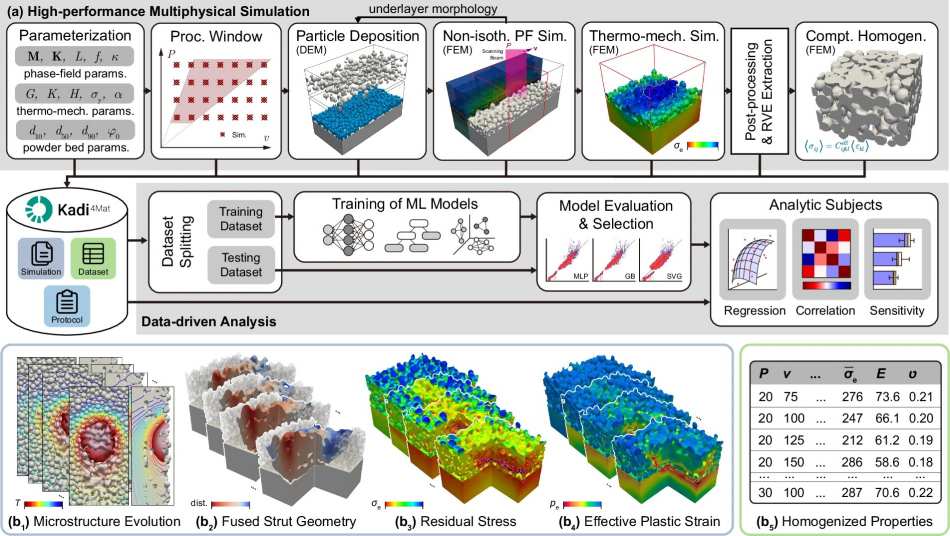 Fig.1 Research framework schematic covering multiphysical PBF simulations and Kadi4Mat data curation. (Bharech S, et al., 2025)
SysMathx provides multiphysics modeling services that help translate complex engineering problems into structured computational models for analysis and simulation. Our focus is on aligning physical understanding, mathematical representation, and numerical implementation to ensure models are consistent, usable, and suitable for engineering workflows.
We work across coupled systems where multiple physical effects interact, organizing problem definitions, building model structures, and preparing simulation-ready frameworks that support design evaluation and decision-making.
| Services | Capabilities |
|---|---|
 Physics-Driven Problem Structuring Physics-Driven Problem Structuring |
We begin by organizing the engineering problem into a structured representation that reflects its physical mechanisms, constraints, and operating conditions.
|
 Model Construction & Computational Representation Model Construction & Computational Representation |
We translate physical descriptions into computational models that can be implemented and executed within simulation environments.
|
 Numerical Implementation & Simulation Workflow Support Numerical Implementation & Simulation Workflow Support |
We support the transformation of models into executable simulation workflows using suitable numerical strategies and computational techniques.
|
 Model Assessment & Insight Extraction Model Assessment & Insight Extraction |
We evaluate model behavior and extract engineering insights to support interpretation and decision-making.
|
Multiphysics Modeling Methods and Tools
In engineering projects, multiphysics modeling is defined by how different numerical approaches are combined to represent real system behavior. The choice of methods depends on the physics involved, the coupling between domains, and the goals of the simulation. At SysMathx, we apply practical modeling strategies to ensure stability, accuracy, and efficiency in real-world applications.
Finite Element and Finite Volume Methods
FEM is widely used for structural and thermal problems, while FVM is preferred for fluid dynamics due to its conservation properties. In multiphysics scenarios, these methods may be used together depending on how different domains are coupled.
Time-Dependent & Nonlinear Simulation
We handle transient and nonlinear systems using adaptive time-stepping and iterative solvers, allowing simulations to remain stable while capturing evolving system behavior under varying conditions.
High-Performance Computing for Multiphysics Models
For large-scale or computationally intensive models, we apply parallel computing and HPC-based acceleration to improve efficiency and enable more detailed simulations.
Model Coupling and Numerical Stability
Multiphysics problems often involve tightly coupled interactions between domains. We manage coupling strategies and solver configurations to maintain numerical stability and ensure consistent convergence across interacting systems.
Applications of Multiphysics Modeling Services
Multiphysics modeling services are applied across engineering domains where coupled physical effects need to be evaluated together rather than in isolation. These applications typically involve interactions between thermal, fluid, structural, and electromagnetic behaviors in real operating conditions.
Thermal And Energy Systems
Used to analyze heat transfer and thermal performance in components and systems under varying operating conditions. These models help evaluate temperature gradients, heat dissipation paths, and potential hotspots within complex assemblies. They are commonly applied in scenarios where thermal behavior directly impacts system efficiency and reliability.
Fluid–Structure Interaction (FSI)
Applied to systems where fluid flow induces structural deformation or where structural motion influences flow behavior. This includes cases with pressure-induced deformation, vibration effects, or flow-induced loading. Multiphysics coupling is essential to capture the feedback loop between fluid forces and structural response.
Electromagnetic Systems And Devices
Supports the analysis of field distributions, signal behavior, and interactions between electromagnetic forces and surrounding materials. These models study how fields propagate, concentrate, or interact with conductive or dielectric components. They are particularly useful in evaluating performance in devices with tightly coupled field-material interactions.
Aerospace And Mechanical System Design
Used to evaluate complex coupled effects such as aerodynamics, structural loading, and thermal stresses in integrated engineering designs. These simulations help assess how multiple physical factors influence overall system performance under real operating conditions. They are often applied in design iterations to improve robustness and optimize system behavior.
Why Choose Our Multiphysics Modeling Services?
- Cross-Domain Expertise – Experience across thermal, fluid, structural, and electromagnetic systems ensures accurate handling of coupled physical effects.
- Reliable Coupling Strategies – Well-structured interaction modeling to maintain stability and consistency across multiple physical domains.
- Engineering-Focused Implementation – Models are built for practical use in simulation, design evaluation, and performance analysis—not just theoretical study.
- Scalable Simulation Capability – From simplified models to high-fidelity simulations, adaptable to different project stages and complexity levels.
- Insight-Driven Results – Clear interpretation of system behavior, helping identify key drivers and support informed engineering decisions.
Start Your Multiphysics Modeling Project!
If your project involves coupled physical systems or requires a structured modeling approach, our team can help define and implement a suitable multiphysics framework. Contact us to discuss your requirements with our technical team.
FAQs
What types of problems are suitable for multiphysics modeling?
Problems involving interacting physical effects—such as heat with flow, or fluid with structural response—are typically good candidates for multiphysics modeling.
How do you handle coupling between different physical domains?
We select coupling strategies based on the problem, balancing stability and accuracy while ensuring consistent interaction between domains during simulation.
What tools or methods are commonly used in multiphysics modeling?
Multiphysics modeling typically uses numerical methods such as finite element, finite volume, or finite difference approaches, often implemented in specialized simulation platforms.
How are multiphysics models validated for accuracy?
Model validation is performed by comparing simulation results with experimental data, benchmark cases, or analytical solutions to ensure reliability and consistency.
Reference
- Bharech S, et al. ML-extendable framework for multiphysics-multiscale simulation workflow and data management using Kadi4Mat. Scientific Data. 2025, 12(1): 962.