
Mathematical Analysis Services
At SysMathx, mathematical analysis is used to understand complex systems with dynamic behavior, uncertainty, and interdependent structures. Our services transform complex systems into structured and interpretable insights that support reliable engineering decisions. By integrating deterministic, uncertainty, stability, sensitivity, and controllability and observability analysis, we provide a comprehensive framework for system evaluation.
Why Mathematical Analysis Matters
Modern systems are increasingly complex, involving nonlinear interactions, multi-scale behavior, feedback loops, and uncertain environments, which make intuition or isolated computational models insufficient for reliable decision-making. Mathematical analysis provides a structured framework to decompose this complexity into measurable and interpretable components, enabling systematic evaluation of system behavior. This approach improves clarity, reliability, and decision-making capability in both theoretical research and practical engineering applications.
Key advantages of mathematical analysis include:
- Structured representation of complex system behavior across multiple scales
- Identification of key system drivers, constraints, and dependencies
- Improved understanding of dynamic behavior and stability characteristics
- Support for engineering design, optimization, and validation processes
- Scalable analysis frameworks for single-domain and multi-domain systems
- Enhanced decision-making through quantitative and interpretable insights
 Fig.1 Mathematical analysis services.
At SysMathx, we provide a complete suite of mathematical analysis services designed to support system understanding, performance evaluation, and engineering decision-making. Each service is tailored according to system structure, data availability, and application objectives. Our approach ensures that every analysis delivers both theoretical rigor and practical relevance, allowing results to be directly applied in engineering design and system optimization. These services are widely applicable across mechanical, electrical, thermal, industrial, environmental, and data-driven systems.
We provide deterministic analysis services to evaluate systems governed by well-defined relationships and predictable behavior patterns. Through deterministic evaluation, we help identify how system structure influences performance and how different components interact under controlled environments. This enables reliable interpretation of system behavior without ambiguity introduced by randomness.
- Structured evaluation of system behavior under defined conditions
- Clear representation of dynamic responses and steady-state behavior
- Identification of structural relationships and dependencies
- Performance characterization under controlled scenarios
- Support for model validation and engineering interpretation
We provide uncertainty quantification services to evaluate how variability, noise, and incomplete knowledge affect system behavior. In real-world systems, uncertainty is unavoidable, and understanding its impact is essential for reliable decision-making. Our services help characterize how uncertainty propagates through system models and influences final outcomes. This allows for more robust interpretation of results and improved confidence in system predictions.
- Quantification of uncertainty sources in system inputs and parameters
- Evaluation of output variability under uncertain conditions
- Probabilistic interpretation of system behavior
- Risk-informed analysis for decision support
- Improved robustness of modeling and prediction results
We provide stability analysis services to evaluate whether systems maintain consistent behavior under disturbances or changing conditions. Stability is a key property in ensuring safe and reliable system operation. Our analysis focuses on identifying equilibrium conditions, instability regions, and transition behaviors that may affect system performance. This helps ensure that systems operate within safe and predictable boundaries.
- Evaluation of system stability under perturbations
- Identification of equilibrium and unstable states
- Analysis of transient and long-term system behavior
- Detection of instability regions and risk conditions
- Support for safe system design and operation
We provide sensitivity analysis services to evaluate how variations in system parameters and inputs affect overall system behavior. This helps identify which factors have the most influence on system performance. By quantifying parameter impact, we enable better prioritization in design, optimization, and control strategies. This ensures that engineering efforts focus on the most critical system components.
- Identification of key influencing parameters
- Quantification of input-output relationships
- Evaluation of system response variability
- Ranking of system sensitivities
- Support for design optimization and parameter tuning
We provide controllability and observability analysis services to evaluate how system states can be influenced and inferred through inputs and outputs. This is essential for control system design and monitoring strategy development. Our services help determine which parts of a system can be controlled effectively and which internal states can be reliably observed. This improves system transparency and supports better engineering design decisions.
- Identification of controllable system states
- Evaluation of observable system components
- Assessment of system monitoring capability
- Support for control system design and structure
- Improvement of system interpretability and transparency
Mathematical Analysis Methods We Use
At SysMathx, we apply a structured set of analytical and computational methods to deliver reliable mathematical analysis services. These methods are integrated service capabilities designed to interpret system behavior, quantify uncertainty, and evaluate performance under different conditions. Our approach ensures that all outputs are consistent, interpretable, and directly applicable to engineering decision-making.
| Items | Descriptions |
|---|---|
| Eigenvalue and Mode Decomposition Method | We decompose system dynamics into characteristic modes using spectral properties to identify stability trends and dominant behavioral patterns. This method reveals key dynamic structures governing overall system behavior. It enables clearer interpretation of long-term stability and response characteristics. |
| Perturbation Expansion Method | Our perturbation expansion method introduces small variations in system parameters to capture local response behavior. We can evaluate system robustness under slight disturbances using this approach. It provides structured insight into near-operating condition behavior. |
| Stochastic Representation Method | We use stochastic structures to represent uncertainty and describe how randomness propagates through system outputs. Our approach captures variability in a mathematically consistent form. It enables systematic quantification of uncertainty effects in complex systems. |
| Optimization Constraint Method | We evaluate system performance under constraints to identify feasible operating regions and optimal configurations. Our method determines trade-offs between competing performance objectives. It supports structured optimization of system behavior under practical limitations. |
| State Reconstruction Method | Internal system states are inferred from observable outputs to evaluate how completely system behavior can be reconstructed. We identify limitations in system observability through this method. It improves understanding of hidden system dynamics and structural properties. |
| Sensitivity Mapping Method | We quantify relationships between parameter variations and system responses to identify key influencing factors. Our method highlights dominant drivers of system behavior. It supports systematic refinement of models and design parameters. |
Applications of Our Mathematical Analysis Services
Our mathematical analysis services are applied across multiple domains to evaluate system behavior, quantify uncertainty, assess stability, and support engineering decision-making in complex environments. We provide structured analytical capabilities tailored to different system types and application requirements.
Engineering Systems
We apply mathematical analysis services to engineering systems to evaluate performance behavior, structural dynamics, and system reliability under varying conditions. The services support design evaluation, system validation, and performance optimization.
Control and Automation Systems
Our controllability and observability analysis is used in control and automation systems to evaluate state accessibility and output responsiveness. The services support controller design, system monitoring, and feedback structure evaluation.
Energy and Power Systems
We apply mathematical analysis services to energy systems to evaluate stability, dynamic behavior, and energy transfer efficiency. The services support system optimization, load balancing, and operational decision-making.
Financial and Economic Systems
Our mathematical analysis services are applied to financial systems to evaluate risk, uncertainty, and dynamic market behavior. The services support scenario analysis, sensitivity evaluation, and decision modeling.
Environmental and Climate Systems
We apply uncertainty quantification and stability analysis to environmental systems to evaluate dynamic changes and variability over time. This improves understanding of complex climate and ecological processes.
Complex Multi-Domain Systems
Our mathematical analysis services are applied to multi-domain systems with coupled physical and functional interactions. The services support system-level behavior evaluation, dependency analysis, and cross-domain interaction assessment.
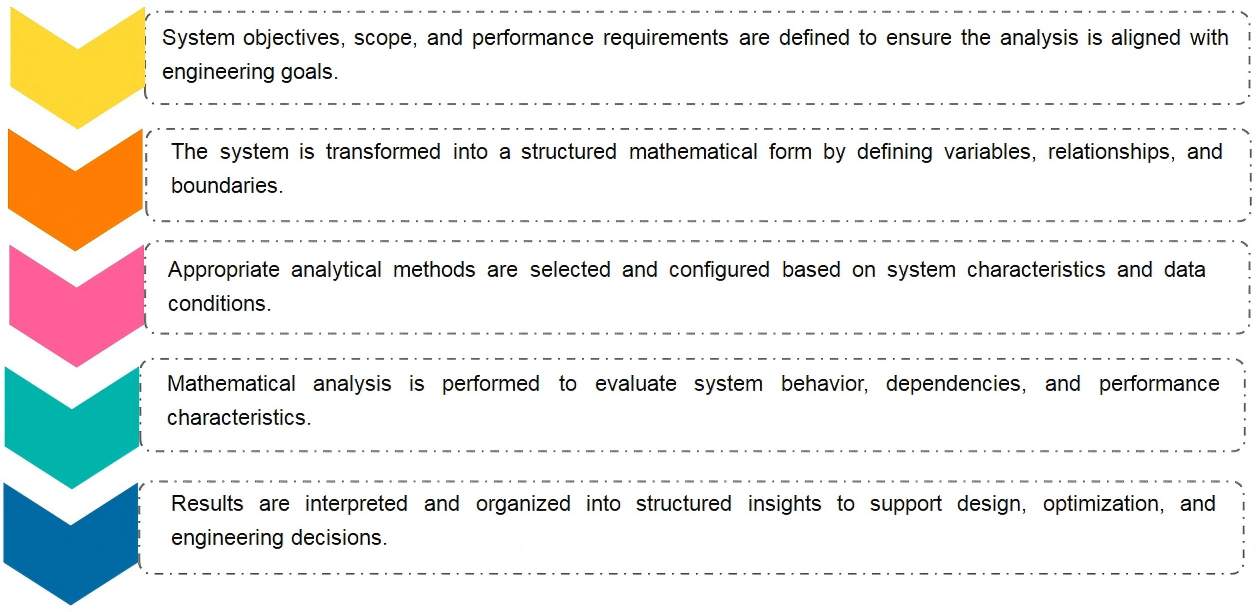
Workflow of Mathematical Analysis Services
Start Your Mathematical Analysis Project Today!
SysMathx delivers mathematical analysis services that transform complex systems into structured and interpretable insights for engineering evaluation and decision-making. By integrating deterministic analysis, uncertainty quantification, stability analysis, sensitivity analysis, and controllability and observability analysis, tailored solutions are developed to match specific system requirements. Contact us with your system overview and analysis goals to receive a customized strategy and technical proposal.
FAQs
What types of systems can be analyzed?
Mathematical analysis can be applied to a broad range of systems, including engineering systems, physical processes, industrial operations, financial systems, and multi-domain coupled systems. It is especially suitable for systems that exhibit dynamic behavior, nonlinear interactions, uncertainty, or strong internal dependencies. We can configure the analytical framework according to system complexity, data structure, and application objectives, ranging from simplified representations to highly detailed mathematical models.
Do I need complete data for analysis?
Complete and high-quality datasets can improve the accuracy and resolution of analysis results, but they are not required to begin the process. Partial, noisy, or incomplete data can still be used to construct an initial system representation and perform preliminary analysis. As additional information becomes available, the model and analysis can be iteratively refined to enhance reliability, stability, and predictive performance.
Can uncertainty be included in the analysis?
Yes, uncertainty is explicitly addressed through structured uncertainty quantification methods integrated into the analysis process. This includes handling parameter variability, measurement noise, incomplete information, and environmental fluctuations. The results not only describe expected system behavior but also provide confidence intervals, variability ranges, and risk-related insights to support more robust decision-making under uncertainty.
Can these methods support control system design?
Yes, controllability and observability analysis plays a key role in supporting control system design and evaluation. It helps determine which system states can be influenced through external inputs and which states can be reliably inferred from measured outputs. This information is critical for designing effective control strategies, improving system monitoring, and ensuring stability and performance in dynamic operating conditions.
Are the results suitable for real engineering applications?
Yes, all analysis outputs are designed with practical engineering applications in mind, including system design, optimization, validation, and operational decision-making. Results are structured to be interpretable, traceable, and directly usable within simulation environments or engineering workflows. This ensures that the analysis supports both theoretical understanding and real-world implementation across complex systems.