
Mathematical Modeling Services
At SysMathx, mathematical modeling turns complex systems into structured, analyzable forms. These forms support prediction, optimization, and decision-making. Physical principles, data analysis, and computational methods work together. This combination brings clearer understanding to systems that have uncertainty and dynamic behavior. Each project is built around the system's own characteristics, the data available, and the goals of the application. Technical rigor and practical relevance are both part of the final result.
What Challenges Does Mathematical Modeling Address
Real-world systems often have nonlinear dynamics, uncertainty, multi-scale interactions, and incomplete or noisy data. When these conditions exist, simple analytical methods or purely empirical approaches are not sufficient for accurate prediction or decision support. Mathematical modeling gives a structured framework for capturing such complexities. The result is more reliable analysis and better insight.
- Complex system behavior is captured in a consistent framework that also scales well.
- Physical knowledge, empirical data, and statistical methods are combined to get better predictive performance.
- Uncertainty and variability are quantified. This supports decision-making that is risk-aware and robust.
- Reliance on costly experiments or high-fidelity simulations is reduced through efficient model approximations.
- Optimization, control, and scenario evaluation are all possible across different operating conditions.
- Sensitivity analysis helps locate key drivers and critical system parameters.
- Model-based design, planning, and performance improvement are supported in complex environments.
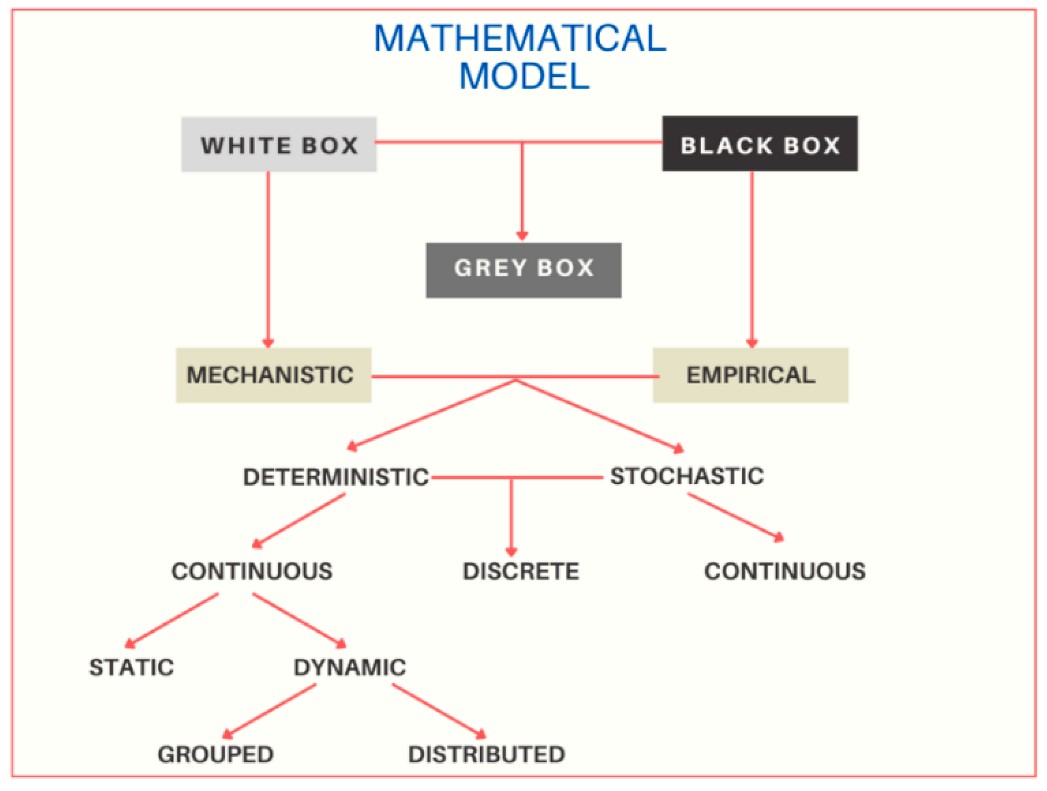 Fig.1 Classification of mathematical models. (García-Rodríguez L C, et al., 2022)
SysMathx provides mathematical modeling approaches suited to various system types, data conditions, and project objectives. Each method is chosen and tuned to balance accuracy, interpretability, and computational efficiency. The result is modeling solutions that are technically rigorous and practically applicable across a wide range of domains.
We use physics-based modeling to represent systems through governing equations and fundamental principles, ensuring consistency with known physical laws. This approach provides high interpretability and strong extrapolation capability beyond observed data. It is widely used when system mechanisms are well understood and reliability is critical.
- Development of models based on conservation laws, differential equations, and mechanistic relationships
- Representation of system dynamics across time and space
- Support for simulation, design validation, and performance prediction
- Capability to analyze system behavior under new or untested conditions
- High transparency for engineering analysis and decision-making
We apply data-driven modeling to extract patterns and predictive relationships directly from observed data, without requiring explicit physical assumptions. This approach is effective for complex or poorly understood systems where traditional modeling is difficult.
- Application of statistical learning and machine learning techniques
- Capture of nonlinear relationships and high-dimensional dependencies
- Adaptation to large, noisy, or heterogeneous datasets
- Support for forecasting, classification, and anomaly detection
- Continuous improvement as new data becomes available
We provide hybrid modeling services that integrate physics-based structures with data-driven components to leverage the strengths of both approaches. Known system behavior is preserved while data is used to capture unknown or complex dynamics. This service improves model accuracy and robustness compared to using either method alone.
- Combination of mechanistic models with data-driven corrections
- Improved prediction in partially understood systems
- Balance between interpretability and flexibility
- Ability to incorporate domain knowledge while learning from data
- Enhanced performance in real-world, noisy environments
We provide surrogate and reduced-order modeling services to create simplified representations of complex systems and reduce computational cost. These models approximate high-fidelity simulations while retaining essential system behavior. They are well-suited for applications requiring fast evaluation and repeated simulations.
- Construction of fast approximations for computationally intensive models
- Significant reduction in simulation time and resource usage
- Support for optimization, sensitivity analysis, and uncertainty studies
- Enablement of real-time or near real-time prediction
- Efficient exploration of large design or parameter spaces
We provide complex system modeling services for systems with many interacting components, nonlinear feedback loops, and emergent behavior. These models capture interactions across networks, agents, or subsystems to understand system-level outcomes. They are essential for analyzing systems where interactions drive overall behavior.
- Representation of interconnected components and interaction networks
- Modeling of feedback mechanisms and adaptive behavior
- Analysis of system stability, resilience, and emergent patterns
- Support for scenario analysis and policy evaluation
- Application to infrastructure, biological, social, and engineered systems
We provide functional and architectural modeling services to describe how system functions are organized and how structural components interact within complex systems. These models capture relationships between functions, subsystems, and interfaces to support system understanding and design. They are essential for analyzing system structure, functionality allocation, and cross-domain integration.
- Representation of system functions, components, and structural relationships
- Modeling of hierarchical architecture and functional decomposition
- Analysis of system interactions, interfaces, and dependencies
- Support for system design, validation, and requirement mapping
- Application to engineering systems, software systems, and multi-domain architectures
What We Analyze to Build Reliable Models
At SysMathx, several types of analysis are performed to evaluate model reliability, performance, and practical usability. These include deterministic analysis in mathematical systems, uncertainty quantification, stability analysis, sensitivity analysis, and controllability and observability analysis. The outcomes of these analyses ensure that modeling decisions are rooted in system behavior, the quality of available data, and the specific goals of the engineering task.
| Items | Descriptions |
|---|---|
| System Dynamics | We examine nonlinearity, time dependence, feedback loops, and interactions across different scales. We also evaluate how system behavior evolves over time to ensure that transient responses, steady states, and critical transitions are properly captured. |
| Data Quality and Availability | We assess how complete, consistent, and reliable the available data is. Noise, missing values, sampling frequency, and data heterogeneity are all considered. These factors guide our decision to choose a physics-based model, a data-driven model, or a hybrid approach. |
| Uncertainty and Variability | Our team identifies sources of parameter variability, measurement errors, and environmental fluctuations. Once these uncertainties are quantified, our models can produce probabilistic predictions and support decisions that account for risk. |
| Computational Efficiency and Scalability | We evaluate how computational demands increase as system size or complexity grows. Trade-offs between accuracy and efficiency are assessed to ensure that our models can handle high-dimensional systems, large datasets, or real-time applications. |
| Model Interpretability and Transparency | We use controllability and observability analysis to understand how system states and outputs relate to decision logic. This improves model interpretability, clarifies how parameters influence results, and supports engineering validation and regulatory requirements. |
| Flexibility and Extensibility | We design our models to accommodate new data, changing conditions, or expanded requirements over time. Sensitivity analysis and system-level evaluation guide our efforts to build models that remain useful in the long term and reduce future development costs. |
Applications of Our Mathematical Modeling Services
Mathematical modeling is applied across domains where system understanding, prediction, and optimization are essential. Our services translate complex processes into structured models that support analysis, simulation, and decision-making. These applications span engineering, science, and industry, where uncertainty and dynamic behavior are key factors in system performance.
Engineering Systems and Design
Our modeling services are applied across engineering systems to simulate performance, evaluate design options, and analyze system behavior under varying conditions. This supports design optimization, performance improvement, and reduced reliance on prototyping across domains.
Financial Modeling and Risk Analysis
Our modeling services are applied across financial systems to capture price dynamics, market variability, and risk exposure. This enables improved risk management, portfolio evaluation, and strategic financial planning across different market conditions.
Environmental and Climate Systems
Our modeling services are applied to environmental and climate systems to capture temperature variation, resource distribution, and pollution dynamics under uncertainty. This supports forecasting and decision-making in environmental planning, resource management, and policy evaluation.
Manufacturing and Industrial Processes
Our modeling services are applied to manufacturing and industrial systems to analyze process behavior, variability, and efficiency across production operations. This supports process optimization, quality control, waste reduction, and improved overall operational performance.
Healthcare and Biological Systems
Our modeling services are applied to healthcare and biological systems to understand dynamic behavior, variability, and system responses. This supports better analysis of progression patterns and intervention effects for research and system-level decision-making.
Autonomous and Intelligent Systems
Our modeling services are applied to autonomous and intelligent systems to predict state evolution under uncertainty and environmental inputs. This supports robust control, real-time decision-making, and system optimization.
Why Choose SysMathx for Mathematical Modeling?
- Nonlinear dynamics, uncertainty, and multi-scale interactions are handled directly.
- Physical knowledge and real-world data are combined for better predictions.
- Uncertainty is quantified to support risk-aware decisions.
- Costly experiments or simulations are reduced through efficient approximations.
- Models are tailored to each system's features, data, and goals.
- Technical rigor and practical relevance are both maintained.
Workflow of Mathematical Modeling Services
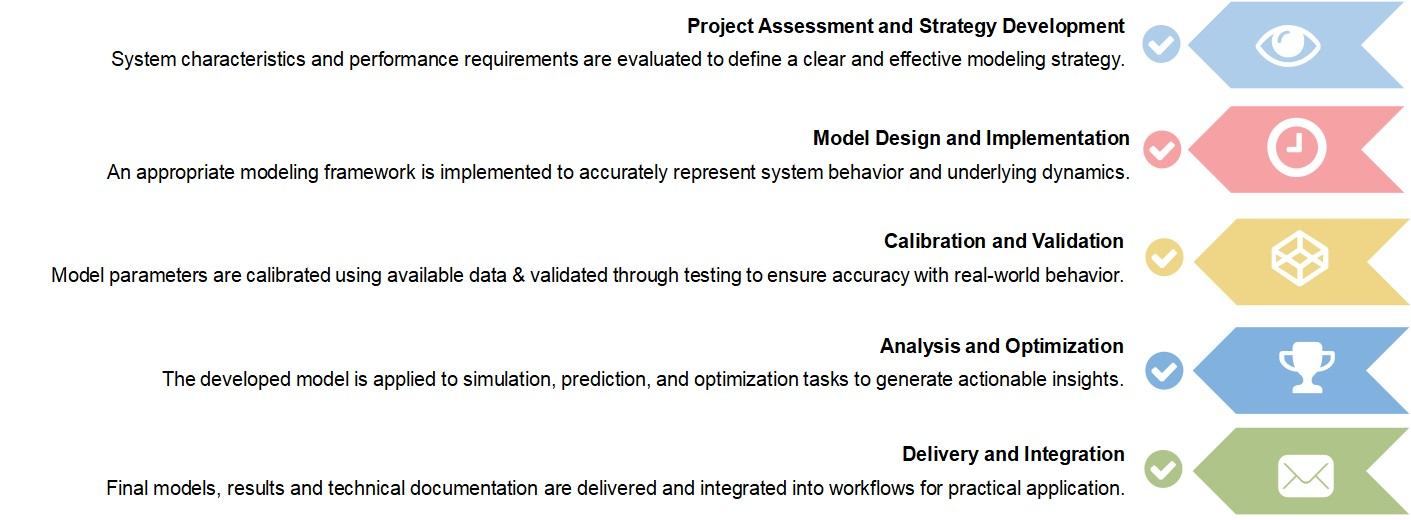
A structured workflow ensures consistency, traceability, and high-quality outcomes across all stages of model development and deployment.
Start Your Mathematical Modeling Project Today!
SysMathx provides mathematical modeling solutions that turn complex systems into structured, reliable tools for analysis, prediction, and decision support. System knowledge, data, and advanced modeling techniques are brought together to develop solutions that fit specific objectives and constraints. A brief description of the system, the data available, and the project goals can be submitted. Contact us for a customized modeling strategy and a detailed technical proposal.
FAQs
What types of problems can mathematical modeling address?
Mathematical modeling is suitable for problems involving prediction, system behavior analysis, optimization, and uncertainty. It is commonly applied in engineering, finance, environmental systems, and industrial processes. The approach is especially valuable when systems are complex or data is incomplete.
How is the appropriate modeling approach selected?
Model selection is based on system characteristics, available data, and project objectives. Factors such as interpretability, computational requirements, and accuracy targets are also considered.
Can both data and physical knowledge be used together?
Yes, hybrid approaches allow integration of physical principles with data-driven methods. This combination improves predictive performance while maintaining consistency with known system behavior. It is particularly useful when systems are partially understood.
How is uncertainty handled in the models?
Uncertainty is explicitly incorporated into modeling through probabilistic methods or sensitivity analysis. This allows models to provide not only predictions but also confidence ranges and risk insights.
Are the models suitable for real-time or fast applications?
Reduced-order and surrogate modeling techniques enable fast computation for time-sensitive applications. These models approximate complex systems while maintaining essential behavior.
Reference
- García-Rodríguez L C, et al. Mathematical modeling to estimate photosynthesis: A state of the art. Applied Sciences. 2022, 12(11): 5537.