
Stability Analysis in Mathematical Systems
Stability analysis investigates how systems respond to perturbations, external disturbances, and varying operational conditions. Understanding stability is crucial for ensuring consistent performance, preventing failures, and designing resilient engineering systems. SysMathx provides stability analysis services that evaluate dynamic responses, detect potential instabilities, and quantify robustness across multiple domains. Our methods provide actionable insights for control, design optimization, and risk mitigation.
Why Perform Stability Analysis of Mathematical Systems
Even small disturbances, parameter variations, or modeling uncertainties can significantly affect the performance, reliability, and safety of complex systems, making stability analysis a critical tool for understanding system behavior over time and under changing conditions. By evaluating stability, engineers and researchers can anticipate potential instabilities, prevent system failures, and optimize operational strategies.
- Predicting how a system responds to different inputs to keep performance reliable.
- Finding the limits where stability may fail, so risks can be managed early.
- Checking if the system can still function when disturbances occur.
- Guiding design improvements in stability margins, control, and efficiency.
- Revealing system dynamics, component interactions, and hidden weaknesses.
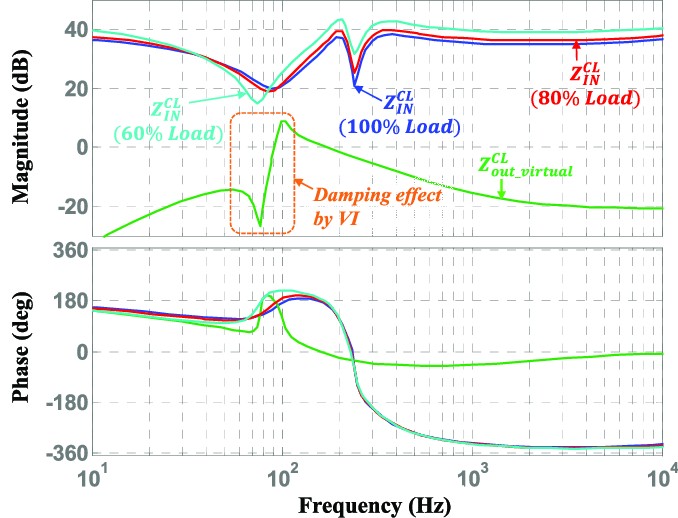 Fig.1 System stability analysis with VI control algorithm. (Lee J S, et al., 2020)
SysMathx provides end-to-end stability analysis services that transform complex system representations into actionable insights. We focus on understanding system responses, identifying potential instabilities, and quantifying resilience under realistic operating conditions. Our services cover dynamic response evaluation, multi-domain stability assessment, eigenvalue and modal analysis, and scenario-based stress testing. By combining analytical, computational, and numerical techniques, we deliver precise and reliable recommendations for system design and operational optimization.
Equilibrium and Local Stability Evaluation
We assess local stability by examining system behavior near equilibrium points, using linearization and small-signal analysis. Our analysts calculate eigenvalues and stability indices to determine how minor disturbances influence system dynamics, supporting early identification of potential instabilities in engineering and physical systems.
- Linearization of nonlinear system equations to approximate local dynamics.
- Computation of eigenvalues and modes for stability classification.
- Sensitivity analysis to identify parameters most affecting equilibrium behavior.
- Recommendations for operational adjustments and local control strategies.
Comprehensive Global Stability Assessment
Our team uses Lyapunov-based methods to evaluate global stability and define safe operating regions. By building suitable Lyapunov functions, we gain insight into how the system behaves under large perturbations and help ensure that control strategies maintain reliability across all states and operating conditions.
- Development of Lyapunov functions for rigorous global stability evaluation.
- Identification of invariant sets and operational stability boundaries.
- Verification of control strategies across a wide range of operating conditions.
- Guidance for improving robustness and expanding safe operational envelopes.
Structural Robustness and Model Resilience
We examine how structural changes, parameter variations, or modeling uncertainties affect whether a system stays stable. Using topological and structural analysis, our team finds the perturbation thresholds where stability can still be preserved, helping engineers design systems that keep performing under uncertainty and design variations.
- Mapping of system trajectories to identify structurally equivalent configurations.
- Determination of allowable perturbations without compromising stability.
- Analysis of key structural dependencies impacting system robustness.
- Actionable recommendations for improving model and system resilience.
Scenario-Driven Stability and Risk Evaluation
Our analysts perform simulations under realistic operational and environmental scenarios to evaluate system stability under uncertainty. This method reveals vulnerabilities, identifies critical parameters, and provides proactive strategies to mitigate potential failures across varying real-world conditions and stress environments.
- Simulation of variable and extreme operating conditions for comprehensive assessment.
- Identification of components or parameters most likely to drive instability.
- Quantitative evaluation of robustness under uncertain or fluctuating inputs.
- Recommendations for risk-informed design, operational planning, and control adjustments.
Our Methods for Stability Analysis in Mathematical Systems
At SysMathx, we rely on a range of advanced mathematical and computational techniques to deliver our services in stability analysis for engineering and physical systems. Our methods enable us to evaluate dynamic behavior, robustness, and reliability under diverse operating conditions. We also use these approaches to identify potential instability mechanisms and support informed engineering decision-making for design and control optimization.
Applications of Stability Analysis in Mathematical Systems
Our stability analysis services are applied across diverse engineering and physical systems to prevent failures, enhance resilience, and support data-driven decision-making. We help engineers understand dynamic behavior, optimize designs, and improve operational reliability under perturbations.
Mechanical Systems
We analyze structural dynamics, vibrations, and load-induced instabilities. Our team provides insights to prevent resonance, reduce fatigue, and improve mechanical resilience under varying operational and environmental conditions over time.
Electrical and Thermal Systems
We assess voltage, current, and thermal fluctuations to ensure stable operation. By identifying critical parameters, our analyses improve system reliability and prevent operational failures, including overheating and electrical instability in complex environments.
Control and Process Engineering
We evaluate control strategies, feedback loops, and process stability. Our work helps design controllers that maintain performance under disturbances and optimize operational efficiency across varying system conditions and external perturbations.
Multiphysics and Coupled Systems
We study interactions between mechanical, electrical, thermal, and other domains. Our analyses uncover critical dependencies and provide guidance for system-level stability improvements in highly coupled and nonlinear operational environments.
How We Work?
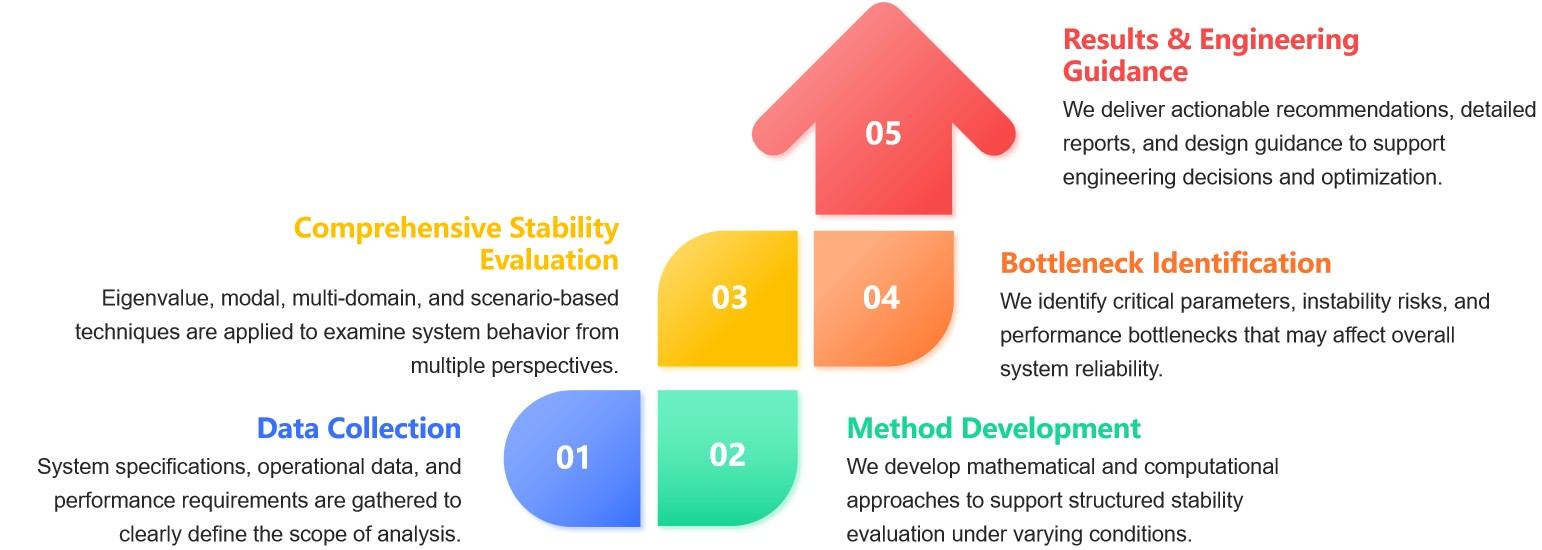
At SysMathx, we tailor stability analysis to your system, data, and performance objectives. Our team integrates mathematical modeling, computational simulations, and scenario analysis to predict instabilities and quantify robustness. We provide actionable insights for design optimization, operational planning, and risk-informed engineering decisions.
Start Your Stability Analysis Project Today!
SysMathx offers stability analysis to help with system resilience, preventing instabilities, and improving engineering performance. Share your system specifications, operational data, or performance goals with us, and we can build a framework that fits your needs and gives you reliable results, so please contact us to start working on your system's robustness and operational confidence.
FAQs
Which industries commonly use stability analysis services?
Stability analysis is widely used in aerospace, automotive, energy, robotics, and process engineering industries. It is especially valuable in systems where safety, reliability, and performance are critical under complex operating conditions. These applications often involve complex dynamics, varying operational conditions, and strict regulatory requirements.
What types of problems can stability analysis help address?
It helps identify instability risks, resonance issues, and performance degradation under changing conditions and external disturbances. The analysis is also useful for understanding system response to perturbations and parameter variations in realistic scenarios. This supports early detection of potential failure mechanisms and proactive mitigation planning.
Can stability analysis be applied to real-time operational systems?
Yes, stability analysis can be applied to both design-stage and real-time operational systems effectively. It supports monitoring dynamic behavior and assessing system robustness continuously during operation. This helps improve safety, maintain consistent performance, and optimize operational efficiency over time.
What kind of data is needed for stability analysis?
Basic system parameters, operational conditions, and performance requirements are typically sufficient to begin the analysis process. Additional data improves prediction accuracy and allows more detailed evaluation of dynamic behavior. The process can also be refined progressively as new measurement and experimental information becomes available.
How does stability analysis support engineering decisions?
It provides quantitative insights into system behavior under uncertainty, disturbances, and operational variability. Engineers can use these insights to improve design robustness, optimize control strategies, and enhance overall system performance. This ultimately supports safer, more reliable, and more efficient system operation.
Reference
- Lee J S, et al. Impedance-based modeling and common bus stability enhancement control algorithm in DC microgrid. IEEE Access. 2020, 8: 211224-211234.