
Operations Research and Optimization Capabilities
Operations research and optimization uses scalable computational methods to solve complex decision-making, resource allocation, and constrained optimization problems. These methods support engineering design, operational planning, and data-driven decisions across scientific and industrial settings. SysMathx turns complex systems into structured decision models that improve efficiency, reduce costs, and support large-scale optimization.
What Operations Research and Optimization Focuses On
Modern engineering and industrial systems require structured optimization methods to handle competing objectives, limited resources, nonlinear constraints, and high-dimensional decision spaces that cannot be efficiently solved using traditional approaches.
- Large-Scale Decision Modeling
Optimization enables efficient decision-making in large-scale and high-dimensional systems by transforming complex problems into structured computational models that can be solved with scalable algorithms. - Constrained Performance Design
System performance can be improved under physical, operational, and economic constraints by identifying optimal configurations that balance multiple limiting factors in real-world environments. - Multi-Objective System Optimization
Multi-objective and nonlinear optimization problems are supported through simultaneous evaluation of competing goals and trade-offs within complex engineering and industrial systems. - Scalable Optimization Computation
Scalable optimization methods efficiently explore large design spaces and improve convergence speed in computationally intensive scenarios. - Integrated Decision Workflows
Optimization is integrated with simulation, AI, and data-driven modeling workflows to enable unified decision-making frameworks for advanced engineering and scientific applications.
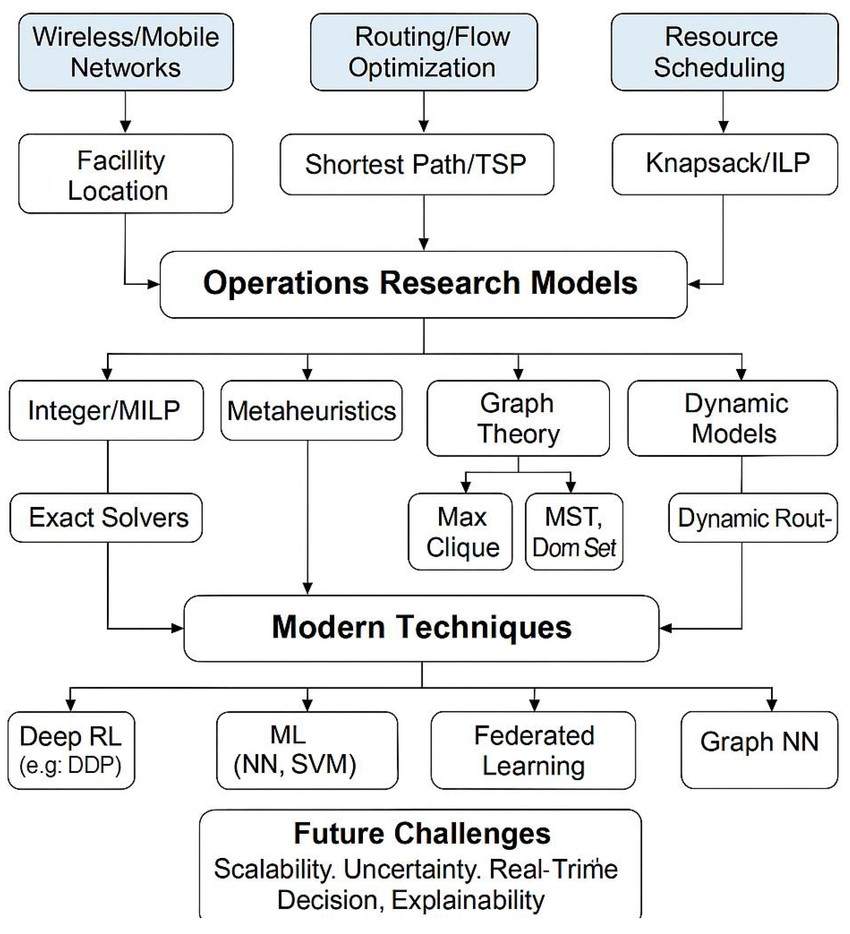 Fig.1 Conceptual framework linking classic operations research models to modern network optimization problems and solution methods. (Adasme P, et al., 2025)
SysMathx provides advanced computational capabilities across mathematical optimization modeling, system-level optimization, simulation-based optimization, and AI-enhanced decision optimization. Our frameworks are designed for large-scale engineering systems and computationally intensive optimization problems. These capabilities enable efficient exploration of complex decision spaces and support robust, data-driven engineering optimization workflows.
Mathematical Optimization Modeling Capabilities
SysMathx supports the formulation and computational solution of optimization problems involving constraints, objectives, and high-dimensional decision variables. Our scalable optimization frameworks enable efficient solution of large engineering and scientific optimization tasks. These capabilities improve decision accuracy and computational efficiency across complex system optimization scenarios.
Deterministic Optimization Computational Support
We provide scalable computation for deterministic optimization problems involving well-defined objectives and constraints in engineering systems. These methods enable efficient exploration of feasible solution spaces under structured mathematical formulations. They also support reliable performance evaluation and optimal decision identification in complex engineering applications.
| Items | Descriptions |
|---|---|
| Linear Optimization | Parallel solving of large-scale linear programming problems for efficient resource allocation and system optimization. |
| Nonlinear Optimization | Efficient computation for nonlinear constrained optimization problems in engineering and scientific systems. |
| Integer Optimization | Scalable solution of combinatorial and discrete decision problems for scheduling and design optimization tasks. |
Stochastic Optimization Computational Support
Our optimization capabilities support uncertainty-aware decision-making and probabilistic system optimization under uncertain conditions. These methods incorporate variability, incomplete information, and stochastic system behavior into the optimization process. This enables more robust and reliable solutions for complex engineering and decision-making problems.
| Items | Descriptions |
|---|---|
| Stochastic Programming | We support parallel optimization under uncertainty scenarios where system parameters follow probabilistic distributions to enable efficient decision-making across multiple possible outcomes. |
| Robust Optimization | We provide scalable computation for worst-case system design problems that ensure solution feasibility and stable performance under parameter uncertainty and adverse conditions. |
| Risk-Based Optimization | We enable efficient evaluation of probabilistic risk constraints within optimization problems to support controlled and reliable decision-making under uncertainty. |
Multi-Objective Optimization Support
SysMathx supports optimization problems involving competing objectives and trade-off analysis across engineering systems. These methods enable systematic evaluation of conflicting performance criteria under constrained conditions. Decision-making is guided by balancing efficiency, cost, and system performance in complex applications.
| Items | Descriptions |
|---|---|
| Pareto Optimization | We support parallel exploration of Pareto-optimal solution sets to identify balanced trade-offs among competing objectives in multi-objective optimization problems. |
| Evolutionary Optimization | We provide scalable population-based optimization methods that simulate evolutionary processes to search large and complex solution spaces. |
System-Level Optimization Capabilities
SysMathx supports large-scale system optimization for engineering design, operational planning, and resource allocation problems involving complex system interactions. This enables more efficient decision-making, improved system performance, and better utilization of constrained resources across engineering applications.
Engineering Design Optimization
Our computational frameworks enable efficient optimization of engineering structures, physical systems, and design parameters. This helps improve performance, reduce cost, and achieve more robust and reliable system designs under real-world constraints.
- Structural design optimization for performance improvement
- Multi-parameter system tuning and calibration
- Performance-constrained engineering optimization
Resource Allocation Optimization
SysMathx supports optimization of resource distribution in large-scale systems with constraints and competing demands. This improves overall system efficiency by balancing limited resources across multiple objectives and operational requirements.
- Efficient allocation of limited system resources
- Load balancing and capacity optimization
- Energy and material distribution optimization
Network Optimization
We provide scalable optimization capabilities for networked systems including transportation, communication, and industrial networks. This improves system-wide efficiency by optimizing flow, connectivity, and coordination across interconnected components.
- Flow optimization in networked systems
- Bottleneck identification and mitigation
- System-wide efficiency improvement
Simulation-Based Optimization Capabilities
SysMathx integrates optimization with simulation workflows to support real-world engineering decision-making where analytical solutions are not feasible. This enables iterative evaluation of system performance under realistic operating conditions. It also improves decision accuracy by combining predictive simulation with optimization-driven refinement.
Simulation-Driven Optimization
We support optimization where system behavior is evaluated through mathematical simulation rather than explicit equations.
- Design space exploration using simulation feedback
- Iterative optimization using computational models
- High-fidelity simulation-based decision optimization
Surrogate-Assisted Optimization
SysMathx accelerates optimization workflows using surrogate models and reduced-order representations. This significantly reduces computational cost while maintaining reliable solution accuracy for large-scale problems.
- Fast evaluation using surrogate models
- Reduced computational cost for large design spaces
- Efficient approximation of expensive simulations
Operations Research and Optimization Methods
At SysMathx, we develop structured optimization methods for solving complex decision-making, planning, and resource allocation problems in large-scale engineering systems. These methods are designed to improve solution efficiency, scalability, and decision quality under constraints in real-world applications.
Applications of Operations Research and Optimization
SysMathx applies optimization capabilities across engineering, industrial systems, AI-driven decision-making, and large-scale operational environments.
Engineering Design Optimization
Our optimization methods are applied to improve structural performance, mechanical efficiency, and engineering system design under operational and physical constraints. These methods support parameter optimization, weight reduction, reliability improvement, and performance enhancement across engineering applications requiring scalable analysis.
Industrial and Manufacturing Systems
We support production scheduling, manufacturing process optimization, and operational efficiency improvement across industrial systems with interconnected workflows and resource limitations. Our optimization frameworks help improve throughput, reduce production delays, and enhance coordination between manufacturing operations and resources.
Energy and Infrastructure Systems
We support optimization of energy distribution, infrastructure planning, and system-level resource allocation across large engineering and operational environments. Our methods improve efficiency, reliability, and utilization of constrained resources within infrastructure and energy systems.
AI-Driven Decision Systems
Our researchers support optimization in intelligent systems where decisions are learned, adapted, and optimized continuously through data-driven computational processes. These methods improve adaptive control, predictive decision-making, and operational performance across AI-assisted engineering environments.
Advantages of Our Operations Research and Optimization Capabilities
- Enable structured decision-making for complex engineering systems under constraints and uncertainty.
- Improve solution quality by transforming real-world problems into solvable optimization models.
- Support scalable computation for large-scale, high-dimensional decision and design problems.
- Enhance computational efficiency through improved convergence and reduced search complexity.
- Enable robust decision-making under uncertainty, variability, and incomplete information.
- Support multi-objective trade-off analysis for balanced and practical optimal solutions.
Start Your Operations Research and Optimization Project!
SysMathx offers practical operations research and optimization capabilities for engineering design, system analysis, resource allocation, and data-driven decision-making. Our computational frameworks help solve large-scale optimization problems, improve system performance, and support engineering decisions across complex environments. Contact us to discuss your optimization challenges, system design requirements, and decision-making objectives.
FAQs
What types of problems can be solved using optimization?
Optimization methods are used for complex decision-making problems involving constraints, limited resources, competing objectives, and large-scale system design challenges across engineering and operational environments. These problems typically require balancing performance, cost, efficiency, and feasibility under real-world limitations, often across interconnected system components. They are also applicable to both steady-state and dynamic system decision scenarios.
Can nonlinear and large-scale optimization problems be handled?
Yes, nonlinear, high-dimensional, and large-scale optimization problems can be effectively addressed using advanced computational frameworks designed for complex engineering systems. These methods support scalable computation, improved convergence, and efficient handling of highly coupled variables and constraints in practical applications. They also remain effective when system behavior is strongly nonlinear or non-convex.
Is simulation-based optimization supported?
Simulation-based optimization is supported by integrating mathematical simulation with optimization algorithms for systems where analytical solutions are not available or are too complex. This approach enables performance evaluation and decision optimization directly through repeated simulation experiments under different scenarios and conditions. It is particularly useful for systems with expensive or black-box evaluations.
Can optimization be combined with AI methods?
Optimization can be combined with AI methods, including machine learning-assisted decision-making, surrogate modeling, and hybrid data-driven approaches. These integrations improve efficiency in exploring large design spaces and enhance decision quality in complex systems with evolving data patterns. They also enable adaptive and learning-based optimization strategies over time.
What industries benefit from optimization capabilities?
Optimization capabilities are widely applied in engineering design, manufacturing systems, logistics, energy systems, infrastructure planning, and AI-driven decision environments. These industries rely on optimization to improve efficiency, reduce cost, and enhance system-level performance across operational scales. They are also critical in emerging intelligent and autonomous system applications.
Can existing engineering systems be optimized?
Existing engineering systems can be analyzed to identify inefficiencies, resource bottlenecks, and performance limitations, and then improved using optimization methods. This supports better resource utilization, improved system behavior, and enhanced operational performance in real-world applications. It can also help extend system lifetime and improve adaptability under changing conditions.
Reference
- Adasme P, et al. Bridging classic operations research and artificial intelligence for network optimization in the 6g era: A review. Symmetry. 2025, 17(8): 1279.