
Complex System Modeling Services
SysMathx provides complex system modeling services that capture emergent behavior, structural interdependencies, and stochastic dynamics in engineering, socio-technical, and natural systems. Based on strong foundations in nonlinear dynamics, network theory, and probabilistic methods, we support the full workflow from system decomposition and agent-based simulation to architecture optimization and uncertainty quantification.
Key Challenges Addressed by Complex System Modeling
Real-world systems are complex, with interacting components, feedback loops, adaptation, and uncertainty that traditional reductionist methods often fail to capture, leading to weak predictions and fragile designs. Complex system modeling addresses these challenges by explicitly representing interactions, structure, and uncertainty. Key advantages include:
- Emergent behavior captured: Explains how system-level patterns arise from local interactions, including tipping points and cascades.
- Adaptive components: Models subsystems that evolve based on feedback and experience.
- Architectural clarity: Reveals dependencies, hierarchies, and bottlenecks for better design decisions.
- Uncertainty quantification: Produces probabilistic outcomes for robust risk-aware analysis.
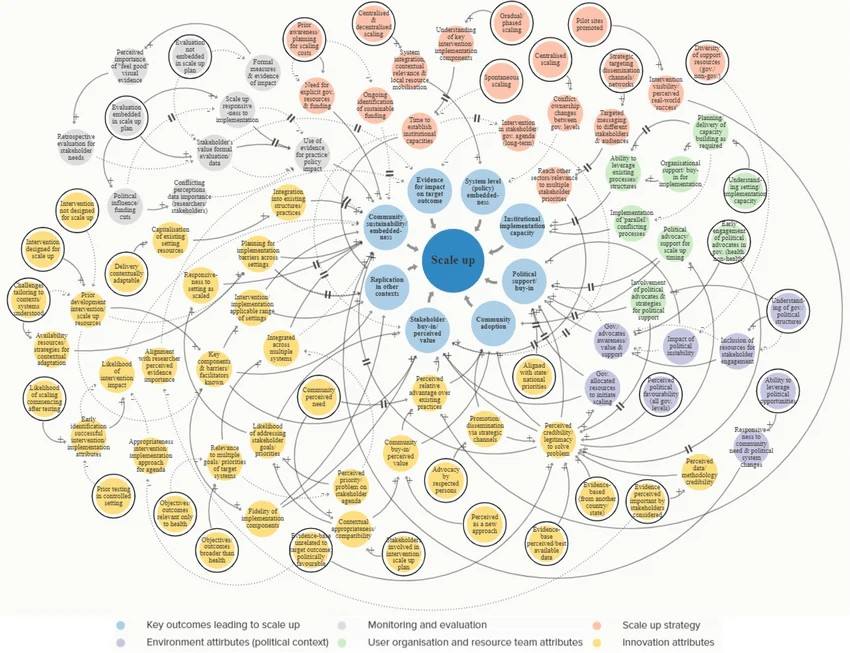 Fig.1 Complex systems model of scaling up. (Koorts H, et al., 2021)
SysMathx provides comprehensive complex system modeling solutions tailored to your specific system characteristics and analytical needs—from system decomposition and behavioral rule specification to simulation, validation, and deployment. We translate your interconnected components and uncertain dynamics into rigorous models that reveal hidden structure and support scenario analysis. Our focus is on capturing what matters, validating against real behavior, and delivering actionable insights.

Complex Adaptive Systems (CAS) Modeling Services
Complex adaptive systems consist of many heterogeneous agents that interact locally, learn, and adapt, producing emergent global patterns. We build agent-based models and evolutionary simulations that capture these dynamics.
- Specification of agent behavioral rules, interaction topologies, and learning mechanisms
- Calibration of agent parameters using empirical or synthetic data
- Simulation of emergent outcomes such as cooperation, clustering, or phase transitions
- Sensitivity analysis to identify which rules or parameters drive system behavior

System Architecture Modeling Services
System architecture describes the structure, dependencies, and information flows among components. We create network-based and hierarchical models that reveal architectural properties and guide design decisions.
- Mapping of component dependencies, interfaces, and interaction graphs
- Analysis of architectural metrics including modularity, centrality, robustness, and redundancy
- Identification of critical paths, single points of failure, and cascade propagation risks
- Architecture optimization for reliability, maintainability, or adaptability

Stochastic Process Modeling Services
Uncertainty and randomness are inherent in many complex systems, from environmental fluctuations to random failures. We incorporate stochastic processes to produce probabilistic predictions and risk estimates.
- Gaussian process regression for flexible, uncertainty-aware surrogate modeling
- Markov chains and state-space models for systems with probabilistic transitions
- Stochastic differential equations for dynamics driven by both deterministic forces and random noise
- Monte Carlo simulation for scenario analysis and uncertainty propagation
SysMathx turns complex systems into actionable models for design, control, and risk analysis, from decomposition to validated simulation and deployment using nonlinear dynamics, network science, and stochastic processes.
| Items | Contents |
|---|---|
| Emergence & Adaptation Handling |
|
| Architecture & Dependency Mapping |
|
| Uncertainty & Stochastic Dynamics |
|
| Hybrid & Multi-Method Integration |
|
Complex System Modeling Methods
SysMathx provides complex system modeling services to analyze and simulate nonlinear, uncertain, and emergent systems using methods from nonlinear dynamics, network science, and agent-based modeling, tailored to your data and objectives.
Applications of Our Complex System Modeling Services
Complex system modeling is applied in domains where interactions, adaptation, structure, and uncertainty drive behavior, transforming interconnected dynamic systems into structured, testable models that support prediction, design, and risk management in complex environments.
Smart Infrastructure Systems
We harness complex system modeling to map interdependencies in power grids and water networks under changing conditions. By simulating cascading effects and vulnerabilities, we quantify stability to guide resilience planning and risk mitigation.
Ecosystem and Environmental Management
We use complex system modeling to simulate interactions among species, resources, and environmental stressors. This provides insights for sustainable resource management, impact assessment, and long-term ecological planning.
Traffic and Transportation Systems
We apply complex system modeling to traffic and transportation networks to capture driver behavior and network interactions under uncertainty. This allows us to analyze congestion patterns and optimize traffic management and system efficiency.
Financial Market Modeling
We use complex system modeling to represent financial markets as interacting agents with adaptive behaviors and network structures. This enables us to analyze market dynamics, assess stability and risk propagation, and evaluate different scenarios.
How We Work?
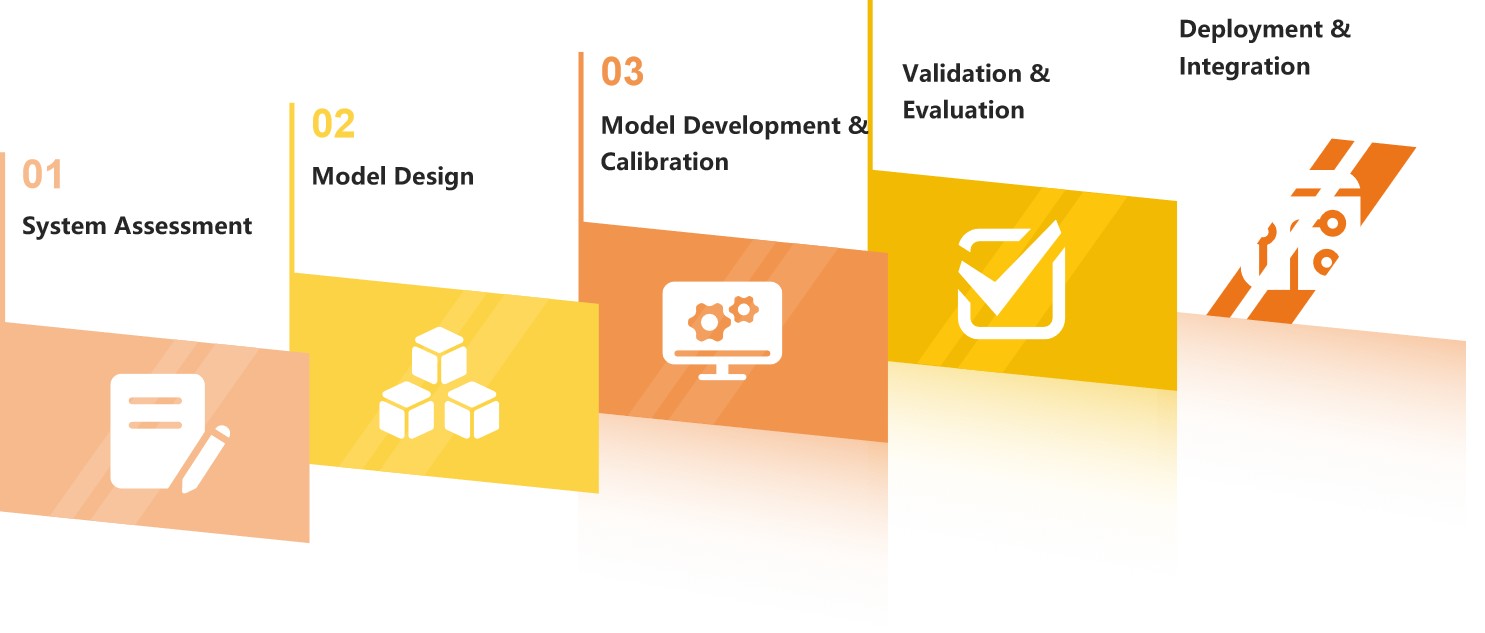
At SysMathx, each project begins with an assessment of data, system characteristics, and performance requirements to define a suitable modeling strategy. Models are then developed, calibrated, and validated to ensure accuracy and reliability. The final models are integrated into your workflow with clear documentation of performance and uncertainty.
Start Your Complex System Modeling Project Today!
SysMathx provides complex systems modeling services to analyze interacting components, adaptive behaviors, and uncertainty, enabling pattern discovery, prediction of emergent outcomes, and robust decision-making. Provide a brief system description and contact us to receive a tailored modeling strategy and detailed technical proposal.
FAQs
What types of data are suitable for these modeling services?
Both time-dependent and cross-sectional data can be used, including noisy, incomplete, or irregularly sampled datasets. The key requirement is that the data contains measurable structure or patterns.
Do these methods require large datasets?
Not necessarily, as many models are designed to work with limited or moderate data. When data is large-scale, efficient approximation techniques are applied.
Can uncertainty be quantified in the results?
Yes, uncertainty is explicitly modeled and reported in all key outputs. This includes prediction intervals, confidence measures, and variability estimates.
How are models validated?
Validation is performed using hold-out testing, cross-validation, and residual analysis. Performance is evaluated under different scenarios to ensure robustness.
Can the models be integrated into existing workflows?
Yes, models are designed for practical deployment in analysis, simulation, and decision-support systems. Integration support is provided for both batch processing and real-time applications. Documentation is included to facilitate implementation.
Reference
- Koorts H, et al. Mechanisms of scaling up: combining a realist perspective and systems analysis to understand successfully scaled interventions. International Journal of Behavioral Nutrition and Physical Activity. 2021, 18(1): 42.