
Time-Forward Simulation Services
Time-forward simulation focuses on predicting how systems evolve over time under defined inputs, parameters, and initial conditions. It is essential for analyzing dynamic behavior, evaluating performance, and understanding system responses in engineering and scientific applications. By advancing system states through numerical computation, time-forward simulation enables accurate tracking of transient and long-term behavior. SysMathx provides time-forward simulation services to model system dynamics, simulate input-driven responses, and support performance evaluation and optimization.
Why Time-Forward Simulation Matters
Time-forward simulation provides a reliable framework for analyzing how systems evolve over time and respond to varying conditions.
- Dynamic behavior prediction
System evolution over time can be accurately captured under defined operating conditions. This allows detailed understanding of both transient and long-term behavior. - Input-response evaluation
System reactions to external signals and control inputs are systematically analyzed. Performance and stability under different operating conditions can thus be assessed. - Scenario-based exploration
Behavioral differences across varying parameters and conditions are systematically examined. This supports comparative analysis across multiple operating scenarios. - High-fidelity modeling
Accurate representation of transient and long-term system dynamics is achieved through detailed modeling. The simulation reflects realistic system evolution over time.
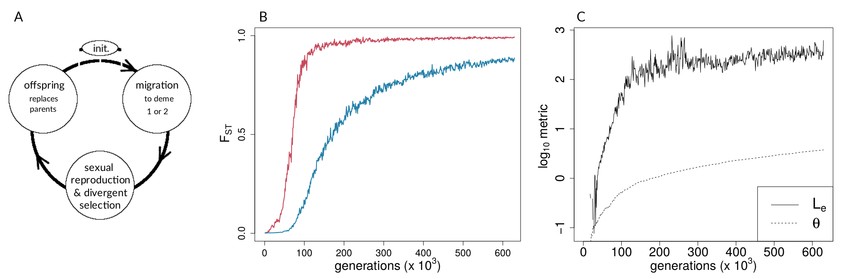 Fig.1 Forward-time simulations: life-cycle diagram, FST over time and coupling measures. (Schilling M P, et al., 2018)
SysMathx delivers end-to-end time-forward simulation services that transform mathematical system models into structured dynamic representations over time. We focus on providing interpretable and reliable simulation results that reflect real system evolution under different inputs, parameters, and operating conditions. Our services support system behavior prediction, performance evaluation, and scenario-based analysis for engineering and scientific applications.
Time-Domain Dynamic Trajectory Prediction
We evaluate how system states evolve over time using numerical time-stepping and integration-based simulation methods. This service enables detailed characterization of transient dynamics, steady-state behavior, and stability trends under defined initial conditions. It provides a structured way to observe how internal variables change continuously throughout system operation. SysMathx delivers comprehensive trajectory-based simulation services to support dynamic behavior analysis and system validation.
- Numerical integration of differential and state-space system models for time evolution
- Generation of full-state trajectories for key system variables across simulation horizons
- Analysis of transient response behavior and steady-state convergence characteristics
- Evaluation of stability trends based on time-dependent system evolution
- Visualization and interpretation of dynamic behavior across multiple time scales
- Assessment of system performance under defined initial conditions and configurations
Input-Driven System Response Simulation
SysMathx can analyze how systems respond to external inputs, control signals, and environmental disturbances through model-based simulation. This service focuses on capturing the relationship between input variations and output behavior, including internal state transitions. It provides insights into system responsiveness, stability, and performance under realistic operating conditions. We deliver input-driven simulation services to support control analysis and system performance evaluation.
- Simulation of system behavior under time-varying and structured input signals
- Evaluation of output responses and internal state evolution under external excitation
- Analysis of system sensitivity to input amplitude, frequency, and pattern variations
- Assessment of stability and robustness under disturbances and control actions
- Quantification of dynamic characteristics such as delay, damping, and amplification
- Support for input-output behavior interpretation in engineering applications
Multi-Scenario & Parametric Evolution Simulation
SysMathx can perform simulation across multiple operating scenarios by systematically varying system parameters, initial states, and input conditions. This service enables comprehensive exploration of system behavior under uncertainty and changing environments. It supports the identification of performance boundaries, sensitivity patterns, and critical transition behaviors.
- Generation of multiple simulation scenarios through parameter and condition variation
- Comparative analysis of system behavior across different operating configurations
- Quantification of sensitivity to parameter changes and initial condition variations
- Identification of critical thresholds, transition points, and stability boundaries
- Evaluation of performance variability under uncertain or changing environments
- Mapping of system response landscapes for optimization and design improvement
Our Methods for Time-Forward Simulation Services
At SysMathx, we apply structured computational strategies to model how systems evolve over time under dynamic conditions. These methods focus on reproducing temporal behavior through numerical and algorithmic simulation rather than static system analysis. By integrating time-stepping computation, input propagation, and scenario generation, we ensure reliable reconstruction of system evolution. Our approaches are designed to support predictive analysis, performance evaluation, and system understanding across complex environments.
Applications of Time-Forward Simulation Services
Time-forward simulation services are used to predict how systems evolve over time under changing inputs, parameters, and operating conditions. SysMathx applies these services to analyze dynamic behavior, evaluate performance, and support engineering decision-making across multiple industries.
Mechanical and Structural Systems
Our time-forward simulation services are applied to evaluate structural response under time-varying loads, vibrations, and environmental effects. System evolution of stress, strain, and deformation is captured across operational time scales.
Industrial and Process Systems
We simulate industrial processes and operational workflows under dynamic conditions. System efficiency, bottlenecks, and delays are analyzed across different scenarios. This supports process optimization and improved operational planning.
Electrical and Power Systems
We simulate dynamic electrical behaviors such as voltage, current, and power flow variations over time. Transient response and system stability under different operating conditions are analyzed in detail. This supports reliable design and evaluation of power systems and electrical networks.
Thermal and Energy Systems
Our services are used to model heat transfer and temperature evolution in energy systems. Energy dissipation, thermal distribution, and efficiency changes are analyzed over time. This enables improved thermal management and energy system optimization.
Control and Automation Systems
We evaluate control system behavior under feedback loops, disturbances, and time-varying inputs. System response, tracking accuracy, and stability characteristics are analyzed across dynamic conditions. This supports the design and tuning of robust control strategies.
Multi-Domain Engineering Systems
Our simulation services capture coupled interactions between mechanical, electrical, and thermal domains. Cross-domain energy exchange and dynamic dependencies are analyzed over time. This enables integrated system-level performance evaluation and design optimization.
Why Choose SysMathx for Time-Forward Simulation Services?
- Time-forward simulation is built on rigorous computational modeling to ensure accurate representation of system evolution under dynamic conditions.
- Time-dependent behavior is captured in a way that reflects real operational responses and scenario variability across different environments.
- A structured simulation framework is provided for analyzing system trajectories, input responses, and multi-condition behaviors.
- Complex system evolution over time can be predicted reliably for engineering analysis and scientific applications.
- Simulation outputs are designed to remain consistent, interpretable, and suitable for decision-making and system evaluation.
Start Your Time-Forward Simulation Project!
SysMathx provides end-to-end time-forward simulation services to help you understand how systems evolve over time under varying inputs, parameters, and operating conditions. We focus on delivering accurate dynamic predictions, response analysis, and scenario-based evaluation for complex systems. By combining numerical computation, state-based modeling, and multi-scenario simulation, we generate actionable insights for engineering and system design. Contact us to define your system requirements and start building reliable time-dependent simulation models.
FAQs
What is the purpose of time-forward simulation?
Time-forward simulation is used to predict how dynamic systems evolve over time under specified conditions and inputs. It helps evaluate transient responses, long-term behavior, and stability characteristics in dynamic environments. The approach supports system understanding, engineering analysis, and performance evaluation across different applications.
Can external disturbances be included in simulation models?
Yes, external disturbances and environmental effects can be incorporated into simulation models. This allows evaluation of system robustness and response behavior under varying operating conditions. It also supports analysis of reliability, stability, and dynamic performance in realistic environments.
Are multiple operating scenarios supported?
Multiple operating scenarios can be simulated by varying parameters, inputs, and initial conditions systematically. This enables comparison of system behavior across different configurations and environments. It supports sensitivity evaluation, uncertainty analysis, and performance exploration under changing conditions.
What types of outputs can simulation provide?
Simulation can generate state trajectories, output responses, and time-dependent evolution patterns. It also provides insight into stability trends, transient behavior, and long-term system performance. These outputs support visualization, engineering interpretation, and dynamic behavior evaluation.
How are simulation results applied in engineering?
Simulation results are widely used to support engineering evaluation and operational decision-making. They help identify performance limitations, critical dynamic behavior, and stability characteristics. The results also support system optimization, design improvement, and control strategy development.
Reference
- Schilling M P, et al. Transitions from single-to multi-locus processes during speciation with gene flow. Genes. 2018, 9(6): 274.