
High-Performance Scientific Computing Capabilities
High-performance scientific computing refers to scalable computational methods used to solve large and computationally intensive scientific and engineering problems. At SysMathx, our high-performance scientific computing capabilities support large-scale simulation, mathematical modeling, optimization, and AI-assisted engineering analysis across complex systems. These capabilities help accelerate computation, improve mathematical efficiency, and support advanced scientific and engineering workflows.
Benefits of High-Performance Scientific Computing
Modern engineering and scientific problems often involve large mathematical models, massive datasets, nonlinear interactions, and computationally intensive simulations that exceed the capability of conventional computing environments. High-performance scientific computing enables these complex workflows to be executed more efficiently through scalable computation, parallel processing, and optimized mathematical execution.
Key advantages of our high-performance scientific computing capabilities include:
- Scalable computation for high-dimensional engineering and scientific problems
- Faster execution of simulation, optimization, and mathematical analysis workflows
- Efficient processing of large scientific datasets and computational models
- Support for AI-assisted engineering and scientific computing environments
- Improved efficiency for multi-physics and coupled-system computation
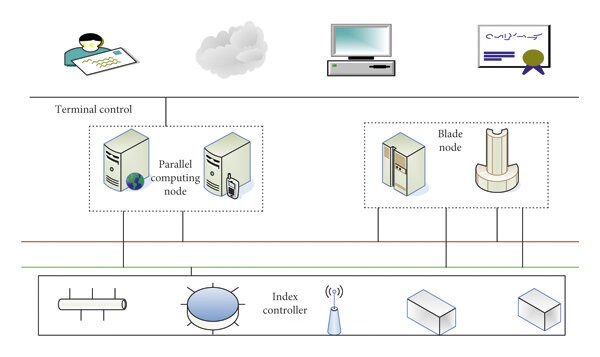 Fig.1 High-performance scientific computing cluster architecture. (Zhu W., 2022)
SysMathx provides high-performance scientific computing capabilities across mathematical modeling, mathematical analysis, and mathematical simulation & dynamical evolution analysis. Our computational environments are designed to support large-scale engineering computation, scientific simulation workflows, and computationally intensive mathematical analysis applications.
High-Performance Computing for Mathematical Modeling
Our high-performance scientific computing capabilities support large-scale mathematical modeling workflows involving physical systems, data-driven models, hybrid computational frameworks, and complex engineering structures. SysMathx applies scalable mathematical processing and parallel scientific computing strategies to improve efficiency for model construction, parameter estimation, and large-scale system analysis.
Physics-Based Modeling Computational Support
We support computationally intensive physics-based models involving differential equations, multi-physics systems, and dynamic engineering behavior. Our scalable computational frameworks improve efficiency for high-resolution physical simulation, large-scale mathematical analysis, and engineering computation workflows.
| Items | High-Performance Computing Support |
|---|---|
| Differential Equation Modeling | Parallel solving of large ODE and PDE systems for engineering analysis |
| Multi-Physics Modeling | Scalable computation for coupled thermal, fluid, and mechanical systems |
| Dynamic System Modeling | Efficient simulation of high-dimensional dynamic systems |
Data-Driven Modeling Computational Support
Our computational capabilities accelerate statistical analysis, nonlinear system identification, and network-based modeling workflows involving large datasets and high-dimensional parameter spaces. These computational environments support scalable engineering computation and data-intensive scientific computing workflows.
| Items | High-Performance Computing Support |
|---|---|
| Statistical Modeling | Parallel computation for large-scale statistical analysis workflows |
| Nonlinear System Identification | Accelerated parameter estimation and nonlinear model fitting |
| Network System Modeling | Scalable analysis of large interconnected systems and networks |
Hybrid Modeling Computational Support
SysMathx combines scalable scientific computing with hybrid physical-data-driven modeling environments to improve computational efficiency and engineering prediction capabilities. These frameworks are particularly valuable for large-scale engineering analysis involving coupled mathematical and data-driven workflows.
| Items | High-Performance Computing Support |
|---|---|
| Physics-Informed Neural Networks | Parallel acceleration for PINN training and PDE learning |
| Mechanism-Data Fusion Modeling | Efficient integration of simulation and data-driven computation |
| Grey-Box System Identification | Scalable parameter estimation for partially known systems |
Surrogate & Reduced-Order Modeling Computational Support
Our computational frameworks support efficient surrogate model generation and reduced-order analysis for optimization-driven engineering workflows. These capabilities reduce computational overhead while maintaining reliable engineering prediction performance across large-scale simulation environments.
| Items | High-Performance Computing Support |
|---|---|
| Response Surface Modeling | Parallel parameter sampling and surrogate construction |
| Proper Orthogonal Decomposition | High-dimensional snapshot decomposition and reduction |
| Gaussian Process Modeling | Accelerated kernel computation and hyperparameter optimization |
Complex System Modeling Computational Support
We support computational workflows involving adaptive systems, stochastic processes, and large interacting systems requiring scalable mathematical analysis. These capabilities support large-scale engineering computation where nonlinear interactions and emergent behaviors influence overall system performance.
| Items | High-Performance Computing Support |
|---|---|
| Complex Adaptive Systems | Parallel simulation of large interacting agent systems |
| System Architecture Modeling | Scalable structural and network-based system analysis |
| Stochastic Process Modeling | Parallel Monte Carlo analysis and uncertainty propagation |
Functional & Structural Modeling Computational Support
Our high-performance scientific computing capabilities support energy-based modeling, event-driven systems, and state-space engineering workflows. These computational methods enable efficient analysis of large interconnected engineering systems across complex mathematical environments.
| Items | High-Performance Computing Support |
|---|---|
| Bond Graph Modeling | Parallel simulation of multi-energy-domain systems |
| Petri Net Modeling | Scalable state-space and event-driven system analysis |
| State-Space Representation | Efficient computation for large state-space systems |
High-Performance Computing for Mathematical Analysis
We provide high-performance scientific computing capabilities for deterministic analysis, uncertainty quantification, sensitivity analysis, stability evaluation, and controllability & observability analysis. Our scalable computational frameworks improve efficiency for large-scale engineering systems, high-dimensional mathematical models, and computationally intensive analysis workflows. These computational capabilities are particularly important for engineering applications requiring repeated mathematical evaluation, large parameter-space exploration, and computationally intensive system analysis.
| Items | High-Performance Computing Support |
|---|---|
| Deterministic System Analysis | Parallel computation for large-scale state-space analysis and mathematical evaluation |
| Uncertainty Quantification | Accelerated Monte Carlo simulation and uncertainty propagation workflows |
| Sensitivity Analysis | Scalable parameter sampling and global sensitivity computation |
| Controllability & Observability Analysis | Efficient matrix computation for complex dynamic systems |
Our Computational Approach
At SysMathx, we apply structured computational strategies to improve scalability, computational efficiency, and mathematical reliability across scientific and engineering workflows. Our focus is not only on accelerating computation, but also on ensuring that large-scale mathematical tasks remain stable, interpretable, and suitable for engineering applications.
Engineering Applications of High-Performance Scientific Computing
SysMathx applies high-performance scientific computing capabilities across engineering, scientific research, AI-driven analysis, and industrial simulation environments. Our computational frameworks support large-scale mathematical workflows, advanced simulation pipelines, and data-intensive engineering applications across multiple domains.
Engineering Simulation
Engineering-scale simulations involving structural mechanics, fluid dynamics, thermal systems, and multi-physics environments are supported through high-performance computing. Our company improves computational efficiency for large-scale mathematical modeling and accelerates engineering design iteration.
Scientific Computing & Mathematical Simulation
Mathematical simulation workflows such as differential equation solving, uncertainty propagation, and parameter exploration are accelerated through scalable computation. Our research team enables efficient execution of complex scientific and engineering computational tasks.
AI-Assisted Scientific Computing
AI-enhanced scientific computing combines physics-based modeling with machine learning for predictive simulation and intelligent analysis. Our company supports hybrid computation workflows for large-scale and data-driven scientific systems.
Large-Scale Data Processing & Scientific Analysis
Large-scale scientific datasets, statistical computations, and mathematical analysis tasks are processed using high-performance computing infrastructure. Our research team enhances scalability and execution speed for data-intensive research applications.
Workflow of High-Performance Scientific Computing
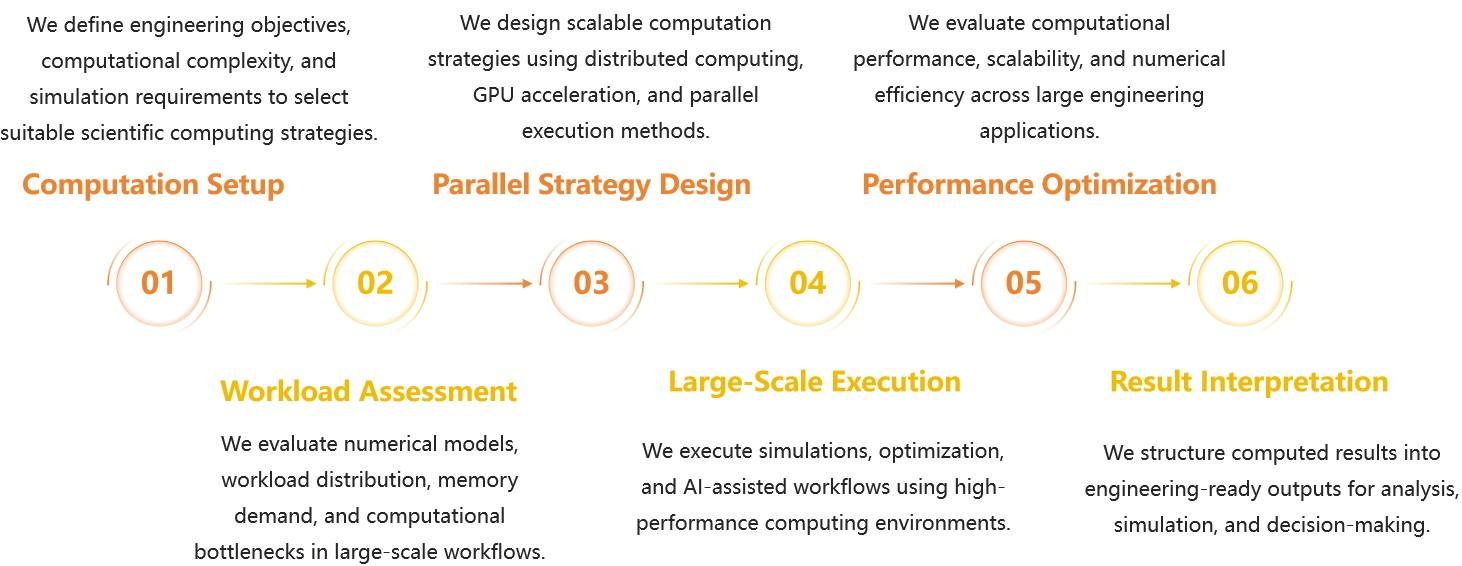
SysMathx applies a structured computational workflow to improve scalability, computational efficiency, and engineering usability across scientific computing environments. Our workflow supports large-scale engineering computation, mathematical simulation, and AI-assisted scientific analysis.
Start Your High-Performance Scientific Computing Project!
Whether your project involves large-scale simulation, AI-assisted scientific analysis, multi-physics computation, or computational optimization, SysMathx provides scalable scientific computing capabilities for demanding engineering and research environments.
Our computational frameworks support high-dimensional mathematical analysis, large-scale simulation workflows, and parallel scientific computing across complex engineering systems. Contact us to discuss your computational challenges, performance requirements, and large-scale engineering objectives.
FAQs
What types of problems require high-performance scientific computing?
High-performance scientific computing is commonly used for computationally intensive problems involving large-scale simulations, high-dimensional mathematical systems, repeated mathematical evaluations, or massive scientific datasets. These problems often require significant memory, processing power, and parallel execution that exceed traditional computing capabilities. It is especially important in engineering, physics, and data-driven scientific research.
Can you support AI and machine learning workflows?
Yes, AI-assisted scientific computing is fully supported, including machine learning acceleration, physics-informed AI modeling, and predictive engineering analysis. These workflows often require large-scale training, simulation coupling, and high-throughput computation. Scalable computing environments are used to ensure efficient execution of complex AI-driven scientific tasks.
Are cloud and distributed computing environments supported?
Yes, high-performance scientific computing can be deployed across cloud platforms, distributed computing clusters, GPU-accelerated systems, and hybrid infrastructures. This flexibility allows computational resources to scale according to project size and complexity. It also enables efficient handling of large simulations and parallel workloads.
Can these capabilities support multi-physics engineering simulation?
Yes, multi-physics simulation is fully supported, including coupled thermal, fluid, structural, electrical, and dynamic systems. These simulations often involve strong interdependencies and require significant computational resources. Scalable computing frameworks ensure stable and efficient execution of complex coupled models.
How does parallel computing improve engineering analysis?
Parallel computing distributes computational tasks across multiple processors, GPUs, or nodes to reduce overall execution time. This is especially beneficial for large simulations, optimization loops, and mathematical analysis requiring repeated evaluations. It significantly improves efficiency and enables faster engineering decision-making.
Can high-performance scientific computing support optimization workflows?
Yes, optimization workflows benefit significantly from high-performance computing through faster parameter exploration and repeated simulation evaluations. This allows large design spaces to be explored more efficiently and accurately. It is widely used in engineering design, system tuning, and performance optimization tasks.
Are your computational frameworks suitable for AI-assisted simulation?
Yes, our computational frameworks are designed to support AI-assisted simulation environments, including scientific machine learning and physics-informed modeling. These systems require tight integration between data-driven models and mathematical simulation engines. High-performance computing ensures these hybrid workflows remain efficient and scalable.
Reference
- Zhu W. Multitone Piano Transcription Analysis and Evaluation Relying on Hierarchical Analysis High-Performance Computing Algorithms. Scientific Programming. 2022, 2022(1): 9153885.