
Deterministic Analysis in Mathematical Systems
Deterministic analysis focuses on systems governed by well-defined rules and predictable input–output relationships, enabling precise evaluation of performance, reliability, and stability. SysMathx provides deterministic analysis services to model system responses, trace functional paths, and quantify energy flows across interconnected components. We turn structured system definitions into analyzable mathematical models that support optimization, design improvement, and validation processes.
Why Deterministic Analysis Matters
Many engineered and physical systems operate under well-defined laws and controlled conditions, where uncertainty is limited but system complexity remains high. In such contexts, accurately capturing system behavior requires approaches that explicitly represent structure, dynamics, and interactions rather than relying on approximations. Deterministic analysis provides a rigorous framework for describing how systems evolve and respond under known conditions.
- Predictable system behavior: Enables precise evaluation of outputs under defined inputs and conditions.
- Clear structural interpretation: Reveals component interactions, dependencies, and critical paths.
- High-fidelity dynamic modeling: Captures system dynamics and state evolution accurately.
- Design and optimization support: Provides a reliable foundation for improving performance.
- Consistency and repeatability: Ensures stable and reproducible results for validation and design.
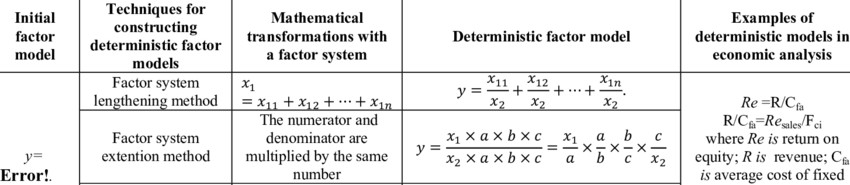 Fig.1 Key characteristics and models of deterministic factor analysis. (Kozlov A, et al., 2022)
SysMathx delivers end-to-end deterministic analysis services that transform system definitions into structured analytical representations. We focus on providing interpretable and validated insights that reflect real system behavior and support engineering decisions. Our services cover system response evaluation, functional structure analysis, and multi-domain flow assessment, tailored to your specific system characteristics and performance objectives.
System Response Analysis via Differential Equations

We evaluate system responses over time using differential equation-based analysis, enabling detailed characterization of dynamic behavior under varying inputs and operational conditions. This approach provides clear insights into performance, stability, and how state variables evolve across different scenarios. SysMathx delivers comprehensive services including formulation of governing equations, analytical and numerical solution of system responses, and evaluation of time-domain and steady-state behavior, stability, and sensitivity under parameter variations.
- Formulation of governing equations for precise system response modeling
- Analytical and numerical evaluation of dynamic and steady-state behavior
- Time-domain and frequency-domain performance assessment
- Stability, sensitivity, and parameter variation analysis
- Scenario-based simulation for optimization and control guidance
Functional Path Analysis

We examine system functionality by mapping causal relationships and tracking how state variables propagate through the system. This reveals critical paths, dependencies, and the primary drivers of system behavior. Our services include derivation of state variables, mapping of causal chains, identification of bottlenecks, scenario-based evaluation of functional changes, and predictive assessment of how local modifications impact overall system performance.
- Identification of state variables and functional dependencies
- Mapping and analysis of causal chains and interaction pathways
- Detection of critical functional paths and bottlenecks
- Scenario-based evaluation of functional changes and impacts
- Recommendations for functional optimization and system improvement
Multi-Domain Energy Flow Analysis

We analyze energy flows across multiple physical domains, including mechanical, electrical, and thermal components, to provide insight into system efficiency, losses, and subsystem interactions. Our services cover modeling of energy transfer, evaluation of conversion, dissipation, and storage processes, identification of inefficiencies and energy bottlenecks, and support for system-level energy optimization. We also deliver reports that guide design improvements, reduce energy waste, and enhance overall system performance.
- Analysis of energy transfer across multiple physical domains
- Evaluation of energy conversion, dissipation, and storage mechanisms
- Identification of inefficiencies, losses, and bottlenecks
- Support for system-level energy optimization and operational improvement
- Recommendations for improving energy efficiency and subsystem coordination
Our Methods of Deterministic Analysis Services
At SysMathx, we apply rigorous mathematical and computational techniques to represent system dynamics and structure with precision. Our methods transform complex models into actionable frameworks that reveal functional dependencies, energy flows, and stability characteristics. By combining analytical formulations, computational solvers, and multi-domain mapping, we ensure deterministic models are accurate, interpretable, and ready for engineering application.
Deterministic Analysis of Mathematical Models
At SysMathx, deterministic analysis is applied across a wide range of mathematical models and system representations to enable consistent and rigorous evaluation of system behavior, performance, and energy flow. We work across physics-based, data-driven, hybrid, and reduced-order models to extract actionable insights that support engineering design, optimization, and validation.
We analyze system behavior across multiple model types, including but not limited to:
| Items | Descriptions |
|---|---|
| Physics-Guided System Models | We performed deterministic analysis on our physics-guided system models using differential equations to capture system dynamics, time-dependent behavior, steady-state responses, and stability under defined conditions. |
| Data-Driven System Models | We conducted deterministic analysis on our data-driven system models by extracting patterns, interactions, and hidden dependencies directly from operational data. This helps us uncover complex system relationships and support informed engineering decisions. |
| Hybrid & Physics-Informed Models | We applied deterministic analysis to our hybrid and physics-informed models by integrating physical principles with data-driven components. This ensures realistic representation of system dynamics while remaining interpretable for practical use. |
| Surrogate & Reduced-Order Models | We performed deterministic analysis on our surrogate and reduced-order models efficiently, approximating complex systems while reducing computational cost. This enables accelerated simulations and supports system optimization. |
| Complex System Models | We conducted deterministic analysis on our complex system models, including adaptive systems, system architectures, and stochastic processes. This allows us to identify critical dependencies, interactions, and potential bottlenecks. |
| Functional and Architectural Models | We applied deterministic analysis to our functional and architectural models focusing on system structure, causal logic, and energy flow. This provides insights into critical pathways, bottlenecks, and opportunities for performance improvement. |
Why Choose Us for Deterministic Analysis?
- Our deterministic analysis is grounded in physics, ensuring consistency with real system behavior.
- We provide clear and interpretable system structures that support decision-making and model validation.
- Our services cover the entire process, from model formulation to practical implementation.
- We offer modeling options ranging from simplified representations to high-fidelity, detailed systems.
- Our outputs are compatible with simulation platforms, control frameworks, and optimization workflows.
- We leverage advanced analytical and computational capabilities to evaluate complex system dynamics.
Start Your Deterministic Analysis Project!
SysMathx offers end-to-end deterministic analysis services to help you understand system behavior, identify functional dependencies, and optimize energy flows across engineering, physical, and multi-domain systems. By combining differential equations, state-space representations, and multi-domain mapping, we deliver precise and actionable insights tailored to your specific requirements. Get in touch with us to discuss your system specifications and deterministic analysis requirements.
FAQs
What types of systems are suitable for deterministic analysis?
Deterministic analysis works best for systems governed by well-defined physical laws or clearly defined input–output relationships. This includes mechanical, electrical, thermal, and control systems, as well as many engineered and natural processes. Such systems allow precise prediction of behavior, performance, and energy flow. By leveraging deterministic models, we can uncover hidden dependencies and optimize system operations reliably.
Do these models require complete system information?
While detailed system data improves accuracy, deterministic analysis can start with partial information or simplified representations. Models can be refined iteratively as additional measurements or operational data become available. This allows clients to begin analysis quickly while gradually improving model fidelity and predictive power.
Can these models handle nonlinear systems?
Yes, nonlinear dynamics are fully supported in our deterministic analysis services. We can capture complex interactions, feedback loops, state-dependent behaviors, and nonlinear couplings between components. This enables realistic simulation of system responses under diverse operational scenarios.
How are the models validated?
Validation is carried out using analytical checks, numerical simulations, and comparisons with experimental or operational datasets. Residual analysis, cross-validation, and scenario testing ensure the model accurately represents real system behavior. Validation guarantees reliability, builds confidence in predictions, and supports engineering decision-making.
Can the results be used in simulation or control systems?
Absolutely. Deterministic models are designed for practical deployment in simulation platforms, control systems, and optimization frameworks. They provide actionable insights for performance evaluation, design improvements, and predictive control. This ensures that models not only describe system behavior but actively support operational and engineering decisions.
Reference
- Kozlov A, et al. Professional Training of Emerging Fuel and Energy Industry Professionals Based on Factor Analysis. TEM Journal. 2022, 11(4).