
Response Surface Methodology (RSM) Services
SysMathx offers professional response surface methodology (RSM) services that transform complex, computationally expensive simulations into efficient surrogate models for engineering applications. Supporting industries such as manufacturing, chemical processing, aerospace, and automotive, these services cover experimental design, model fitting, optimization, and uncertainty analysis.
What Is Response Surface Methodology and How It Works
Response Surface Methodology is a statistical approach for modeling relationships between inputs and outputs, widely used in design optimization and process improvement. It builds fast surrogate models to approximate expensive simulations for efficient analysis and optimization.
- First-order models: Capture linear trends for initial exploration of the design space.
- Second-order models: Include curvature and interactions to locate optimal conditions.
- Key advantage: Enables fast evaluation and optimization without repeated costly simulations.
- Limitation: Less effective for highly nonlinear or high-dimensional problems compared to methods like proper orthogonal decomposition (POD).
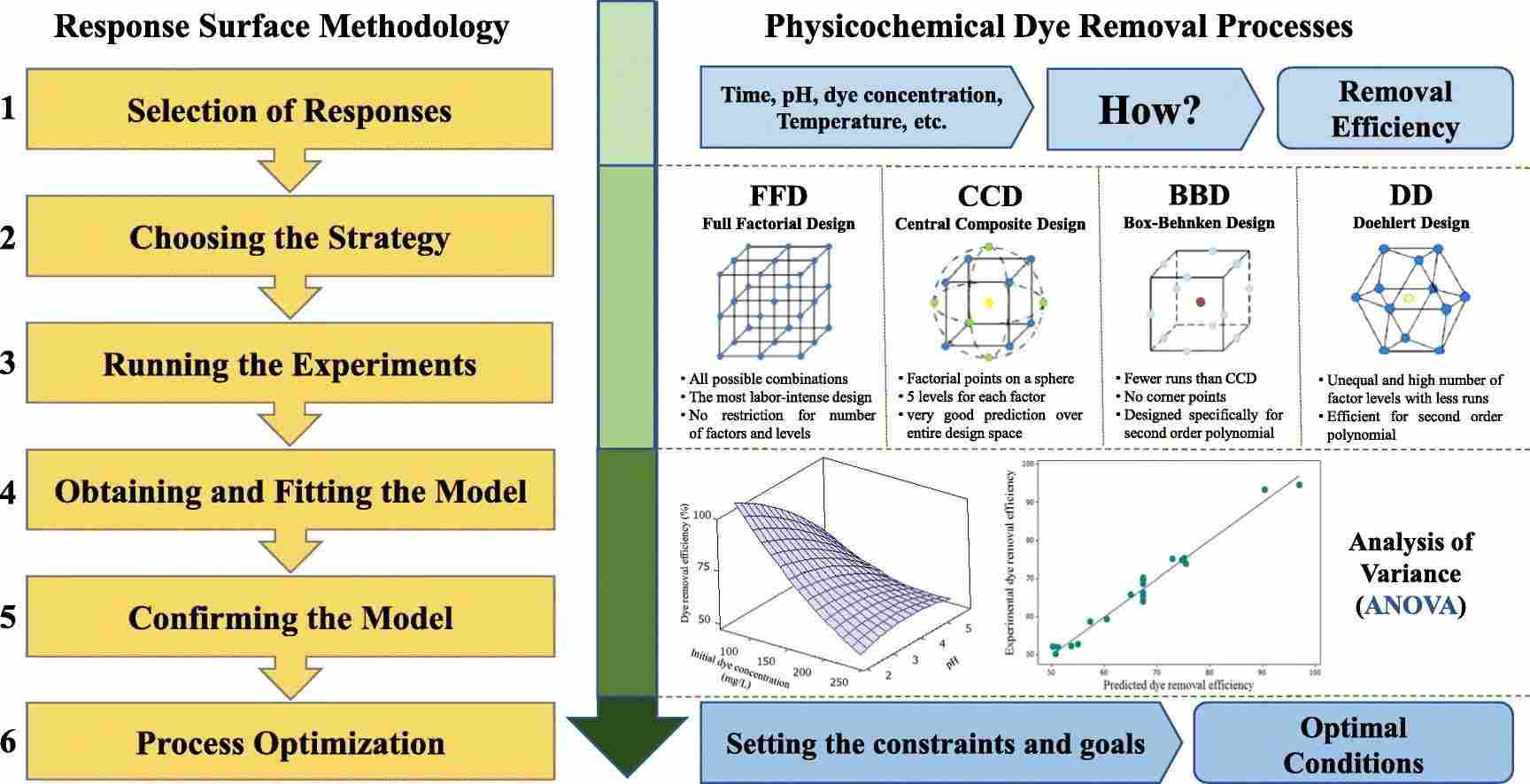 Fig.1 Application of RSM in physicochemical dye removal from wastewater. (Karimifard S, et al., 2018)
SysMathx delivers comprehensive RSM services tailored to your engineering or scientific challenges. From experimental design and data collection to model fitting, validation, and deployment, we transform simulation outputs or experimental measurements into rigorous surrogate models. Our approach ensures methodological rigor, accurate predictions, and transparent processes that support decision-making and optimization.
Experimental Design and Planning Services
For reliable RSM, data must be carefully collected to maximize information from a minimal number of runs. We design efficient experiments to capture the most critical information about the system.
Capabilities:
- Planning experiments to explore the full design space systematically
- Balancing resource constraints with data requirements
- Sequentially refining experiments to improve model accuracy
- Creating reproducible and transparent experiment protocols
Deliverables:
- Experiment tables with input variable settings and run order
- Sample size recommendations and design rationale
- Documentation for reproducible experimentation
Polynomial Surrogate Model Fitting Services
Once data is collected, we fit smooth mathematical surfaces to approximate the input-output relationships. Our approach ensures the model is interpretable, reliable, and predictive.
Capabilities:
- Selecting appropriate model order and complexity based on data
- Evaluating variable influence and interactions
- Testing model assumptions and checking residuals
- Validating predictions to ensure model accuracy
Deliverables:
- Fitted surrogate model with coefficients and uncertainty measures
- Diagnostic plots to assess model fit and residual behavior
- Model performance metrics for predictive reliability
Model Validation and Diagnostics Services
A surrogate model is only valuable if it predicts reliably on new or unseen data. We rigorously validate models to ensure they guide accurate decision-making.
Capabilities:
- Evaluating predictive performance using cross-validation and hold-out data
- Detecting potential outliers and influential data points
- Assessing whether the model captures key trends and system behavior
- Providing recommendations for model refinement and improvement
Deliverables:
- Prediction error metrics and accuracy assessments
- Confidence intervals for new predictions
- Comprehensive validation report with recommendations
Process Optimization and Design Space Exploration
The ultimate value of an RSM model is to identify optimal operating conditions. We guide you through the fitted surface to locate ideal settings, whether optimizing a single response or balancing multiple objectives.
Capabilities:
- Identifying peak or target response values in the design space
- Exploring design space visually and quantitatively
- Performing sensitivity analysis to understand variable impact
- Supporting multi-objective trade-offs and robust decision-making
Deliverables:
- Recommended input settings with predicted outcomes
- Confidence intervals for predictions
- Visualization of response surfaces and feasible regions
Response Surface Methodology Methods
SysMathx uses RSM as a core service approach to model and analyze complex systems by mapping how multiple inputs influence outputs. Through structured mathematical response surfaces, we capture key interactions and nonlinear patterns, enabling efficient system exploration, insight generation, and optimization.
Applications of Response Surface Methodology Services
Chemical Process Optimization
In chemical systems, we apply RSM to model how multiple operating variables jointly affect reaction outcomes under different conditions. This enables us to analyze performance trends and identify efficient operating regions for our system evaluation and optimization.
Aerodynamic Shape Evaluation
In aerodynamic design, we employ RSM to approximate nonlinear performance behavior through simplified surrogate models of design variables. This enables us to systematically explore design variations and analyze how shape changes influence system response.
Additive Manufacturing Parameter Analysis
In manufacturing processes, we use RSM to model the joint influence of multiple process settings on material quality through simplified response relationships. This allows us to evaluate interaction effects and interpret how combined parameter variations drive changes in process behavior.
Pharmaceutical Formulation Studies
In formulation systems, we apply RSM to represent how ingredients and processing conditions jointly affect product characteristics through simplified response relationships. This allows us to examine variable interactions and assess system responses across different compositions.
Why Choose Response Surface Methodology Services?
- Statistical Rigor: Models are validated using standard diagnostic methods to ensure reliable predictive performance.
- Efficient Data Use: RSM extracts maximum information from limited simulations or experiments.
- Interpretable Results: Outputs are expressed as clear mathematical relationships for easy interpretation.
- Workflow Compatibility: Models integrate smoothly with common computational tools and workflows.
- Uncertainty Awareness: Predictions include reliability information to support interpretation.
- Method Flexibility: Different approaches are selected based on problem complexity and data availability.
Start Your RSM Optimization Project!
Have a system with multiple interacting factors and complex response behavior? SysMathx turns your simulation or experimental data into fast, reliable surrogate models for optimization, sensitivity analysis, and prediction. Contact us to discuss your problem, and our technical team will recommend a tailored RSM strategy or alternative modeling approach if more suitable.
FAQs
What problems can Response Surface Methodology (RSM) be used for?
RSM is used for systems with multiple interacting variables, especially when relationships between inputs and outputs are complex and need to be approximated for analysis or optimization.
When is RSM more suitable than full-scale simulation?
RSM is suitable when simulations are expensive or time-consuming, and a fast approximation is needed for exploring trends, sensitivities, or optimal conditions.
What is the main output of an RSM model?
The main output is a mathematical response surface that describes how system responses change with different input variables.
Can RSM handle nonlinear system behavior?
Yes, RSM can capture moderate nonlinearities and interactions between variables, especially using second-order surface representations.
What should be provided to start an RSM project?
Typically, information such as input variables, response definitions, and available simulation or experimental data is sufficient to begin model development.
Reference
- Karimifard S, et al. Application of response surface methodology in physicochemical removal of dyes from wastewater: a critical review. Science of the Total Environment. 2018, 640: 772-797.