
State-Space Representation Services
SysMathx provides state-space representation services to transform complex dynamic systems into structured, simulation-ready models for analysis, control design, and optimization. Modern engineering systems often involve multiple interacting variables and time-dependent behaviors that are difficult to analyze using simplified or static approaches. A structured state-space framework enables clearer understanding of system dynamics and more accurate prediction of system responses.
Why State-Space Representation Matters
Dynamic systems with multiple inputs and outputs often present complex interactions and time-dependent behaviors that are hard to analyze without a structured framework. Traditional modeling approaches may miss internal system states or dynamic relationships, which limits analysis and control capabilities. State-space representation offers a unified and rigorous way to describe system dynamics. It provides deeper insight and supports advanced analysis and control design.
- Internal system states, inputs, and outputs are captured within a single mathematical framework.
- Control strategies can be developed and validated for a wide range of dynamic systems.
- The approach works for high-dimensional and multi-variable systems across different domains.
- Time-dependent behavior analysis and system response evaluation are both supported.
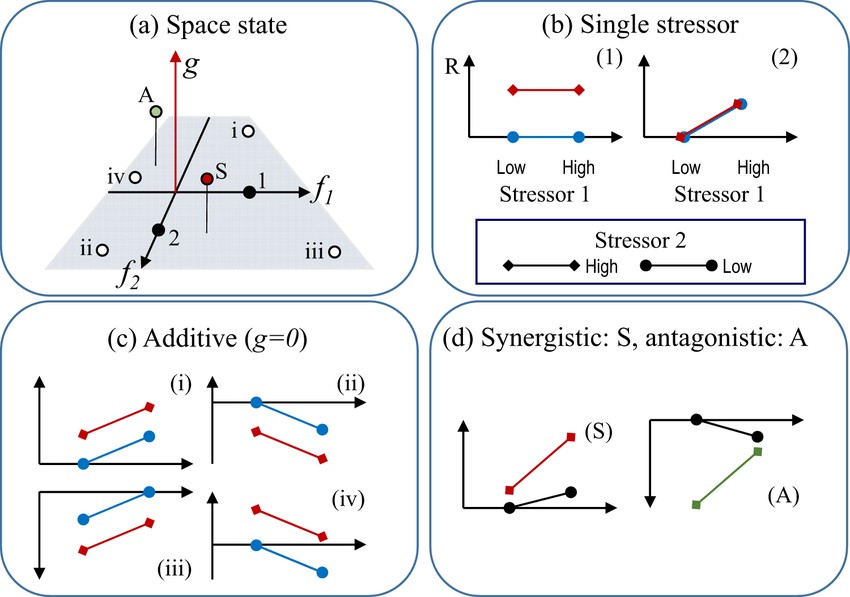 Fig.1 State-space representation plots D1/D2 on axes, G as resultant R. (Giménez L, et al., 2021)
SysMathx provides end-to-end state-space modeling services that support system analysis, simulation, and control oriented applications. The approach focuses on building structured, interpretable, and simulation ready models based on specific system characteristics and objectives. System descriptions, equations, or data are used to construct accurate representations of dynamic behavior and input-output relationships.
System Modeling and State-Space Formulation Services
SysMathx develops state-space models that represent system dynamics through structured equations capturing state evolution and input-output relationships. We translate physical system descriptions, governing equations, or data into consistent and analyzable state-space formulations tailored to your application needs. This enables rigorous analysis, supports control design, and provides a reliable foundation for simulation and system optimization.
- State variable identification and definition based on system characteristics
- Formulation of state-space equations for dynamic system representation
- Conversion from physical models or differential equations into structured forms
- Development of interpretable and simulation-ready state-space models
Dynamic Simulation and System Analysis Services
SysMathx provides simulation-ready state-space models that enable detailed evaluation of system behavior under varying inputs, operating conditions, and external disturbances. We support comprehensive analysis of system dynamics, allowing deeper insight into how systems respond over time and under different scenarios. These models serve as a reliable foundation for performance assessment, design validation, and system optimization.
- Time-domain simulation of system behavior under different inputs and conditions
- Dynamic response analysis to evaluate system reactions and performance
- Stability assessment and transient behavior evaluation for system reliability
- Scenario-based system testing to analyze performance under varying operational conditions
Control-Oriented Modeling and Analysis Services
Through our control-oriented modeling and analysis services, we create state-space models that underpin control system design and evaluation. This approach allows us to apply modern control techniques, optimize system performance, and achieve effective regulation across a variety of dynamic systems, supporting both theoretical study and practical implementation of control strategies.
- Controllability and observability analysis for system assessment
- Support for state feedback and observer design
- Linearization of nonlinear systems for control applications
- Preparation for advanced control methods and implementation
Model Validation and System Optimization Services
We use our model validation and system optimization services to develop and refine state-space models that accurately capture system behavior and support optimization goals. We assess model performance against data or simulation results to ensure reliability and predictive accuracy, providing a strong foundation for system improvement and enhanced performance.
- Model validation against experimental data or simulation outputs
- Parameter estimation and refinement for improved accuracy
- Sensitivity and performance analysis of system behavior
- Optimization of system design and operational performance
State-Space Representation Foundations and Capabilities
SysMathx provides state-space representation capabilities to support the modeling, analysis, and control of dynamic systems with multiple inputs, outputs, and time-dependent behaviors. We transform system descriptions, equations, or data into structured state-space frameworks that clearly capture system dynamics and interactions. These capabilities form the foundation for delivering simulation-ready, analyzable models that support system understanding, control design, and optimization.
- Identification and formulation of system state variables
- Mapping of physical quantities into state-space representations
- Construction of structured system models
- Representation of multi-variable system interactions
- Modeling input-output relationships for system analysis
- Development of representations with multiple inputs and outputs
- Coupling internal states with observable outputs
- Analysis of system response to external inputs
- Controllability and observability analysis
- Support for feedback control and observer design
- Linearization of nonlinear systems
- Preparation for advanced control methodologies
- Modeling of time-dependent and dynamic system behavior
- Representation of linear and nonlinear system dynamics
- Formulation of state evolution equations
- Analysis of transient and steady-state responses
Applications of State-Space Representation Services
Control Systems Engineering
We use our state-space representation services in control systems engineering to model dynamic behavior, feedback loops, and system stability. This enables us to design and analyze control systems for reliable and optimized performance.
Robotics and Autonomous Systems
We apply our state-space representation services in robotics and autonomous systems to capture motion, control, and interactions with the environment. This enables precise system management and facilitates real-time decision-making.
Energy and Power Systems
We utilize state-space representation to model the dynamic evolution of power grids and energy networks. This enables precise stability analysis and optimized flow control to ensure peak system performance.
Aerospace and Mechanical Systems
We leverage state-space modeling to define complex aerospace and mechanical dynamics. This facilitates precise analysis of motion and forces, optimizing system interactions and control.
Process and Industrial Systems
We apply state-space modeling to represent the time-varying dynamics of industrial operations, enabling advanced analysis and control design to enhance process efficiency and optimize system performance.
Multi-Domain Dynamic Systems
We utilize state-space representation services to unify diverse physical domains into a single, cohesive modeling framework. This enables analysis of coupled systems, offering a holistic view of dynamics across mechanical, electrical, and thermal domains.
Advantages of Our State-Space Representation Services
- A structured and mathematically consistent representation of dynamic systems is provided.
- Accurate simulation and analysis of time-dependent system behavior are enabled.
- Advanced control design and system optimization are effectively supported.
- Complex multi-variable and high-dimensional systems are handled efficiently.
- Simulation-ready models for practical engineering applications are delivered.
- System understanding and decision-making are improved through clear model structure.
Start Your State-Space Modeling Project!
Ready to model and analyze your dynamic system with a structured and reliable approach? SysMathx provides professional state-space representation services to help you build accurate models, analyze system behavior, and design effective control strategies. Contact SysMathx today to discuss your project and receive a tailored modeling solution.
FAQs
What types of systems can be modeled using state-space representation?
State-space representation is suitable for dynamic systems with time-dependent behavior, including mechanical, electrical, control, and multi-domain systems with multiple inputs and outputs.
Is state-space modeling only for linear systems?
State-space methods can be applied to both linear and nonlinear systems, although linear models are often used for analysis and control design, while nonlinear models capture more complex system behavior.
Can existing models be converted into state-space form?
Yes, differential equations, transfer functions, and physical system descriptions can be systematically converted into state-space representations for analysis and simulation.
What is the benefit of using state-space models for control design?
State-space models provide direct access to system states, enabling advanced control techniques such as state feedback, observers, and optimal control methods.
Can state-space models be used for simulation?
Yes, state-space models are inherently suitable for simulation and can be used to evaluate system behavior under different inputs and conditions.
Reference
- Giménez L, et al. A state-space approach to understand responses of organisms, populations and communities to multiple environmental drivers. Communications Biology. 2021, 4(1): 1142.