
Hybrid Modeling Services
SysMathx offers hybrid modeling services that combine first-principles physics with data-driven techniques. The resulting models are both physically consistent and empirically accurate. In many engineering systems, only part of the underlying mechanisms is known—governing equations may be available, but some parameters, boundary conditions, or sub-models remain uncertain or entirely unknown. Hybrid modeling fills this gap by embedding data-driven components directly into physics-based frameworks.
Why Choose Hybrid Modeling for Incomplete Systems?
In practical engineering scenarios, system knowledge is often incomplete—some mechanisms are well understood, while others remain uncertain or difficult to quantify. Relying only on first-principles models can lead to oversimplification, whereas purely data-driven methods may overlook important physical structure. Hybrid modeling combines both perspectives to better reflect real system behavior.
- Use available physics effectively – Known equations, constraints, or conservation laws provide a stable foundation, while data-driven terms capture unknown interactions or nonlinear effects.
- Lower data requirements – Physical structure narrows the solution space, allowing models to learn meaningful patterns from smaller datasets and reducing dependence on extensive measurements.
- Improve generalization – Models guided by physics tend to behave more consistently outside the training range, helping avoid unrealistic or unstable predictions.
- Preserve interpretability – Core variables and parameters remain linked to physical meaning, making results easier to analyze, validate, and refine.
- Adapt to system complexity – Flexible data-driven components can be introduced only where needed, avoiding unnecessary model complexity while still capturing critical dynamics.
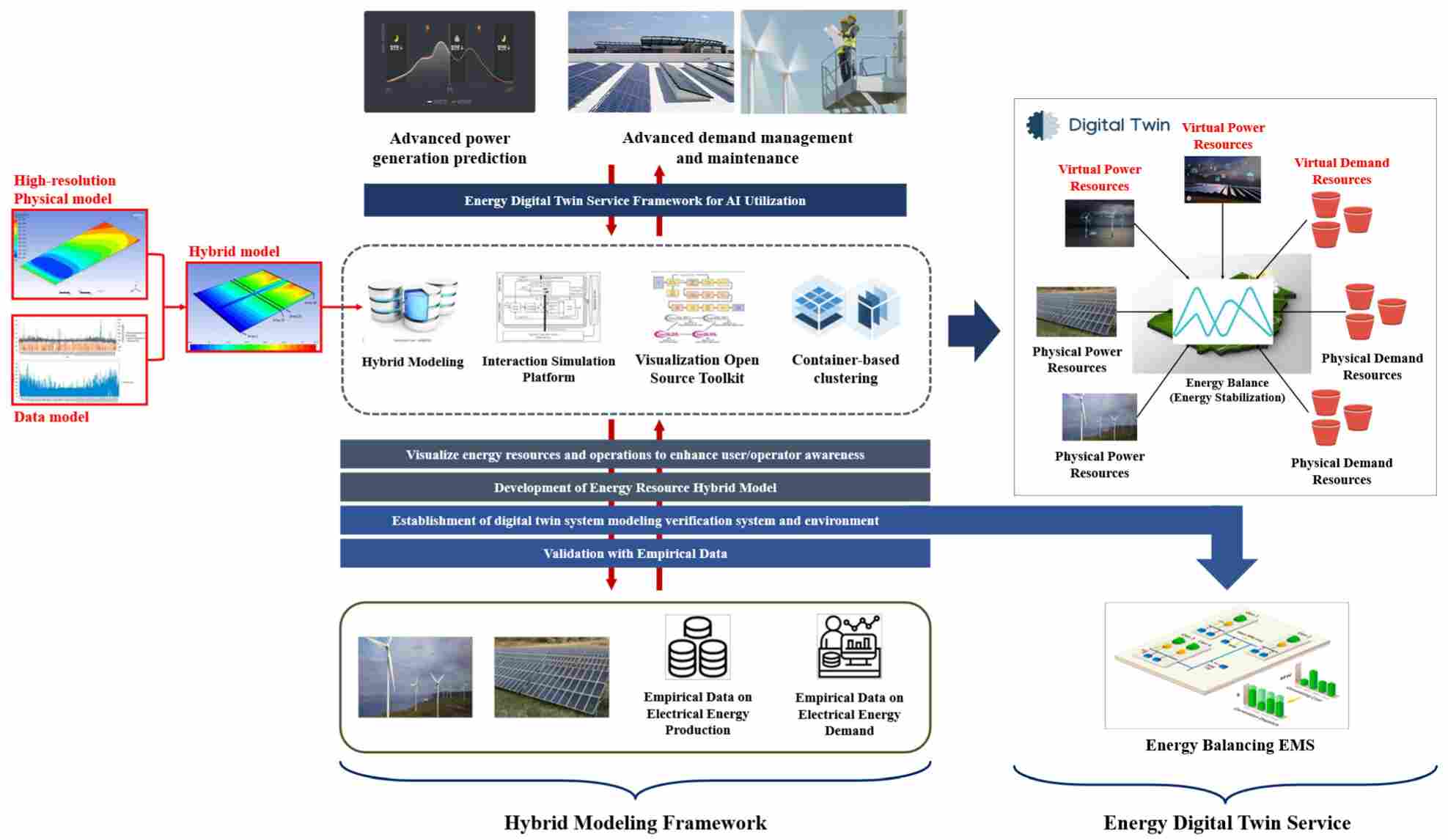 Fig.1 Development structure and data flow of the hybrid modeling framework. (Lee J, et al., 2025)
At SysMathx, we provide a range of hybrid modeling services tailored to different levels of prior knowledge and data availability. Each approach balances physical consistency with data-driven flexibility to meet your engineering objectives.

Physics-Informed Neural Network Services
When governing differential equations are available but boundary conditions, initial states, or parameters are uncertain, this approach embeds physical constraints directly into the training process. It enables models to remain consistent with known principles while learning from limited or scattered data. Typical capabilities include solving forward and inverse problems, working with irregular domains, handling incomplete inputs, and estimating unknown parameters.

Mechanism-Data Fusion Modeling Services
For systems with a partially reliable physics foundation, this service combines known mechanisms with data-driven components to capture complex or unresolved effects. The physical model describes the main structure, while learned components refine predictions where gaps exist. This approach supports correction modeling, reduced-order representations, adaptive hybrid structures, and improved robustness under varying conditions.

Grey-Box Model Identification Services
When system structure is known but key relationships or parameters are uncertain, this service integrates prior knowledge with data-driven identification. It maintains the core model framework while learning missing components from data. Typical capabilities include constrained system identification, parameter estimation under varying conditions, and integration of known system properties into the modeling process.
SysMathx develops hybrid modeling solutions that integrate physical principles with data-driven learning to support complex systems where full governing descriptions are not available. These solutions are designed to handle different levels of prior knowledge and data availability in a flexible and structured way.
- Physical laws, conservation principles, or governing relationships are embedded directly into the learning process
- Model training is guided to follow known system behavior even when data is sparse or noisy
- Helps reduce unrealistic predictions by limiting solutions to physically meaningful spaces
- Suitable for systems where measurements are limited but basic physical structure is available
- A baseline physics-based model is used as the starting point for system representation
- Data-driven components are introduced to capture missing dynamics or unmodeled effects
- Corrections can address simplifications, parameter mismatch, or neglected interactions
- Improves prediction accuracy while keeping the original physical structure intact
- Known system structure such as state relationships or governing form is preserved during modeling
- Unknown functions, parameters, or nonlinear terms are inferred from observed data
- Ensures the model remains interpretable and consistent with known system formulation
- Effective when partial equations or structural information is available but incomplete
- Combines measurement data with partial physical understanding to build adaptive models
- Model behavior can adjust across different operating conditions or regimes
- Captures system changes that are difficult to express using fixed analytical forms
- Useful for time-varying or condition-dependent dynamic systems
Applications of Hybrid Modeling Services
Hybrid modeling is applied in many engineering and scientific fields where part of the system behavior is known from physics, while the remaining part must be learned from data. These applications show how physical principles and measurement data can be combined to improve prediction and understanding.
Turbulent Flow Modeling
This application begins with governing equations for fluid motion as the physical foundation. A learning model is then used to represent turbulence effects that are not fully resolved by the basic equations. The model is trained using limited high-fidelity simulation data. By focusing only on the missing flow behavior, the approach improves prediction accuracy without requiring full detailed simulations in every case.
Battery State Estimation
A physics-based equation model is used to describe battery behavior over time. Some thermal-related parameters, such as heat generation and heat loss, are not fully known. By combining the physical equations with measurement data such as voltage, current, and surface temperature, the model can estimate internal states and unknown thermal properties at the same time.
Structural Damage Detection
A mathematical model of the undamaged structure is used as the reference condition. Vibration measurements from the real structure are then compared with the expected behavior. Instead of explicitly defining how damage occurs, a learning component is used to represent changes in stiffness. This allows detection of damage location and severity based on deviations from the reference model.
Chemical Reactor Modeling
The system is described using conservation of mass and energy as the physical rules. However, the detailed reaction relationships are not fully known. A data-based model is used to learn reaction rates from measurements of concentration and temperature over time. The physical constraints ensure that basic conservation laws are satisfied while the data model fills in missing reaction behavior.
Aerodynamic Prediction
A simplified physical model is used to describe lift and drag under basic flow conditions. A data-driven component is added to correct errors caused by complex effects such as flow separation and compressibility changes. This combined model provides more accurate predictions across a wider range of operating conditions compared with the basic physical model alone.
Medical Device Simulation
A general physical model of blood flow is used as the starting point. Patient measurement data from imaging is then used to adjust boundary conditions and material properties. This creates a personalized simulation that remains consistent with physical laws while reflecting individual differences in anatomy and flow conditions.
How We Work?
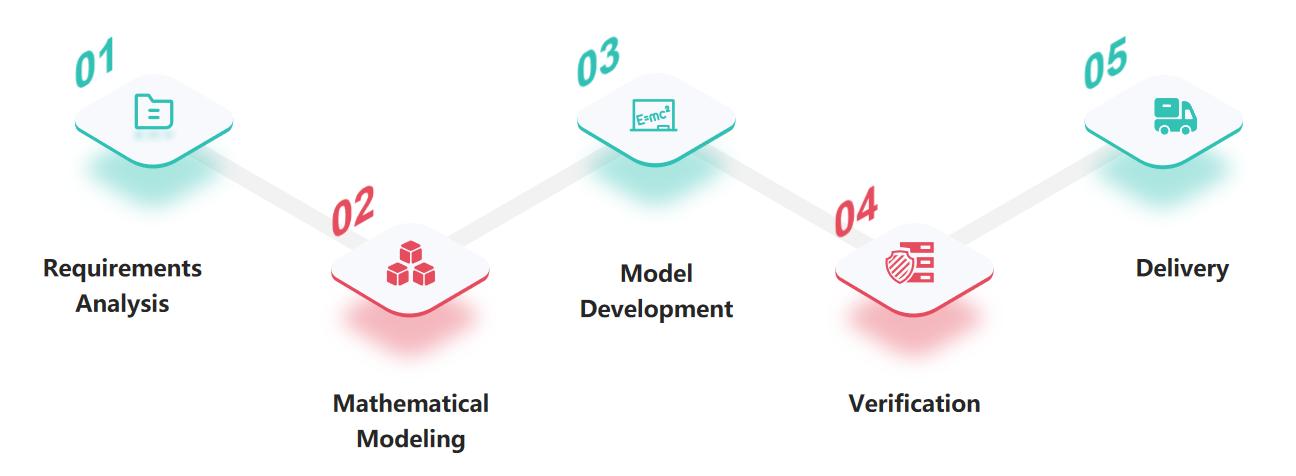
SysMathx employs a structured, phased project management approach to ensure efficient and reliable delivery of hybrid modeling services. Each project is guided through a well-defined workflow that integrates system understanding, hybrid model design, data integration, model development, and validation to achieve both physical consistency and data-driven accuracy.
Start Your Hybrid Modeling Project Today!
Have a physics model that is partially correct — and data that could fill the gaps? Let us help you build a hybrid model that combines the best of both worlds. Contact us with a description of your governing equations (or known structure) and available data, and our team will propose a suitable hybrid modeling approach. We will work with you to ensure the model is tailored to your system requirements and application goals.
FAQs
Do I need a complete PDE or ODE model to use hybrid modeling?
No. Partial knowledge — even just the structure of equations with unknown parameters, or known conservation laws without exact forms — is sufficient. The data-driven component handles the missing parts.
What is the difference between PINNs and grey-box identification?
PINNs are typically used when the PDE form is known and you have scattered or sparse measurements, often for inverse problems. Grey-box identification is more suited for ODE systems with known state variables but unknown nonlinear functions, typically with time-series data.
How much data is required compared to pure machine learning?
Significantly less. Physics constraints act as strong regularization. In some PINN applications, as few as dozens of measurement points can yield reasonable solutions, whereas black-box methods would require thousands.
Can hybrid models be used for real-time applications?
Yes. Once trained, hybrid models (including PINNs with surrogate acceleration) can be evaluated quickly. For very fast applications, we can distill the hybrid model into a lightweight surrogate.
How do you validate a hybrid model when no ground truth is available?
We use multiple strategies: consistency checks (physics residuals), cross-validation against held-out data, sensitivity analysis, and comparison with simplified analytical solutions where available.
Reference
- Lee J, et al. Development of a hybrid modeling framework for the optimal operation of microgrids. Energies. 2025, 18(8): 2102.