
Physics-Informed Neural Networks (PINNs) Services
Sysmathx provides physics-informed neural network services for solving differential equations and estimating unknown parameters from sparse or noisy data. Unlike traditional solvers that rely on dense meshes and strict boundary conditions, this approach embeds physical laws directly into the learning process to ensure consistency with both data and governing equations.
Why PINNs for Sparse-Data Physics Problems
Traditional numerical methods for partial differential equations (PDEs), such as the finite difference method (FDM) and finite volume method (FVM), typically depend on fine meshes and well-defined boundary and initial conditions. When data is sparse, geometries are irregular, or parameters are unknown, these methods become difficult to apply.
Physics-Informed Neural Networks (PINNs) take a different approach by approximating the solution with a neural network while embedding the governing equations into the training process. The model is guided by both limited data and physical laws enforced at collocation points.
Key benefits:
- Works with scattered data: No mesh or grid is required; supports irregular measurement points.
- Inverse problem capability: Unknown parameters can be learned together with the solution.
- Better robustness: Physics constraints help reduce overfitting under sparse or noisy data.
- Flexible geometry handling: Can be applied to complex domains through point sampling instead of meshing.
- Flexible for complex geometries: PINNs can be applied to irregular domains by sampling points inside the region and along boundaries, avoiding the need for mesh generation.
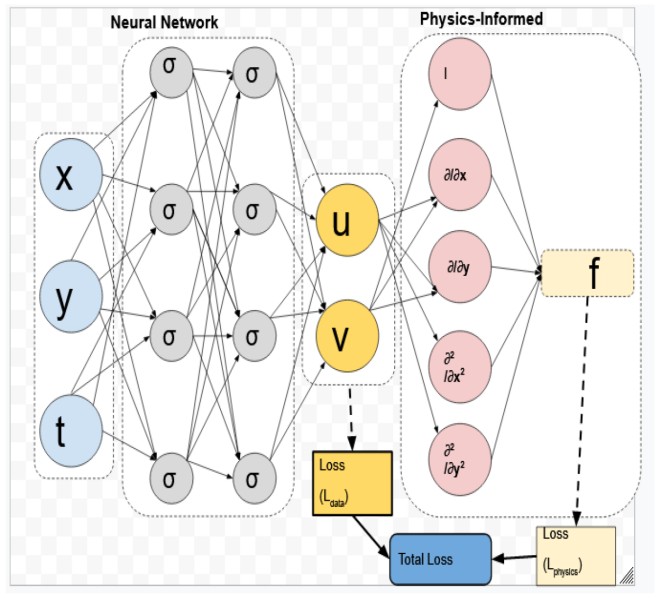 Fig.1 Schematic diagram of a PINN. (Lawal Z K, et al., 2022)
At SysMathx, we provide end-to-end PINNs solutions — from problem formulation and domain sampling to network architecture design, training, and validation. Each service is tailored to your PDE system, data availability, and accuracy requirements. We also offer mechanism-data fusion modeling and grey-box model identification for systems that combine known structure with unknown dynamics.
| Services | Capabilities |
|---|---|
|
Forward PDE Solving from Sparse Measurements
|
When the governing PDE and model parameters are known but initial and boundary conditions are only partially available or measured at scattered locations, PINNs can be used to reconstruct the full solution field. This is especially useful in cases where conventional numerical solvers struggle due to incomplete boundary information or complex, irregular geometries. Key capabilities include:
|
|
Inverse Parameter Estimation from Experimental Data
|
When the governing PDE is known but some parameters are unknown or vary with operating conditions, PINNs can be used to estimate these parameters directly from measurement data. This avoids the need for repeated parameter sweeps or traditional iterative forward simulations. Key capabilities include:
|
|
PDE Discovery from Partial Observations
|
When the governing equation is unknown but a set of candidate terms can be assumed, PINNs combined with sparse regression can be used to infer the underlying PDE directly from scattered observations. This extends traditional equation discovery methods to settings where only partial or noisy state measurements are available. Key capabilities include:
|
|
Surrogate Modeling for Accelerated Simulation
|
Once a PINN is trained on a family of PDE problems with varying parameters or boundary conditions, it can be reused as a fast surrogate model in place of traditional numerical solvers. This is particularly useful in scenarios that require repeated evaluations, such as design optimization, uncertainty analysis, or real-time decision-making. Key capabilities include:
|
PINNs Methods and Tools
Our PINNs methodology combines neural network design, automatic differentiation, physics loss formulation, and optimization strategies tailored for differential equation constraints.
Applications of PINNs Services
PINNs are applied across engineering and scientific domains where measurement data is sparse, geometries are irregular, or traditional solvers are impractical. The following examples illustrate typical use cases.
Additive Manufacturing Thermal Field
Sparse thermocouple readings during laser melting are used to reconstruct the full transient temperature field with fine spatial and temporal resolution, while inverse learning is applied to estimate key thermal properties such as conductivity and absorptivity, enabling more accurate monitoring of melt pool evolution, thermal gradients, and defect formation mechanisms in complex build processes.
Cardiovascular Flow Modeling
From scattered velocity data obtained by 4D flow MRI, a physics-informed framework is employed to reconstruct full blood flow dynamics, including pressure fields and wall shear stress distributions, while ensuring consistency with Navier–Stokes equations to support more reliable, patient-specific cardiovascular analysis and clinical decision support.
Structural Stress Reconstruction
Limited strain gauge measurements on complex engineering structures are expanded into high-resolution full-field stress and strain distributions through physics-informed modeling, while simultaneously calibrating uncertain material parameters to match observed mechanical responses without relying on repeated full-scale finite element simulations.
Battery State Estimation
Sparse voltage and temperature measurements recorded during battery operation are integrated into coupled electrochemical–thermal physics models to estimate internal states such as lithium concentration and temperature distribution, as well as degradation-related parameters, improving visibility into internal operating conditions under limited sensing.
Why Choose Our PINNs Services?
- Physics Guarantee – The partial differential equation residual is explicitly minimized rather than learned indirectly, ensuring that solutions satisfy the governing equations at sampled points within the domain.
- Sparse-Data Expertise – Network structures and loss balancing are designed to prevent overfitting under limited measurements, while physical constraints act as a strong regularization mechanism.
- Irregular Geometry Handling – No mesh generation is required, as sampling points are taken directly from geometric descriptions such as computer-aided design files, surface formats, or point clouds, reducing preprocessing effort.
- Inverse Problem Efficiency – Unknown parameters are identified within a single training process instead of iterative nested optimization procedures, enabling efficient scaling to multiple unknown variables.
- Uncertainty Quantification – Ensemble approaches, variational formulations, or dropout-based techniques are used to provide confidence intervals for both predicted fields and estimated parameters.
- Deployment Ready – Trained models are lightweight and computationally efficient during inference, making them suitable for real-time use and integration into digital twin systems.
Start Your Physics-Informed Neural Networks Project Today!
Working with a differential equation but only sparse measurements and no full mesh or boundary information? A physics-informed neural network can be built to directly handle forward or inverse problems without relying on complete discretization. Contact us with your governing equations, available data, and project objectives, and we will design a tailored PINN solution for your specific application.
FAQs
How sparse can the measurements be?
It depends on the problem complexity and the strength of the physics. For elliptic PDEs, PINNs can work with as few as dozens of measurement points. For hyperbolic or chaotic systems, more data is typically needed. We can assess feasibility before starting.
Do I need to provide the exact PDE form?
For forward solving and inverse parameter estimation, yes — the PDE form is required. For PDE discovery, we need a candidate library of terms, and the method identifies which terms are active.
What if my domain has complex geometry?
PINNs excel at irregular domains. We sample collocation points from any geometry representation (CAD, mesh files, or even point clouds). No mesh generation or mesh quality concerns.
How long does training take?
Training time scales with the number of collocation points, network size, and problem difficulty. Small 2D problems may train in minutes on a GPU; large 3D problems may take hours. We can adjust accuracy vs. speed trade-offs.
Can PINNs handle time-dependent problems?
Yes. Time is treated as an additional input dimension. The PDE residual includes time derivatives computed via automatic differentiation. Both initial and boundary conditions are enforced as loss terms.
Reference
- Lawal Z K, et al. Physics-informed neural network (PINN) evolution and beyond: A systematic literature review and bibliometric analysis. Big Data and Cognitive Computing. 2022, 6(4): 140.