
Nonlinear System Identification Services
SysMathx provides professional nonlinear system identification services that build dynamic models directly from input-output measurements. Many real-world systems — from robotic arms and chemical reactors to biological neurons and vehicle suspensions — exhibit nonlinear behaviors that linear models cannot capture. We construct interpretable, dynamical models that describe how a system responds to inputs over time, using measured data as the only starting point. As part of our data-driven modeling suite, we also offer statistical modeling services for data interpretation and uncertainty quantification, as well as network system modeling services for interconnected and graph-structured systems.
Why Nonlinear System Identification for Dynamic Systems
Linear models are convenient, but many engineering systems simply do not behave linearly over their full operating range. Friction, saturation, hysteresis, backlash, and aerodynamic drag are common nonlinearities that linear models either ignore or approximate poorly. Nonlinear system identification addresses this gap by building models that explicitly represent these nonlinear behaviors while remaining grounded in measured data rather than first-principles derivations.
- Capture real nonlinear behavior – Models include nonlinear terms (polynomials, sigmoids, piecewise functions) that linear methods cannot represent.
- Work without full physics – When governing equations are unknown or too complex to derive, identification builds models directly from experimental data.
- Balance complexity and generalizability – Regularization and model selection prevent overfitting while preserving predictive power on unseen data.
- Preserve interpretability – Unlike pure black-box neural networks, identified models often reveal structure (e.g., which nonlinear terms matter most).
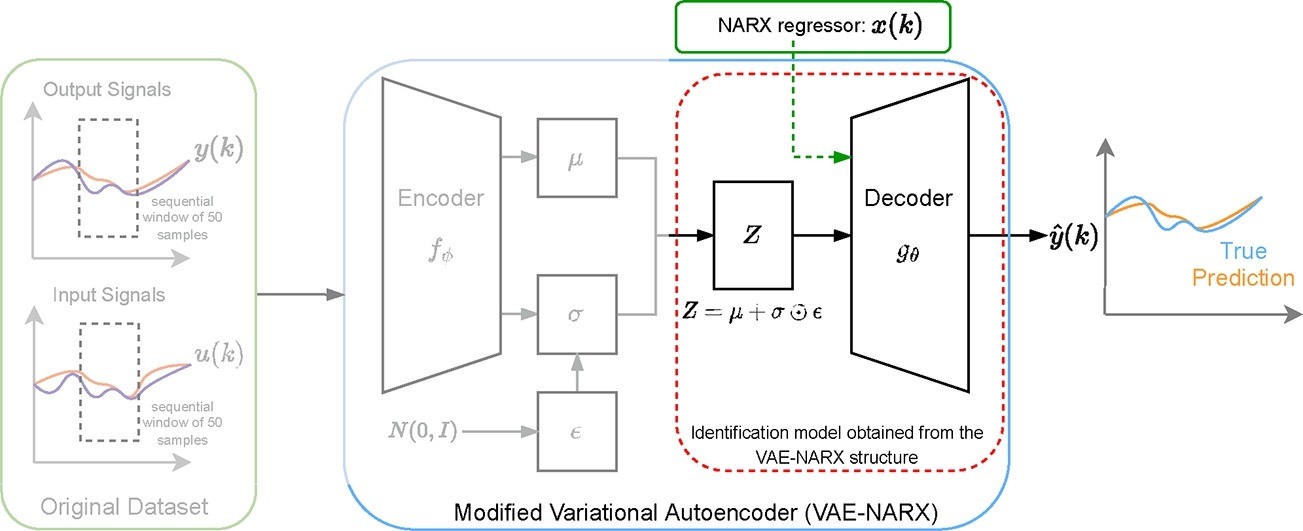 Fig.1 Variational autoencoder–based nonlinear system identification. (Paniagua J L, et al., 2024)
At SysMathx, we provide end-to-end nonlinear system identification solutions — from data preprocessing and structure selection to parameter estimation and model validation. Each service is customized to your system's dynamic behavior, data characteristics, and application requirements.
| Services | Capabilities |
|---|---|
|
Polynomial-Based Nonlinear Modeling
|
For systems where nonlinear behavior can be approximated using combinations of past inputs and outputs, polynomial-based approaches provide a structured and interpretable modeling framework. These methods are well-suited for engineering applications requiring clarity and efficiency.
|
|
Block-Structured Nonlinear Modeling
|
For systems that can be decomposed into static nonlinear components and linear dynamic responses, block-oriented modeling provides a parsimonious and physically meaningful representation. This approach is especially useful when partial structural knowledge is available.
|
|
Sparse Data-Driven Equation Discovery
|
When the governing relationships are unknown but expected to be compact, sparse modeling techniques can uncover low-dimensional representations from data. These approaches focus on identifying the most relevant terms from a broader candidate space.
|
|
Hybrid Physics–Data Driven Modeling
|
For complex systems with partially known mechanisms, hybrid approaches combine physical insights with data-driven components to improve modeling flexibility and robustness.
|
Nonlinear System Identification Methods and Tools
At SysMathx, nonlinear system identification is based on a combination of established analytical techniques and data-driven modeling strategies. System dynamics are inferred from measured data through multiple methodological frameworks, each designed to address different characteristics of nonlinear behavior, data quality, and modeling objectives.
Applications of Nonlinear System Identification Services
Nonlinear system identification is applied across engineering domains where linear models fail to capture observed behavior — from mechanical systems with friction to biological neurons and aerodynamic vehicles. The following examples illustrate typical use cases.
Robotic Manipulator Dynamics Identification
Collect joint torque and position data during trajectory tracking. Identify nonlinear friction components such as Coulomb, viscous, and Stribeck effects, as well as inertial parameters. The resulting model supports model-based control and feedforward compensation.
Chemical Reactor Kinetic Modeling
Record concentration and temperature responses under changes in feed flow or heating input. Capture nonlinear reaction kinetics, including temperature-dependent Arrhenius behavior and Monod-type growth relations in biological systems. The model supports process analysis and scale-up studies.
Automotive Suspension Characterization
Measure force–displacement and force–velocity responses using experimental test rigs. Identify nonlinear spring and damping characteristics, including hysteresis, asymmetric damping, and saturation effects. The model improves ride comfort and handling simulation accuracy.
Battery Equivalent Circuit Modeling
Apply current pulse tests and impedance data to identify nonlinear equivalent circuit representations. Include state-dependent resistance and capacitance behavior. The model supports state-of-charge and state-of-health estimation.
Aerodynamic Coefficient Estimation
Use wind tunnel or flight test data to identify nonlinear aerodynamic coefficients as functions of angle of attack and Mach number. The model supports flight envelope analysis and control system development.
Neural System Identification
Record input–output spike activity from biological neural systems or neural circuits. Identify nonlinear dynamic behavior including threshold effects, adaptation mechanisms, and synaptic interactions. The model supports computational neuroscience and neuromorphic system studies.
Why Choose Our Nonlinear System Identification Services?
- Method Selection Matched to the Problem – Modeling approaches are selected based on system structure, data availability, and application goals rather than fixed workflows. The aim is to match the method to the engineering context.
- Interpretability-Focused Modeling – Preference is given to models that retain physical meaning, such as identifiable dynamics and dominant nonlinear effects. Less interpretable structures are used only when necessary.
- Robust Handling of Real Data – Noise, missing values, and irregular sampling are addressed through appropriate preprocessing and estimation strategies suited to the data condition.
- Validation Beyond Fitting Accuracy – Model evaluation includes testing on unseen data, residual behavior analysis, and stability checks rather than relying solely on training performance.
- Ready for Simulation and Control Use – Results are delivered in implementation-ready formats compatible with tools such as MATLAB, Simulink, and Python for simulation and control applications.
- Uncertainty Reporting Included – Model outputs include parameter variability and prediction confidence to support interpretation and decision-making under uncertainty.
Start Your Nonlinear System Identification Project Today!
Have input-output data from a system that behaves nonlinearly — but no physical model to explain it? Let us help you build interpretable dynamic models directly from measurements. Contact us with a description of your system and available data, and our identification team will propose a tailored modeling strategy.
FAQs
How much data is needed for nonlinear system identification?
It depends on model complexity and noise levels. Simple block-structured models may require a few hundred samples; NARMAX or neural ODEs may need thousands. We can perform data requirements analysis before starting.
What types of nonlinearities can you handle?
Polynomial nonlinearities, saturation, dead zones, hysteresis, backlash, friction, piecewise linear functions, and neural-network-parameterized nonlinearities. If you can measure it, we can model it.
Do I need to know the model structure in advance?
No. Structure selection is part of our service. We use data-driven methods (orthogonal least squares, sparse regression) to discover which terms matter. Any prior knowledge you have can be incorporated as constraints or initial guesses.
Can you identify models from closed-loop data?
Yes, but special care is required. We use closed-loop identification methods (direct, indirect, joint input-output) that account for input correlation with disturbances. Please inform us if your data was collected under feedback control.
What is the difference between system identification and machine learning?
System identification focuses on dynamical models (input-output maps over time) with emphasis on interpretability, extrapolation, and uncertainty. Standard machine learning often treats samples as independent and ignores temporal structure.
Reference
- Paniagua J L, et al. Nonlinear system identification using modified variational autoencoders. Intelligent Systems with Applications. 2024, 22: 200344.