
Network System Modeling Services
SysMathx provides network system modeling for interconnected systems where interactions between components are as important as individual behavior. Many engineering and scientific systems, such as power grids, transportation networks, biological circuits, and sensor networks, cannot be fully understood in isolation. We develop graph-based models to capture dependencies, flows, and influence patterns across networks.
Why Model Systems as Networks?
In many real-world applications, systems do not function in isolation. Instead, components interact through physical couplings, communication pathways, or latent statistical relationships. Conventional modeling approaches that assume independent components can overlook important dynamics such as cascading failures, delayed responses, or collective synchronization. Network system modeling addresses this limitation by explicitly representing interactions between components, enabling a system-level understanding of how local changes propagate globally.
- Propagation analysis – Evaluate how disturbances spread across interconnected components through direct and indirect pathways, including cascade and delay effects.
- Dependency discovery – Reveal hidden relationships between variables, even when explicit connections are not directly observed.
- Scalability for complex systems – Graph-based formulations allow efficient modeling of large-scale systems with many interacting elements.
- Network-level intervention – Support identification of key nodes and connections for monitoring, control, and robustness improvement.
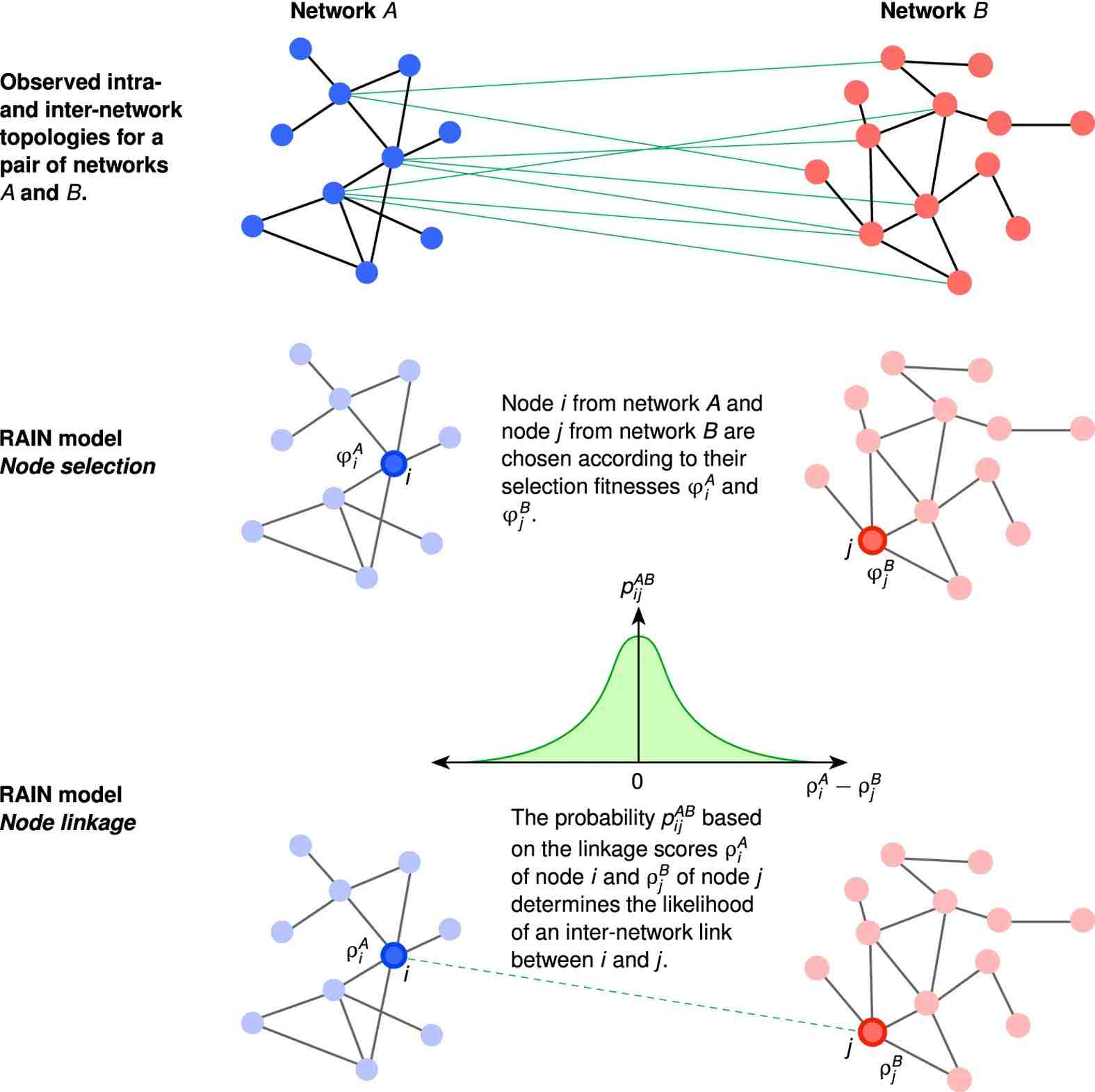 Fig.1 Schematic of the RAIN model showing observed networks A and B (top) and inferred inter-network links from intra-network features. (Goswami B, et al., 2015)
At SysMathx, we offer comprehensive network system modeling workflows spanning structure inference, graph-based characterization, dynamic identification, and spatiotemporal modeling. All services are adapted to the underlying interconnection topology, data regime, and analytical objectives. Our framework further incorporates statistical modeling and nonlinear system identification capabilities.
| Services | Capabilities |
|---|---|
|
Graph-Based Regression&Propagation Modeling
|
For systems where the network structure is known, we build graph-based regression models that capture how quantities propagate through connections. These models respect the underlying topology and are suitable for influence propagation, spatial dependence, and network autoregressive processes.
|
|
Network Structure Inference from Nodal Data
|
When the network connectivity is unknown but nodal data are available, we infer the underlying graph structure from observations. This reveals hidden dependencies and causal relationships among nodes without requiring prior knowledge of connections.
|
|
Dynamic Network Identification
|
When network structure or node dynamics change over time or with operating conditions, we build dynamic network models. These capture how influence patterns shift in response to external drivers or system evolution.
|
|
Spatial-Temporal Graph Models
|
For systems with both spatial(network) and temporal dependencies, we build spatial-temporal graph models. These are ideal for sensor networks, traffic systems, climate monitoring, and other applications where time and network structure interact.
|
Network System Modeling Methods and Tools
Our work focuses on representing and analyzing systems where interactions between components play a central role. Different modeling strategies are applied depending on how relationships are observed, how the system structure is defined, and how information flows across the network.
Applications of Network System Modeling Services
Network system modeling is applied across domains where interactions between components determine overall system behavior — from infrastructure networks to biological systems and distributed sensing. The following examples illustrate typical use cases.
Power Grid Cascade Analysis
A system-level representation is used to study how transmission line outages affect power redistribution across the grid. This helps identify critical connections whose failure may lead to cascading disruptions and supports grid reliability planning and contingency assessment.
Traffic Flow Prediction on Road Networks
Road segments are represented as interconnected units where congestion in one area influences surrounding routes. This enables spatiotemporal understanding of traffic dynamics and supports real-time travel time estimation and transportation management.
Brain Connectivity Analysis
Relationships between brain regions are inferred from synchronized activity patterns during cognitive processes. This provides a structured view of functional organization and supports comparison of connectivity patterns under different conditions.
Supply Chain Disruption Propagation
Dependencies between suppliers and manufacturers are represented to understand how delays or shortages spread through the system. This helps locate critical nodes and evaluate alternative supply pathways for resilience planning.
Sensor Network Calibration and Fault Detection
Measurements from distributed sensors observing the same environment are compared to identify inconsistent behavior. This supports detection of abnormal sensor readings and improves overall measurement reliability.
Ecological Species Interaction Networks
Relationships among species are inferred from population dynamics data. This helps describe how changes in one species influence others and supports analysis of ecosystem stability and balance.
Why Choose Our Network System Modeling Services?
- Topology-Consistent Modeling – System representations are constructed to align with the actual network structure, whether it is provided directly or derived from observed data. This ensures that all interactions are consistent with the underlying connectivity of the system.
- Scalable Network Processing – The modeling framework is designed to support large-scale systems with high numbers of interacting components by using efficient computational representations that reduce complexity while preserving key structure.
- Coupled Structure–Behavior Representation – System connectivity and dynamic behavior are treated as a unified process, allowing interaction pathways and temporal evolution to be analyzed together rather than separately.
- Explainable Network Outputs – Model results highlight key interaction pathways, influential components, and propagation patterns, enabling clearer interpretation of how system behavior emerges from network structure.
- Robustness to Imperfect Data – The framework is designed to work under incomplete, noisy, or partially observed conditions, where measurements may not fully capture all system components or interactions.
- Problem-Specific Adaptation – Modeling strategies are selected and adjusted based on whether the system is static or evolving, fully observed or partially known, and directed or undirected in nature.
Start Your Network System Modeling Project Today!
Have a system where components interact — but unsure how to model those dependencies? Let us help you build network models that capture influence, propagation, and interdependence. Contact uswith a description of your system structure and available data, and our modeling team will propose a tailored approach. We focus on turning complex interactions into clear, structured network representations that support better analysis and practical decision-making.
FAQs
Do I need to know the network structure in advance?
Not necessarily. If the graph is known from design documents or physical connections, we can incorporate it directly. If unknown, we can infer network structure from nodal observations — though some experimental design or perturbations may be needed to distinguish correlation from causation.
How large of a network can you handle?
For static networks, methods scale to tens of thousands of nodes with sparse connections. For dynamic network identification, typical sizes range from tens to a few hundred nodes depending on time-series length and complexity.
What types of node data do you work with?
Continuous measurements (sensor values, flows), discrete events (faults, alarms), counts (traffic volume, neuron spikes), or categorical states (on/off, open/closed). Mixed data types can be handled with appropriate likelihood models.
Can you model networks where connections have time delays?
Yes. Time-delayed influences can be captured using lagged variables in network autoregressive models, or through transfer entropy and Granger causality with lag selection.
What is the difference between network modeling and multivariate time series analysis?
Multivariate methods treat all variables as equally related. Network modeling imposes or infers a sparse structure that reflects the actual interconnection topology, leading to more interpretable and often more parsimonious models, especially when the number of variables is large relative to data length.
Reference
- Goswami B, et al. A random interacting network model for complex networks. Scientific reports. 2015, 5(1): 18183.