
Bond Graph Modeling Services
Modeling systems that span mechanical, electrical, hydraulic, and thermal domains is essential for modern industrial automation. Traditional block-diagram approaches often obscure energy interactions, leading to integration challenges and inefficiencies. SysMathx provides bond graph modeling services using a unified power-flow framework to clearly represent energy exchange and ensure physically consistent, robust digital models.
Harnessing the Power of Unified Physical Representation
Traditional modeling approaches such as block diagrams or signal-flow graphs often overlook the crucial loading effects that emerge when physical systems interact. Bond graph modeling overcomes this limitation by treating energy as the universal currency of system dynamics.
- Thermodynamic Rigor: Bond graphs are constrained by the first and second laws of thermodynamics, ensuring energy conservation and physical consistency in simulation.
- Structural Insight: The graphical structure reflects system architecture, enabling identification of energy flow paths, bottlenecks, and dissipation regions.
- Computational Efficiency: Causality is determined in advance, reducing algebraic loops and improving numerical stability in complex simulations.
- Seamless Domain Integration: A unified set of elements supports electrical, mechanical, hydraulic, thermal, and acoustic systems within one framework.
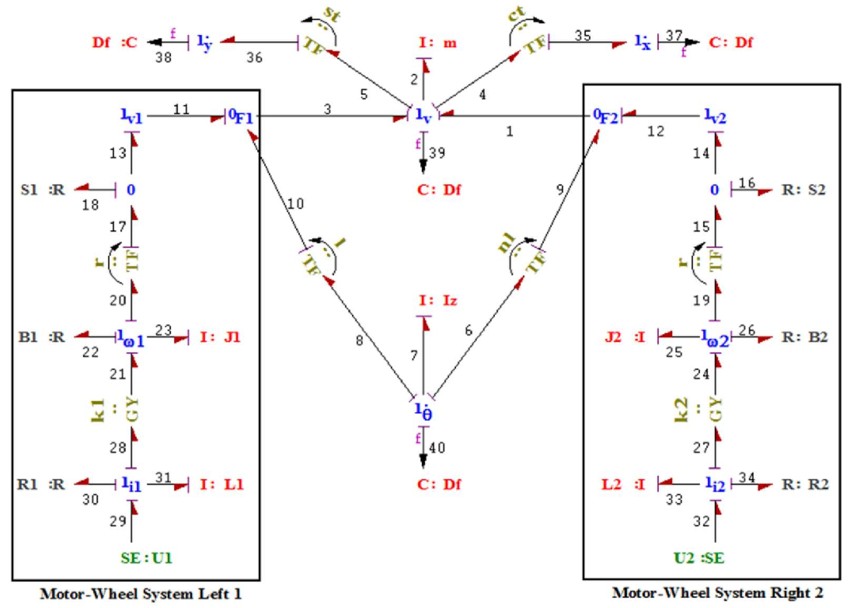 Fig.1 Bond graph model dynamics of the considered mobile robot. (Joshi J, et al., 2023)
SysMathx provides a comprehensive suite of bond graph modeling services tailored to complex multi-domain systems. Our offerings are structured according to both the depth of analysis and the specific stages of the product development lifecycle. This ensures flexible support from early-stage design through detailed analysis and system optimization.
Multi-Domain Architecture Design and Synthesis
We construct a unified energetic architecture for complex multi-domain systems, ensuring consistent interaction across mechanical, electrical, hydraulic, and thermal components. This approach enables modular design, seamless integration, and scalability throughout the development lifecycle. By explicitly modeling energy exchange, we reduce integration risks and improve system-level performance.
- Subsystem Decomposition: Break down complex assemblies into modular energy ports, enabling independent modeling of motors, gearboxes, sensors, and actuators.
- Transducer Modeling: Develop transformer and gyrator elements to accurately represent cross-domain energy conversion.
- Parasitic Effect Integration: Incorporate higher-order effects such as fluid compressibility, structural flexibility, and electromagnetic interference.
- Interface Standardization: Define rigorous power-port interfaces to ensure compatibility and reusability of components.
Advanced Dynamic Derivation and State-Space Analysis
We translate graphical bond graph models into rigorous mathematical representations that serve as high-performance analytical engines. This enables full transparency of system dynamics and avoids reliance on black-box simulation tools. The resulting models support stability analysis, control design, and performance evaluation.
- Symbolic Equation Generation: Derive nonlinear first-order differential equations in state-space form.
- Causality Conflict Resolution: Identify and resolve derivative causality issues using structured procedures.
- Eigenvalue and Stability Assessment: Analyze system stability, resonances, and damping characteristics.
Energy-Shaping and Passivity-Based Control
We leverage the inherent energy structure of bond graph models to design control strategies that are stable by construction. This energy-based perspective ensures robustness under nonlinear and uncertain operating conditions. It also enables more efficient and physically meaningful control solutions.
- Hamiltonian-Based Control: Design control laws based on total system energy to guarantee stability.
- Virtual Energy Storage Design: Introduce virtual storage elements to shape dynamic response.
- Energy-Optimal Path Planning: Compute trajectories that minimize total energy consumption.
Diagnostic Modeling and Failure Mode Simulation
Our bond graph models provide deep visibility into internal energy flows, enabling precise diagnostics and failure analysis. We use this approach to identify inefficiencies, predict faults, and evaluate long-term system behavior. This supports our reliability engineering and predictive maintenance strategies in complex systems.
- Efficiency Mapping: Trace power flow to quantify losses due to friction, leakage, or resistance.
- Fault Signature Identification: Simulate failure scenarios to identify diagnostic signatures.
- Degradation Modeling: Incorporate time-varying parameters to capture wear and aging effects.
- Thermal-Fluid Coupling: Model heat transfer associated with energy dissipation for thermal safety analysis.
Bond Graph Modeling Methods
Our modeling approach is rooted in the sequential energetic paradigm, prioritizing the conservation of energy as the governing principle for system accuracy. By resolving computational causality during the modeling phase, we deliver high-performance mathematical engines that are inherently stable and ready for real-time simulation.
Applications of Bond Graph Modeling Services
Electric and Hybrid Powertrains
Our services model the complete energy flow from the high-voltage battery through power electronics to the electric motor and mechanical drivetrain. We capture energy conversion losses, coupling effects, and dynamic interactions across subsystems.
Precision Robotics and Haptics
Our services model detailed energy interactions within robotic systems, including joint inertia, friction, compliance, and actuator dynamics. We capture force transmission and motion response to support accurate system-level behavior representation.
Aerospace Flight Control Systems
Our services model the interactions between electrical, hydraulic, and mechanical subsystems within integrated flight control architectures. We analyze energy flow, dynamic coupling, and system response under varying flight conditions.
Offshore Renewable Energy
Our services model energy conversion processes in systems such as wind turbines and wave energy converters from environmental inputs to electrical outputs. We capture dynamic loading, structural damping, and energy dissipation under highly variable offshore conditions.
Advanced Manufacturing and Hydraulics
Our services model fluid power systems to capture pressure dynamics, flow transients, and energy losses in hydraulic machinery. This enables us to analyze system responsiveness, stability, and efficiency for hydraulic and manufacturing applications.
Battery Thermal Management Systems
Our services model coupled electrochemical and thermal behaviors in lithium-ion battery systems using energy-based approaches. We analyze heat generation, transfer, and dissipation under varying loads and environmental conditions to support thermal stability and safety evaluation.
Advantages of Our Bond Graph Modeling Services
- We know how fluid, solid, and electromagnetics work together to accurately represent complex multi‑domain systems.
- Energy conservation is strictly enforced, giving you physically reliable models for high‑fidelity simulation and digital twins.
- Models stay flexible and reusable, making it easy to adapt when your system config or hardware evolves.
- Deployment‑ready models are optimized for real‑time execution on embedded controllers and FPGA platforms.
- Full documentation of governing equations and model structure gives you complete visibility, traceability, and intellectual ownership.
Start Your Bond Graph Modeling Project!
Ready to eliminate the guesswork from multi-domain engineering projects? Start your bond graph modeling journey with SysMathx today and gain a clear, energy-based understanding of complex systems. Whether in early R&D or addressing field challenges, contact us to discuss how our modeling services can support accurate analysis, reliable design, and informed decision-making.
FAQs
How does Bond Graph modeling differ from Block Diagrams?
Unlike block diagrams, which represent signal flow and assume one-way cause and effect, Bond Graph modeling represents energy exchange between system components. This allows interactions to be bidirectional, meaning loading effects between components are naturally captured. As a result, bond graphs provide a more physically consistent representation of real engineering systems.
Can Bond Graphs handle non-linear systems?
Yes, bond graph modeling can effectively represent nonlinear systems through flexible constitutive relationships for energy storage, dissipation, and transformation elements. Nonlinear behaviors such as variable stiffness, flow-dependent resistance, and state-dependent dynamics can be directly incorporated. This makes it suitable for accurately modeling complex real-world physical processes.
What is causality in a Bond Graph?
Causality defines the direction of computation between effort and flow variables within each bond. It determines which variable is treated as input and which is derived as output for each component. Proper causality assignment ensures that the system equations remain mathematically consistent and solvable in simulation.
For which industries is this service most beneficial?
Bond graph modeling is most beneficial for industries involving tightly coupled physical systems such as automotive, aerospace, robotics, and energy systems. It is particularly useful where mechanical, electrical, hydraulic, and thermal domains interact within one system. These applications require accurate energy-based modeling for design, analysis, and optimization.
Reference
- Joshi J, et al. Bond graph model-based control of a wheeled mobile robot[C]//2023 5th International Conference on Power, Control & Embedded Systems (ICPCES). IEEE. 2023: 1-6.