
Energy Solutions Based on Advanced Mathematical Analysis and Modeling
Energy systems come with a lot of complex physics including fluid flow, heat transfer, structural dynamics, and multiphase interactions. These processes usually follow partial differential equations, nonlinear dynamics, and uncertainty quantification. Traditional engineering methods often have a hard time capturing all this complexity. SysMathx steps in with energy solutions grounded in mathematical analysis and modeling. We turn real energy phenomena into computable models that you can actually simulate, analyze, and optimize.
Why Energy Needs Advanced Mathematical Analysis
The energy industry is under pressure to deliver efficiency, safety, and environmental compliance. Renewables come with intermittency and variability. Nuclear systems demand near perfect reliability. Oil and gas operations face tricky subsurface conditions. Environmental risks call for accurate predictions of how contaminants move and how ecosystems get affected.
- Simulating physical processes: Differential equations are used to model fluid flow, heat transfer, and structural behavior for numerical analysis.
- Predicting system performance: Simulation shows how an energy system will behave early on under all kinds of operating conditions.
- Quantifying risks: Uncertainty in geological formations, weather patterns, and material properties is analyzed to figure out safety margins.
- Optimizing designs: Mathematical models help find the best operating parameters and system configurations.
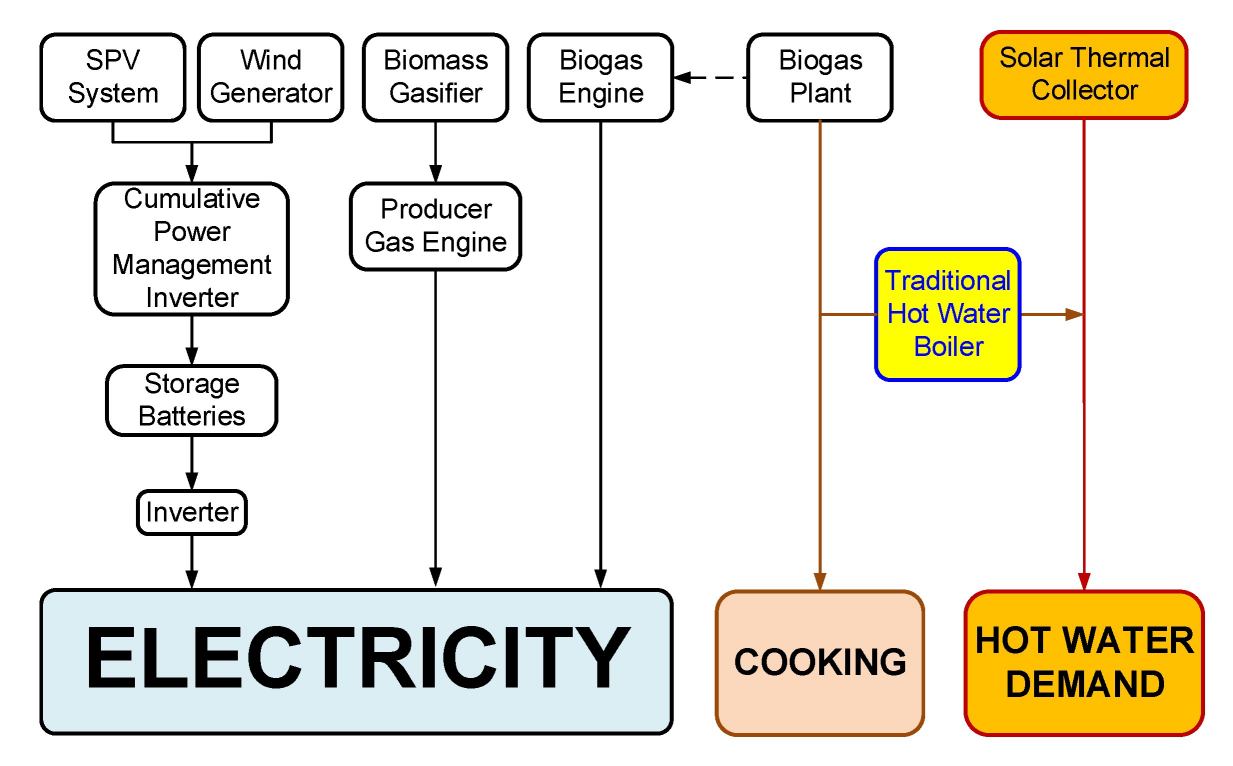 Fig.1 Diagram of the smart integrated renewable energy system. (Gómez Sánchez M, et al., 2020)
SysMathx delivers energy solutions built on advanced numerical analysis and mathematical modeling. We work across multiple domains including renewable energy, nuclear power, oil and gas, and environmental risk management. Our methods are designed to support system level modeling and simulation of complex energy systems, optimize performance, and guide smarter decisions under uncertainty.
Renewable Energy Modeling
Wind farms, solar plants, and hydroelectric facilities are subject to high levels of variability and uncertainty. Our modeling and analysis methods provide predictions of resource availability, system response, and grid integration performance. This results in more reliable and efficient operation of renewable energy systems.
| Solutions | Description |
|---|---|
| Wind Resource Assessment | Modeling wind speed distributions, turbulence intensity, and wake effects is where our methods contribute to optimized turbine placement and improved energy yield prediction. |
| Solar Irradiance Prediction | When it comes to solar energy, our analyses focus on solar radiation variability, cloud cover, and temperature effects to enhance photovoltaic system performance forecasting. |
| Hydropower System Modeling | For hydropower, we simulate reservoir inflow, water level dynamics, and turbine response. This work supports optimal dispatch and flood control strategies. |
| Grid Integration Analysis | Our approaches also evaluate the impact of renewable variability on grid stability, frequency regulation, and energy storage requirements. |
Nuclear Power Modeling
The highest levels of safety and reliability are demanded by nuclear power systems. Reactor physics analysis, thermal hydraulic simulation, and accident scenario evaluation all rely on our mathematical modeling methods. These methods are designed to ensure safe and efficient operation, with reduced uncertainty.
| Solutions | Description |
|---|---|
| Neutronics and Reactor Physics | Our modeling methods are used to solve neutron transport equations, which then allow us to analyze flux distributions, track fuel burnup, and evaluate reactivity control strategies. |
| Thermal-Hydraulic Simulation | Coolant flow, heat transfer, and two phase phenomena inside reactor cores and cooling circuits are all modeled using simulation approaches that were developed by our team. |
| Accident and Transient Analysis | Loss of coolant accidents, reactivity insertion events, and other off normal conditions are simulated with our analysis framework, and the results help support safety assessment through our methods. |
Oil and Gas Modeling
Subsurface flow, multiphase transport, and surface facility dynamics all contribute to the complexity of oil and gas operations. Our solutions are supported by mathematical modeling to optimize recovery, reduce operational risks, and extend asset life. These methods also enhance efficiency and ensure safety throughout the process.
| Solutions | Description |
|---|---|
| Reservoir Simulation | We solve multiphase flow equations in porous media with our advanced modeling methods. This allows us to predict how oil, gas, and water move over time in an efficient manner. |
| Wellbore and Pipeline Flow | Our advanced computational approaches are used to model pressure drop, temperature profiles, and flow regime transitions in wellbores and pipelines. This gives us accurate system level analysis. |
| Hydrate and Wax Deposition | To prevent critical flow assurance issues in complex operational environments, we analyze phase behavior and deposition mechanisms within our robust framework. |
| Production Optimization | We also integrate reservoir, well, and facility models using our optimized solutions. The goal is to maximize recovery while minimizing overall operating costs effectively. |
Environmental Risk Modeling
Energy projects face environmental risks that include contaminant release, ecosystem disruption, and long term liability. Our mathematical analysis supports risk assessment and mitigation planning, all while improving predictive accuracy and reducing uncertainty across all operational phases.
| Solutions | Description |
|---|---|
| Contaminant Transport Modeling | Solving advection-diffusion-reaction equations with our methods to predict pollutant movement in air, water, or soil while enhancing accuracy and reducing computational cost significantly. |
| Ecosystem Impact Assessment | Modeling population dynamics, food web interactions, and habitat changes under different scenarios using our approach to support better decisions and protect biodiversity effectively. |
| Spill and Release Simulation | Analyzing the spread and fate of oil spills, chemical releases, or radionuclides in the environment with our tools to improve response strategies and minimize long-term ecological damage. |
| Long-Term Risk Quantification | Evaluating uncertainty in environmental parameters with our framework to estimate probabilities of exceedance and liability while strengthening confidence in financial planning. |
Our Methods for Solving Energy Systems Complexity
SysMathx combines advanced mathematical analysis, uncertainty quantification, and domain-specific physics to deliver energy solutions from problem formulation to simulation and optimization. Our approach focuses on computational rigor and practical applicability. Our solutions support improved decision-making in complex energy systems.
Applications of Energy Solutions
SysMathx applies advanced mathematical analysis and modeling across renewable energy, nuclear energy, oil and gas, and environmental risk management domains. Our solutions support system optimization, performance prediction, and risk-informed decision-making for complex energy systems.
Wind Farm Development
Wind farm performance depends on complex interactions among turbines, terrain, and atmospheric conditions. We model wind resource distributions, wake effects, and turbine dynamics to optimize layout and predict annual energy production. Uncertainty in wind patterns is quantified to provide reliable confidence intervals for investors and operators.
Solar Power Plant Optimization
Photovoltaic and concentrated solar power plants are sensitive to irradiance, temperature, and soiling effects. We develop irradiance prediction models and thermal simulations to optimize panel orientation, cleaning schedules, and storage dispatch. These models help maximize energy capture and reduce operational costs.
Nuclear Reactor Safety Analysis
Nuclear safety requires rigorous analysis of normal, off-normal, and accident conditions. We apply neutronics and thermal-hydraulic models to simulate reactor behavior under various scenarios. These simulations support safety case development, and operational procedure optimization.
Oil Reservoir Management
Effective reservoir management requires understanding of multiphase flow, rock properties, and well interactions. We build reservoir simulation models to predict recovery under different production strategies. These models help operators choose infill drilling locations, injection schemes, and pressure management approaches.
Pipeline Flow Assurance
Oil and gas pipelines face flow assurance risks from hydrates, wax, and scale deposition. We model multiphase flow, temperature profiles, and phase behavior to predict deposition risks and design mitigation strategies. This reduces unplanned shutdowns and extends pipeline life.
Environmental Impact Assessment
Energy projects must comply with environmental regulations and manage long-term liability. We model contaminant transport in air, water, and soil to predict the consequences of potential releases. Uncertainty in environmental parameters is quantified to support risk-based decision-making.
Advantages of Our Energy Solutions
- Domain-specific physics expertise: Deep understanding of the mathematical foundations behind renewable, nuclear, oil and gas, and environmental systems
- Rigorous mathematical methods: Application of validated and verified computational techniques for reliable predictions
- Uncertainty quantification: Systematic handling of geological, meteorological, and material uncertainties that affect energy system performance
- Practical engineering focus: Models and simulations designed to support real operational decisions, not just academic exercises
- Deliverable models and code: All models come with documentation and code that clients can run and adapt internally
- Cross-disciplinary integration: Ability to couple thermal, fluid, structural, and geophysical models for comprehensive system analysis
Start Your Energy Modeling and Optimization Project!
Whether your project involves wind farm optimization, nuclear safety analysis, reservoir simulation, or environmental risk assessment, SysMathx provides energy solutions based on advanced mathematical analysis and modeling. We help energy companies turn physical problems into computable models. Through simulation, analysis, and optimization, we improve system performance and reduce operational risks. Contact us to discuss your energy challenges and analysis needs.
FAQs
What practical problems can advanced mathematical analysis solve for energy companies?
It can address wind farm layout optimization, solar power generation forecasting, nuclear reactor safety analysis, reservoir production optimization, pipeline flow assurance, and environmental impact assessment. These methods convert complex physical processes into computable models to improve efficiency and reduce risk.
What data is required to start an analysis?
System geometry, material or geological properties such as permeability and thermal conductivity, operating conditions, and experimental or field data are typically required for model calibration. More complete datasets generally lead to higher model accuracy and more reliable predictions.
How is model accuracy validated?
Validation is performed by comparing simulation results with experimental data, field measurements, or benchmark cases from published studies. Model applicability and error ranges are clearly defined to ensure reliability and transparency.
Can these models handle uncertainty?
Uncertainty quantification methods are used to evaluate the impact of geological conditions, weather variability, and material properties on system behavior. Results are provided as statistically meaningful confidence intervals to support robust decision-making.
Can the delivered models be used internally?
All delivered models and code packages include complete documentation for independent use within your organization. Engineering teams can run, modify, and extend them without relying on continuous external support.
Can you optimize existing energy systems?
Historical data and physics-based models are combined with mathematical optimization techniques to identify optimal operating strategies. This improves system efficiency, reduces operational costs, and enhances overall performance.
Reference
- Gómez Sánchez M, et al. A mathematical model for the optimization of renewable energy systems. Mathematics. 2020, 9(1): 39.