
Sensitivity Analysis in Mathematical Systems
Sensitivity analysis examines how variations in system inputs influence outputs, providing a structured way to understand parameter importance, system dependencies, and performance variability. SysMathx offers sensitivity analysis services that help quantify influence mechanisms, identify critical parameters, and support robust engineering design under changing conditions. Our approach transforms complex mathematical systems into interpretable sensitivity relationships for optimization, reliability, and decision support.
How Sensitivity Analysis Works in Mathematical Systems and Why It Matters
In engineering and physical systems, small parameter variations can significantly affect system behavior, performance, and reliability, making it essential to understand how inputs influence outputs. Sensitivity analysis provides a mathematical basis for quantifying these effects, revealing key dependencies and supporting more robust, reliable, and optimized system design under uncertainty and real-world variability.
- Influence understanding: Identifies which parameters most strongly affect system outputs and performance behavior.
- Robust design support: Helps develop systems that maintain stability under parameter variations.
- Risk reduction: Detects critical parameters that may lead to instability or failure.
- Decision support: Provides quantitative guidance for optimization, control, and engineering decisions.
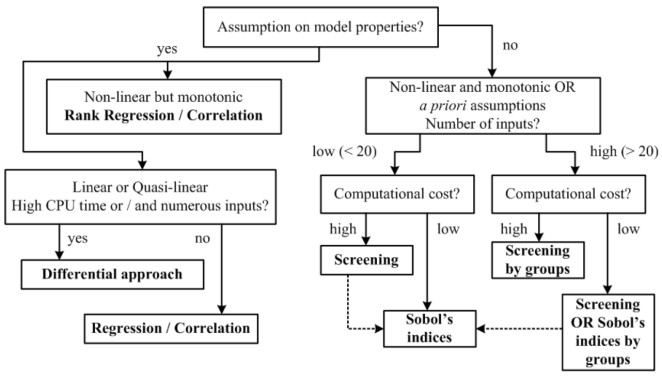 Fig.1 Brief classification of sensitive analysis techniques. (Sysoev A., 2023)
SysMathx provides comprehensive sensitivity analysis services that quantify how system parameters influence behavior, stability, and performance. Our services integrate mathematical modeling, differential techniques, and variance-based methods to extract actionable insights from complex systems. We focus on identifying critical drivers, evaluating interaction effects, and supporting robust engineering decisions across multiple domains.
Parameter Sensitivity Evaluation
We evaluate how individual parameters affect system outputs by systematically analyzing variation effects across operating conditions and real-world scenarios. This method helps reveal which parameters have dominant influence on system behavior and performance.
Our analysts use these results to identify high-impact variables and support targeted design optimization. This enables engineers to focus on the most influential factors affecting system reliability, efficiency, and long-term operational stability.
- Systematic variation of parameters to measure output response changes
- Identification of dominant influencing factors in system behavior
- Quantification of parameter impact on performance and stability
- Guidance for targeted optimization and engineering improvement
Output Gradient Analysis via Differential Methods
We compute sensitivity gradients using differential and adjoint-based mathematical techniques. This provides precise information on how small changes in inputs affect system outputs under varying operational conditions.
Our team uses gradient information to detect sensitive operating regions and critical response directions. These insights support fine-tuning of system parameters for improved stability, performance, and overall system reliability in practical applications.
- Gradient computation of outputs with respect to system parameters
- Differential analysis of local sensitivity behavior
- Identification of high-sensitivity operating regions
- Support for precise system tuning and optimization
Interaction Effect Analysis via Variance Decomposition
We apply variance-based decomposition methods to evaluate how multiple parameters interact to influence system behavior under different operating conditions. This approach reveals combined effects that cannot be captured by single-parameter sensitivity alone.
Our analysts use these results to understand complex parameter interactions and hidden dependencies within the system. This supports robust multi-variable design and improves system reliability under uncertainty and real-world variability.
- Decomposition of output variance into parameter contributions
- Identification of interaction effects between multiple variables
- Quantification of joint influence on system performance
- Support for robust multi-parameter optimization strategies
Our Methods of Sensitivity Analysis in Mathematical Systems
At SysMathx, we use a combination of mathematical and computational techniques to understand how system parameters affect performance, stability, and overall behavior. Our methods help identify key drivers of system response and support more reliable, robust engineering decisions under uncertainty and complex operational conditions.
Sensitivity Analysis of Mathematical Models
SysMathx evaluates how input variations influence system performance. Our insights help prioritize parameters, guide design, and improve reliability.
| Items | Descriptions |
|---|---|
| Physics-Guided System Models | We conducted sensitivity analysis on physics-guided system models to evaluate system dynamics, stability, and the influence of critical parameters. |
| Data-Driven System Models | We performed sensitivity analysis on data-driven system models to quantify input–output relationships and identify key dependencies. |
| Hybrid & Physics-Informed Models | We applied sensitivity analysis to hybrid and physics-informed models, combining physical principles with data-driven components. |
| Reduced-Order & Surrogate Models | We used sensitivity analysis on reduced-order and surrogate models for fast evaluation. These models efficiently highlight influential parameters while approximating complex system dynamics. |
| Complex Multi-Domain Models | We performed sensitivity analysis on complex multi-domain models to identify critical factors across coupled subsystems. The models reveal system-wide sensitivities to guide optimization. |
| Functional and Structural Models | We applied sensitivity analysis to functional and structural models to assess causal structures and energy flows. These models highlight bottlenecks and opportunities for system improvement. |
Applications of Sensitivity Analysis in Mathematical Systems
Aerospace and Space Systems
We evaluate variations in key parameters to assess their impact on flight stability, structural response, and mission reliability under operational and environmental conditions. Our results support safer designs and improved robustness in extreme aerospace environments, ensuring better performance.
Energy and Power Systems
We investigate how load fluctuations, resource changes, and operational conditions influence system efficiency and long-term stability across scenarios. This helps improve reliability, optimize energy usage, and support resilient power system operation under variable demands.
Robotics and Autonomous Systems
Effects of sensor noise, actuator variations, and control parameter changes are examined for motion accuracy, precision, and overall system stability. Our findings support improved control design, enhanced precision, and more reliable autonomous system performance in complex dynamic environments.
Environmental and Climate Systems
We assess how uncertainties in input parameters affect long-term system evolution, response, and behavior under changing environmental conditions. This enables better understanding of sensitivity patterns within complex, dynamic environmental and climate systems for improved prediction and management.
How We Work?
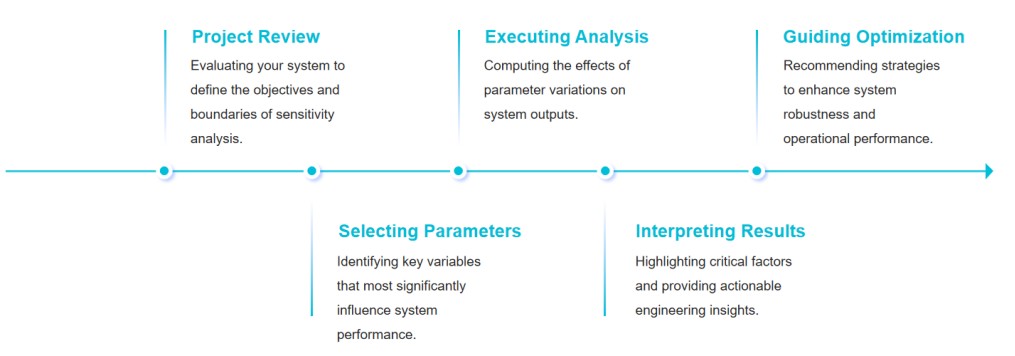
At SysMathx, we design, implement, and validate sensitivity analysis workflows tailored to your system specifications, data availability, and performance objectives. Our team integrates parameter evaluation, differential gradient analysis, and variance decomposition to quantify influence, detect critical factors, and optimize design decisions.
Start Your Sensitivity Analysis Project Today!
SysMathx offers sensitivity analysis services tailored to your system, so you can understand how it behaves, identify which parameters matter most, and improve engineering performance. Share your system details, design goals, or operational data with us, and our team will build a sensitivity analysis framework that fits your needs, so please contact us to see how we can help improve system reliability and optimize your design process.
FAQs
What information is needed to start a sensitivity analysis?
Typically, basic input parameters, output definitions, and operating conditions are sufficient to begin sensitivity analysis. Even incomplete datasets can be used as a starting point for evaluation in many practical engineering cases. Additional information can be incorporated later to refine accuracy and depth of results significantly, depending on system complexity and objectives.
How long does a sensitivity analysis usually take?
The duration depends on system complexity, number of parameters, and data availability for reliable evaluation. Simple systems can be evaluated quickly, while complex multi-domain systems require more time for detailed assessment and validation across multiple conditions. The process is scalable based on project requirements and available computational resources and constraints.
Can sensitivity analysis handle uncertain or noisy data?
Yes, sensitivity analysis can incorporate uncertain or noisy data effectively in real-world applications with proper handling. It helps identify stable patterns and reliable parameter influences despite variability and measurement imperfections in inputs and observations. This makes it suitable for real-world and imperfect data conditions encountered in practice across many domains.
What are the main outputs of sensitivity analysis?
Key outputs include parameter influence rankings, response trends, and identification of critical variables affecting system behavior. These results highlight how different inputs affect system behavior, stability, and overall performance under varying operational conditions. They provide a clear basis for engineering interpretation, optimization, and informed decision-making processes in system design.
Is sensitivity analysis only used during design stages?
No, sensitivity analysis is used across design, optimization, and operational phases throughout system development and application lifecycle. It supports both early-stage system development and ongoing performance monitoring, evaluation, and improvement in real applications. This makes it valuable throughout the entire system lifecycle in engineering practice and continuous system improvement.
Reference
- Sysoev A. Sensitivity analysis of mathematical models. Computation, 2023, 11(8): 159.