
Chaos & Complex Dynamics Services
Chaos and complex dynamics analysis focuses on understanding nonlinear systems that exhibit sensitive dependence on initial conditions, irregular trajectories, and emergent long-term behavior. These systems often evolve in unpredictable yet structured ways governed by underlying mathematical rules. SysMathx provides chaos and complex dynamics services to analyze chaotic motion, identify attractor structures, and evaluate long-term system evolution in nonlinear environments.
Why Perform Chaos & Complex Dynamics Analysis
Complex dynamic systems often generate behavior that appears random but is governed by deterministic nonlinear rules. Small variations in initial conditions can lead to significantly different outcomes, making prediction and control highly challenging. Chaos and complex dynamics analysis provides a structured way to understand these behaviors and reveal hidden order in nonlinear evolution.
- System trajectories may diverge significantly due to small initial variations
- Long-term behavior is often governed by strange attractors and nonlinear structures
- Predictability decreases while structural patterns still exist in phase space
- Nonlinear interactions generate emergent and multi-scale dynamic behavior
- Traditional linear analysis methods cannot fully describe chaotic evolution
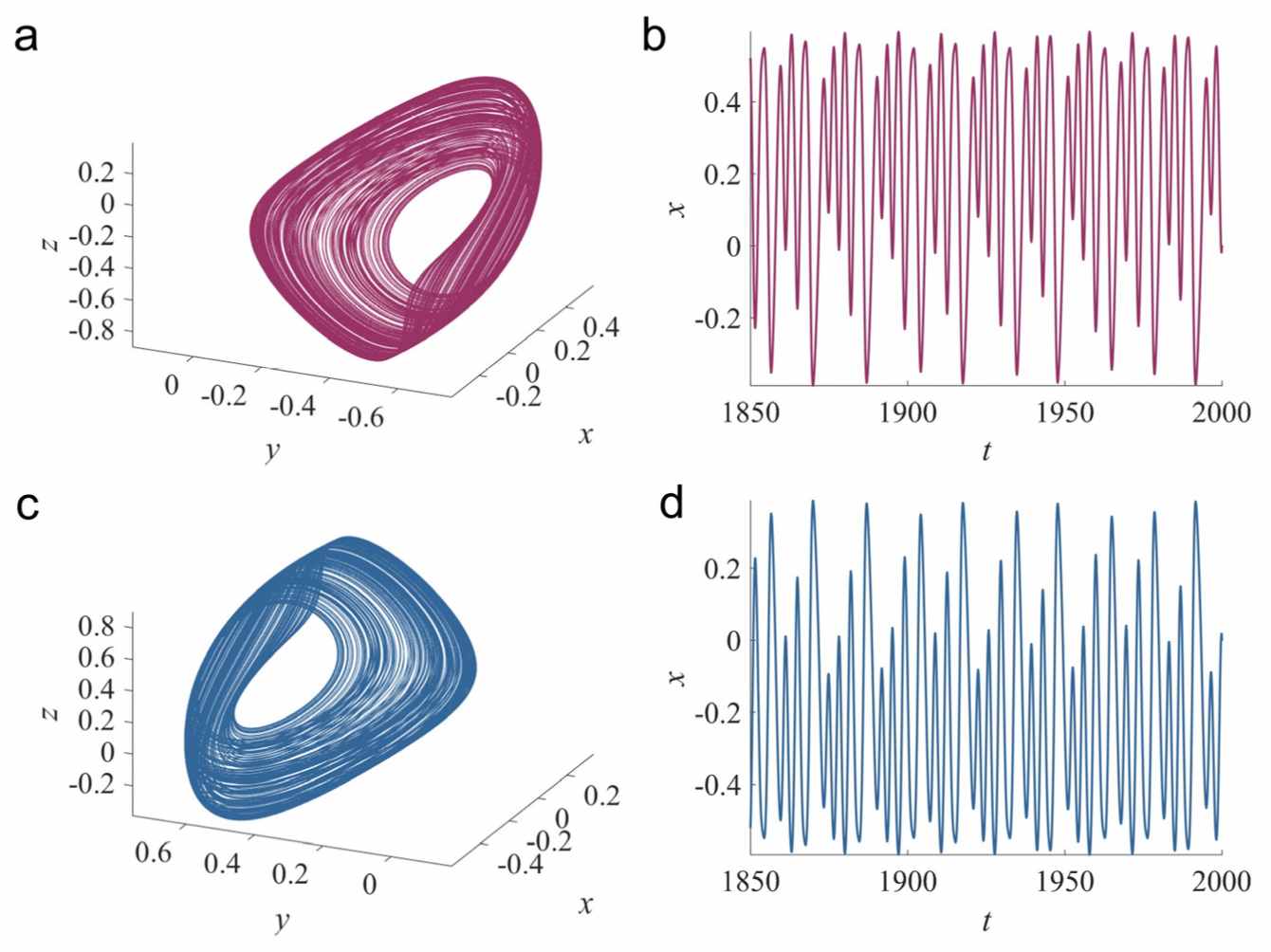 Fig.1 Quadratic-nonlinear chaotic system: dynamical properties and stability. (Almatroud O A, et al., 2024)
SysMathx delivers end-to-end chaos and complex dynamics analysis services that transform nonlinear system models into structured representations of chaotic behavior and dynamic evolution. The focus is on identifying attractors, sensitivity properties, and long-term behavior patterns under nonlinear interactions. These services support system characterization, stability interpretation, and complexity evaluation in advanced engineering and scientific systems across diverse application domains and scenarios.
Chaotic Trajectory & Sensitivity Analysis
SysMathx provides chaotic trajectory analysis service to examine how nonlinear systems evolve under extreme sensitivity to initial conditions. It enables identification of divergence patterns and irregular motion structures in state space. This service supports understanding of unpredictability and dynamic amplification effects in chaotic systems.
- Evaluation of trajectory divergence under infinitesimal initial variations in nonlinear dynamic systems over time evolution processes
- Identification of sensitive dependence on initial conditions in nonlinear systems with strong parameter coupling effects
- Characterization of irregular and aperiodic motion patterns occurring in complex chaotic dynamic environments
- Analysis of short-term predictability and long-term divergence behavior across evolving nonlinear state trajectories
- Mapping of chaotic evolution in multi-dimensional state space for complex system behavior interpretation and structural insight
Attractor Structure & Phase Space Reconstruction
We provide attractor analysis service to identify long-term geometric structures formed by chaotic systems. It enables reconstruction of phase space representations to reveal hidden order in complex dynamics. This service supports classification of strange attractors and nonlinear motion patterns.
- Reconstruction of phase space from nonlinear system trajectories using structured state variable evolution over time sequences
- Identification of strange attractors and invariant structures emerging from long-term nonlinear dynamic system evolution processes
- Analysis of long-term system convergence behavior in chaotic regimes with respect to stability and structural persistence properties
- Characterization of fractal-like geometric patterns in state space arising from repeated nonlinear dynamic interactions
- Evaluation of structural stability within attractor regions under varying initial conditions and parameter perturbations
Complex Dynamics & Long-Term Behavior Evaluation
SysMathx provides complex dynamics evaluation service to study long-term evolution of nonlinear systems with multiple interacting components. It focuses on emergent behavior, multi-scale interactions, and transition phenomena. This service supports interpretation of system evolution beyond periodic or stable regimes.
- Analysis of long-term nonlinear evolution patterns in dynamic systems with interacting variables and coupled state dependencies
- Identification of emergent behavior from interacting subsystems under nonlinear feedback and cross-domain coupling effects
- Evaluation of multi-scale dynamic interactions and transitions across different temporal and structural system levels
- Detection of regime shifts between order and chaos driven by parameter variations and internal nonlinear interactions
- Assessment of global system evolution under nonlinear coupling with emphasis on stability, structure, and long-term predictability properties
Our Methods for Chaos & Complex Dynamics Services
At SysMathx, our methods focus on capturing nonlinear chaotic behavior through structured computational and geometric analysis of dynamic systems. These approaches are designed to reveal sensitivity to initial conditions, long-term evolution patterns, and hidden attractor structures. By combining state-space reconstruction, iterative dynamics computation, and complexity mapping, our methods provide a consistent framework for analyzing chaotic systems. This supports deeper understanding of unpredictability and emergent behavior in nonlinear environments.
Applications of Chaos & Complex Dynamics Services
Chaos & complex dynamics services provided by SysMathx are applied to analyze how nonlinear systems behave under strong sensitivity, feedback interactions, and long-term evolution effects. These services help uncover hidden attractors, instability mechanisms, and transition behaviors that cannot be captured through standard linear or purely time-domain approaches. Across engineering and scientific domains, they support deeper understanding of system unpredictability and structural complexity.
Mechanical and Structural Systems
Our services are used to evaluate nonlinear vibration behavior, instability growth, and irregular oscillations in mechanical structures. They help identify conditions where small disturbances lead to large dynamic responses. This supports safer structural design and improved prediction of long-term mechanical performance under varying loads.
Electrical and Power Systems
We analyze nonlinear electrical behavior such as voltage instability, oscillatory currents, and chaotic responses in power networks. These services help detect transition points where stable operation may shift into instability. This enables improved reliability and better control of complex electrical systems under dynamic load conditions.
Control and Automation Systems
Our services support the analysis of feedback-controlled systems with nonlinear and sensitive dynamic responses. They help evaluate how small input variations affect overall system stability and trajectory evolution. This improves controller robustness and enhances performance in uncertain operating environments.
Thermal and Energy Systems
We apply chaos and complex dynamics methods to study irregular heat transfer, turbulence-like thermal behavior, and unstable energy distribution. These services help identify non-uniform temperature evolution and transition patterns. This supports improved thermal regulation and more efficient energy system design.
Multi-Domain Engineering Systems
Our services are applied to systems where mechanical, electrical, and thermal interactions create strongly coupled nonlinear dynamics. They help reveal emergent behavior resulting from cross-domain feedback effects. This enables more accurate system-level understanding and integrated performance optimization.
Industrial and Process Systems
We use these services to analyze nonlinear process fluctuations, operational instability, and irregular production dynamics. They help identify hidden inefficiencies and unstable operating regimes. This supports better process control, planning, and long-term operational stability.
Why Choose SysMathx for Chaos & Complex Dynamics Services?
- Nonlinear system behavior is modeled in a structured way across operating conditions for clearer system interpretation.
- Sensitivity analysis reveals how small changes affect long-term trajectories and stability in nonlinear systems.
- Attractor structures and hidden patterns are identified to explain system organization in state space.
- Results remain consistent across parameters, supporting reliable evaluation and engineering decisions.
- Outputs complement simulation and stability analysis for a more complete view of dynamics and transitions.
Start Your Chaos & Complex Dynamics Project!
SysMathx provides end-to-end chaos and complex dynamics analysis services to help you understand nonlinear behavior, sensitivity effects, and long-term system evolution. These services transform complex dynamic models into interpretable structural representations that reveal hidden patterns and instability mechanisms. By combining attractor analysis, sensitivity evaluation, and state-space methods, we deliver actionable insights for system design, validation, and optimization. Contact us to define your system requirements and begin your nonlinear dynamics analysis project.
FAQs
What types of systems are suitable for chaos & complex dynamics analysis?
Chaos and complex dynamics analysis is suitable for nonlinear systems that exhibit sensitivity to initial conditions and irregular behavior. It is widely applied in mechanical, electrical, thermal, control, and multi-domain engineering systems. These methods are especially useful when long-term behavior cannot be predicted accurately using linear approaches.
Do these services require a full mathematical model?
A complete model improves accuracy, but analysis can also be performed using partially defined or simplified system representations. The key requirement is that the system can be expressed in a structured dynamic form. Models can be refined later as more information becomes available.
Can chaotic behavior be predicted accurately?
Exact long-term prediction of chaotic systems is not possible due to extreme sensitivity to initial conditions. However, structural patterns such as attractors, stability regions, and statistical behavior can be reliably identified. This provides meaningful insight into system behavior even when precise trajectories diverge.
How is chaos identified in a system?
Chaos is identified through indicators such as sensitivity to initial conditions, Lyapunov exponents, and irregular trajectory evolution. Phase space reconstruction is also used to reveal attractor structures. These methods together help confirm the presence of chaotic dynamics.
Can these results be used with simulation or control systems?
Yes, chaos and complex dynamics results can complement numerical simulation and control system design. They help explain instability sources and nonlinear response behavior. This supports improved system robustness and more informed engineering decisions.
Reference
- Almatroud O A, et al. A novel chaotic system with only quadratic nonlinearities: analysis of dynamical properties and stability. Mathematics. 2024, 12(4): 612.