
Mathematical Simulation & Dynamical Evolution Analysis
Mathematical simulation & dynamical evolution analysis focuses on the rigorous mathematical study of how nonlinear dynamical systems evolve over time, state space, and parameter space. These systems are typically governed by differential equations, nonlinear mappings, and state-dependent evolution rules, which lead to complex and often non-intuitive global behavior. SysMathx provides structured mathematical simulation and dynamical evolution analysis services that transform complex system models into interpretable dynamic representations for stability evaluation, behavioral interpretation, and system-level prediction.
Why Perform Mathematical Simulation & Dynamical Evolution Analysis
Mathematical simulation & dynamical evolution analysis is essential for understanding systems whose behavior cannot be fully described using linear approximations or static models. In advanced mathematical systems, evolution is governed by nonlinear interactions, feedback structures, and high-dimensional state-space geometry. These properties make system behavior highly sensitive to initial conditions and parameter variations, requiring structured mathematical frameworks for proper interpretation.
Key advantages include:
- Capturing nonlinear evolution governed by differential and dynamical equations
- Identifying global behavior beyond local linear approximations
- Revealing stability structures and invariant geometric properties
- Understanding sensitivity-driven and parameter-dependent transitions
- Supporting rigorous analysis of long-term asymptotic behavior
- Enabling unified interpretation of numerical and qualitative dynamics
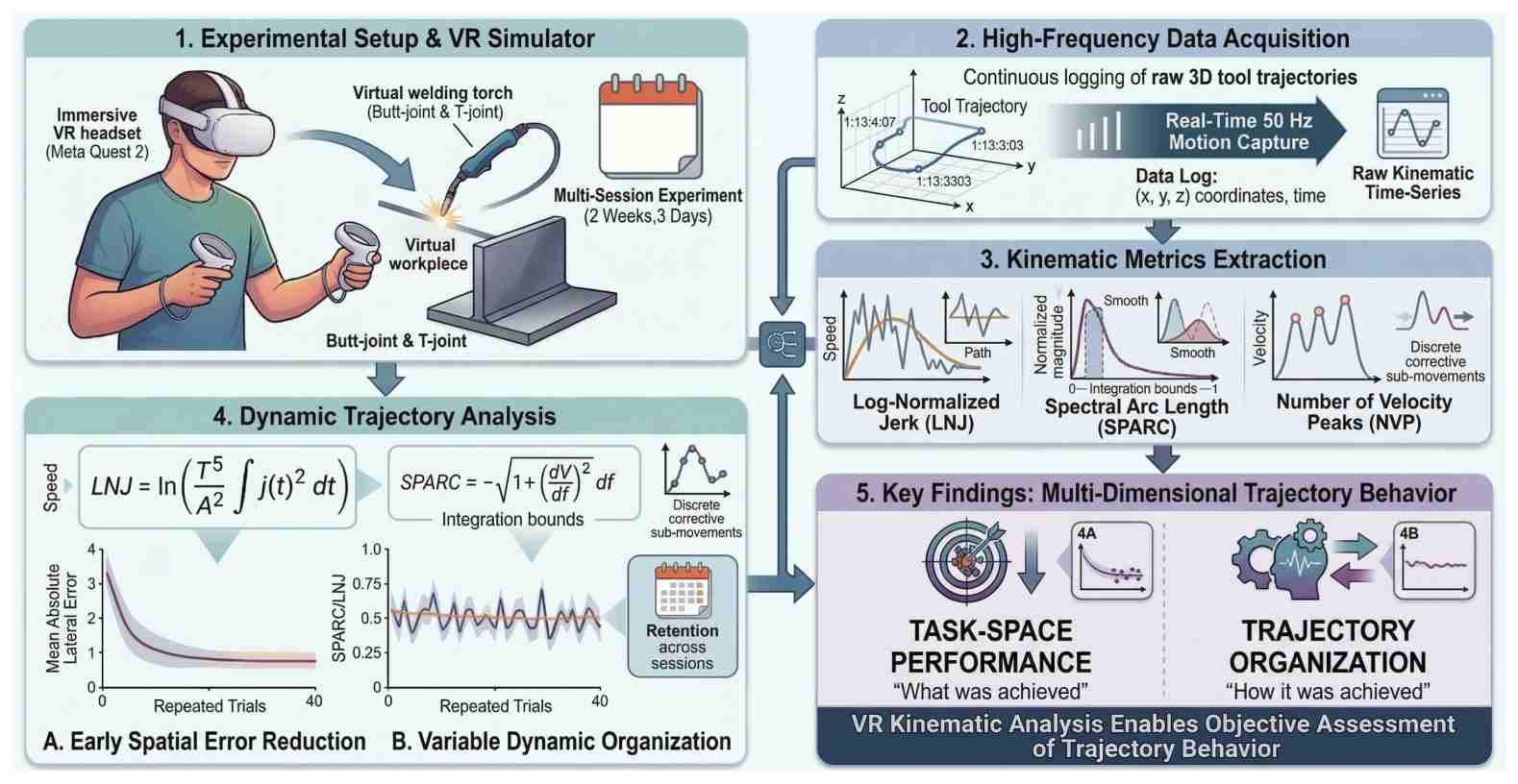 Fig.1 Mathematical modeling and dynamic trajectory analysis occur within the virtual reality welding simulator. (Koçak N F, et al., 2026)
At SysMathx, mathematical simulation & dynamical evolution services provide a structured framework for analyzing system behavior across time evolution, state-space geometry, and parameter-dependent dynamics. Each service is designed according to system structure, modeling requirements, and analytical objectives, ensuring adaptability across different levels of complexity and data availability. Our approach integrates numerical computation with mathematical interpretation of nonlinear systems to support understanding of system evolution, stability behavior, and dynamic regime transitions across diverse application domains.
Time-forward simulation services focus on modeling the temporal evolution of dynamical systems using differential equations and state-space representations. SysMathx provides structured simulation services that compute system trajectories step by step under specified initial conditions and input configurations. These services enable the evaluation of transient dynamics, steady-state behavior, and time-dependent system responses in nonlinear environments.
- Numerical integration of dynamical system equations for computing time evolution with stable numerical schemes.
- State trajectory computation over continuous or discrete time for describing complete system evolution paths.
- Analysis of transient and steady-state evolution behavior for understanding short-term dynamics and stability trends.
- Evaluation of input-driven dynamic responses under different excitation signals and operating conditions.
- Multi-condition time evolution simulation for comparing system behavior under varying parameters and initial states.
Phase & qualitative analysis services focus on the geometric and structural interpretation of dynamical systems in state space. Instead of relying only on time evolution, they analyze global system structures such as equilibrium points, attractors, and invariant manifolds. We provide structured phase and qualitative analysis services that extract state-space structures and interpret global system behavior through mathematical and geometric frameworks.
- Phase space reconstruction reveals global flow structure of dynamical systems.
- Equilibrium points and stability regions are identified to determine where system behavior converges, diverges, or remains invariant.
- Nonlinear behaviors are classified within state space to distinguish stable, oscillatory, and complex dynamic regimes.
- System flow is interpreted geometrically, invariance, and trajectory transformations.
- Long-term evolution patterns are extracted to understand asymptotic behavior and global system organization.
Bifurcation Analysis Services study how the qualitative behavior of dynamical systems changes when system parameters vary. They focus on detecting critical transitions where system stability or structure changes fundamentally. SysMathx provides structured bifurcation analysis services that investigate how parameter variations reshape system dynamics and stability structure.
- Critical parameter values are detected where qualitative changes in system behavior begin to occur.
- Stability properties are tracked across parameter variations to understand how equilibrium conditions evolve.
- Regime transitions between different dynamic behaviors are systematically characterized and compared.
- Different types of bifurcation phenomena are classified based on their local and global structural effects.
- Changes in system structure are mapped across parameter space to reveal underlying dynamic transitions.
Chaos & complex dynamics services focus on nonlinear systems that exhibit sensitive dependence on initial conditions and long-term unpredictability. These systems often show deterministic yet highly complex and irregular behavior patterns. We provide structured chaos and complex dynamics services that analyze unpredictable behavior and uncover hidden order within nonlinear dynamical systems. These services support the interpretation of complexity, emergence, and long-term structural evolution in chaotic regimes.
- Sensitivity to initial conditions is evaluated through trajectory divergence under small perturbations.
- Strange attractors and invariant structures are extracted to reveal geometric organization in chaotic systems.
- Long-term predictability limits are examined to understand how uncertainty grows over time in dynamics.
- Emergent behaviors arising from nonlinear interactions are analyzed to explain system complexity.
- High-dimensional chaotic structures are interpreted to describe their geometric and dynamic organization.
Mathematical Simulation & Dynamical Evolution Methods We Use
At SysMathx, we apply a structured set of numerical and analytical methods to study how dynamical systems evolve across time, state space, and parameter space. These methods combine mathematical modeling, computational simulation, and nonlinear system theory to ensure accurate representation of system evolution. Our approach ensures that all results remain consistent, interpretable, and suitable for advanced engineering and mathematical analysis.
| Items | Descriptions |
|---|---|
| Numerical Time Integration Method | We apply stable numerical integration schemes to solve dynamical system equations and compute time evolution with high precision. This method captures both continuous and discrete trajectories of system behavior across different time scales. It is used to support accurate simulation of transient responses and long-term dynamic evolution in nonlinear systems. |
| State Space Propagation Method | We propagate system states sequentially in state space based on governing equations and initial conditions. This method reconstructs complete evolution paths and reveals how system structure changes over time. It is used to analyze dynamic progression and state transitions in complex nonlinear systems. |
| Input-Driven Evolution Method | We incorporate external inputs and disturbances into system evolution to study forced dynamic responses. This method establishes the relationship between input variations, internal states, and output behavior. It is used to evaluate system sensitivity and response characteristics under varying operating conditions. |
| Parameter Evolution Simulation Method | We simulate system behavior under parameter variations to capture changes in dynamic regimes. This method reveals how structural behavior shifts across different configurations and control settings. It is used to study nonlinear transitions, stability variation, and regime changes. |
| Trajectory Reconstruction Method | We reconstruct continuous system trajectories from discrete simulation results in both time and state space. This method ensures consistent representation of dynamic evolution across computational steps. It is used to improve understanding of global system behavior and long-term evolution patterns. |
| Stability Evolution Analysis Method | We evaluate system stability across time and parameter changes using dynamic stability indicators. This method tracks convergence, divergence, and transition behavior throughout system evolution. It is used to identify stable and unstable operating regimes in nonlinear dynamical systems. |
Applications of Mathematical Simulation & Dynamical Evolution Analysis
Mechanical and Structural Systems
Our services are used to analyze vibration behavior, structural deformation, and dynamic stability in mechanical and structural systems. Time-dependent evolution of stress, displacement, and motion trajectories can be evaluated under varying loads and environmental conditions.
Electrical and Power Systems
We apply mathematical simulation and dynamical evolution analysis to study transient electrical behavior, power flow evolution, and stability transitions in electrical systems. Dynamic interactions between voltage, current, and control mechanisms can be interpreted through system evolution models.
Thermal and Energy Systems
Our services help evaluate temperature evolution, heat transfer dynamics, and energy distribution behavior in thermal and energy systems. Dynamic responses under changing operational and environmental conditions can be simulated and interpreted systematically.
Control and Automation Systems
We use dynamical evolution analysis to study feedback behavior, control response, and stability properties in automated systems. System trajectories and state transitions under control actions can be evaluated across different operating conditions.
Multi-Domain Coupled Systems
Our services are applied to systems involving coupled mechanical, electrical, thermal, and fluid interactions. Mathematical simulation enables interpretation of cross-domain dynamic dependencies and nonlinear evolution behavior.
Industrial and Process Systems
We analyze operational evolution, process stability, and dynamic transitions in industrial and manufacturing systems. System behavior under disturbances, parameter variations, and changing process conditions can be evaluated quantitatively.
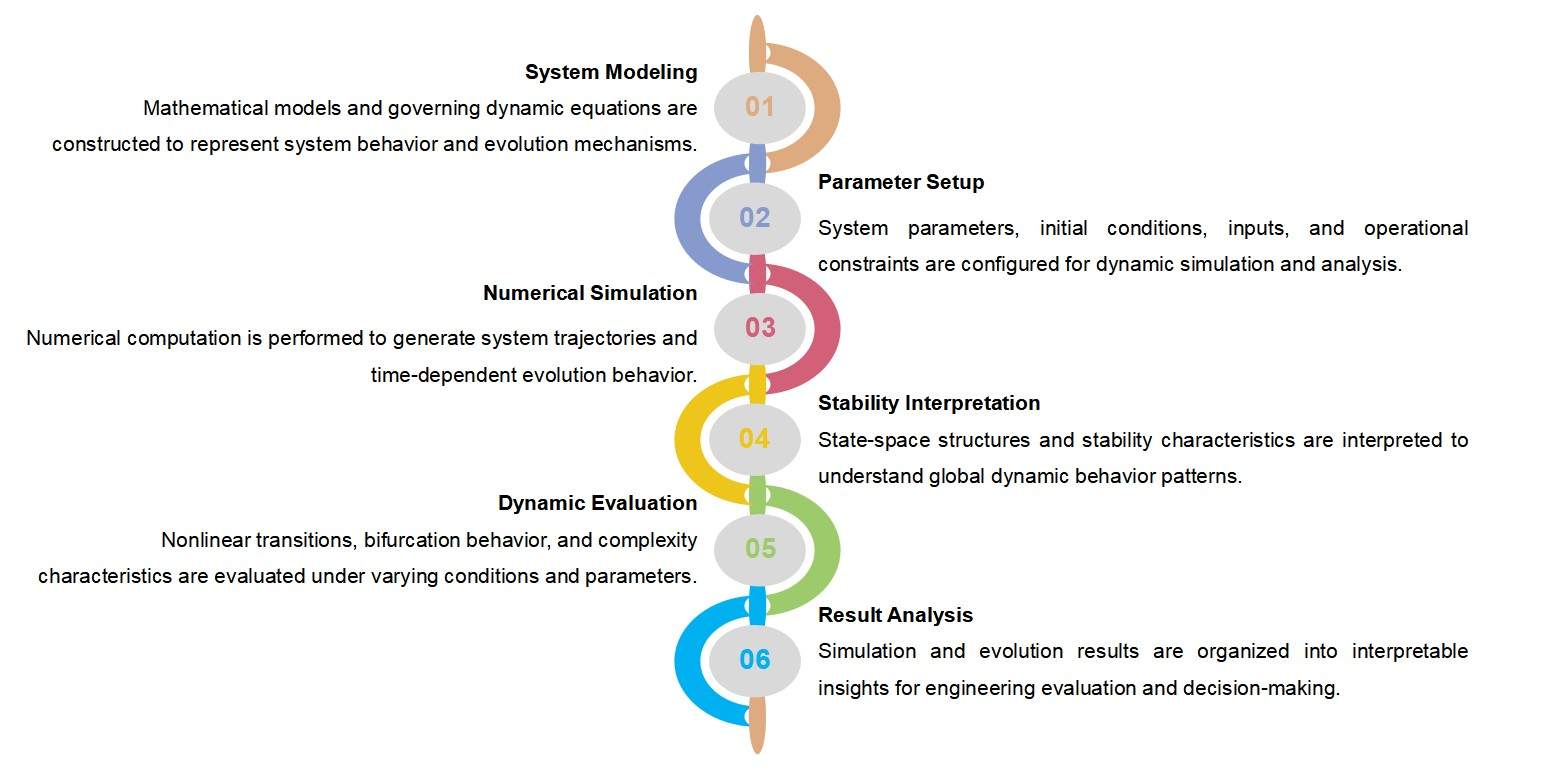
Workflow of Mathematical Simulation & Dynamical Evolution Analysis
Start Your Mathematical Simulation & Dynamical Evolution Analysis Project!
At SysMathx, we provide mathematical simulation and dynamical evolution analysis services to help interpret complex system behavior across time, state space, and nonlinear operating conditions. Our services integrate numerical simulation, stability evaluation, qualitative dynamics, bifurcation analysis, and complex system evolution to support engineering analysis and mathematical modeling. Contact us to discuss your system requirements and begin developing structured dynamic analysis solutions for advanced engineering and scientific applications.
FAQs
What types of systems are suitable for mathematical simulation & dynamical evolution analysis?
These services are suitable for systems governed by dynamic mathematical relationships and nonlinear interactions. They are widely applied to mechanical, electrical, thermal, industrial, and multi-domain engineering systems. The methods are especially useful for systems with time-dependent evolution, stability transitions, and complex dynamic behavior.
Can nonlinear systems be analyzed using these services?
Yes, nonlinear systems are a major focus of mathematical simulation and dynamical evolution analysis. The services support analysis of instability, bifurcation behavior, chaotic evolution, and complex state transitions. This enables deeper understanding of system behavior beyond linear approximations.
Does the analysis require complete mathematical models?
Complete mathematical models improve analysis accuracy and detail, but simplified models can also be used initially. System representations may be refined progressively as additional information becomes available. This allows flexible analysis across different stages of system development and engineering design.
What is the role of state-space analysis in dynamical evolution studies?
State-space analysis helps interpret how system variables evolve and interact within dynamic environments. It reveals structural properties such as equilibrium regions, attractors, and stability behavior. This provides a global understanding of system evolution beyond numerical trajectories alone.
Can these services support engineering design and optimization?
Yes, the results can support engineering design, control evaluation, and performance optimization processes. Dynamic evolution analysis helps identify critical operating regions and system sensitivities. This enables more reliable decision-making for complex engineering systems.
How are simulation accuracy and reliability maintained?
Accuracy is maintained through stable numerical computation methods and consistent mathematical modeling frameworks. Parameter selection, initial conditions, and computational procedures are evaluated systematically throughout the analysis process. Where possible, simulation results can also be validated against theoretical expectations or observed system behavior.
Reference
- Koçak N F, et al. Mathematical Modeling and Dynamic Trajectory Analysis in a Virtual Reality Welding Simulator. Mathematics. 2026, 14(9): 1506.