
Phase & Qualitative Analysis Services
Phase & qualitative analysis services focus on understanding dynamic systems through geometric structures, qualitative behavior patterns, and state-space representations. SysMathx provides structured analysis services to interpret system trajectories, identify stability characteristics, and evaluate feasible state evolution under constraints. These services complement numerical simulation by revealing global system behavior from a structural and topological perspective. The result is a deeper understanding of system dynamics beyond time-based computation.
Why Perform Phase & Qualitative Analysis Services
Dynamic systems often exhibit complex behavior that cannot be fully understood through numerical time simulation alone. Their long-term characteristics are governed by structural properties in state space, such as equilibrium points, attractors, and stability regions. Phase and qualitative analysis provides a global perspective on system behavior without requiring full trajectory computation, enabling deeper structural interpretation of nonlinear dynamics and constraint-driven evolution.
- System behavior can be interpreted through geometric structures in state space
- Stability and transitions are governed by equilibrium and attractor properties
- Long-term dynamics often emerge from nonlinear system interactions
- Constraint conditions significantly influence feasible system evolution
- Qualitative behavior provides insight beyond numerical time-domain results
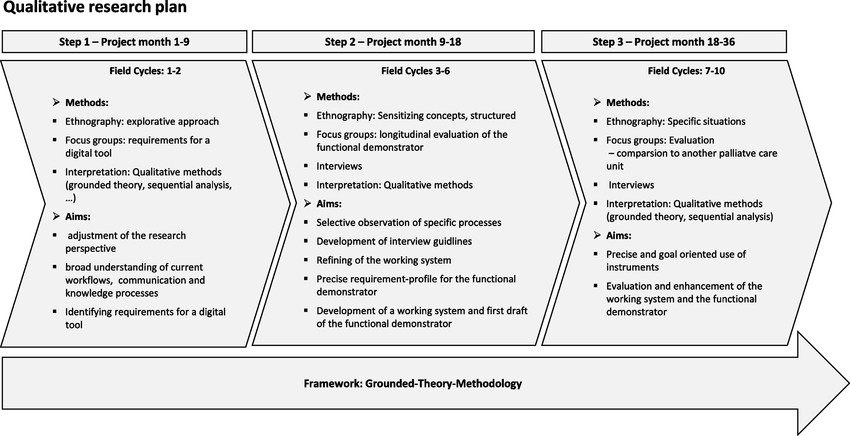 Fig.1 Phases of the qualitative research approach. (Grimminger S, et al., 2023)
SysMathx delivers end-to-end phase and qualitative analysis services that transform mathematical system models into structured state-space interpretations. The focus is on identifying stability behavior, equilibrium structures, and reachable state regions under constraints. These services support system understanding, design validation, and dynamic behavior interpretation for complex engineering systems, enabling deeper insights into nonlinear dynamics and long-term system evolution across varied operating conditions.
Phase Space & State Trajectory Analysis
SysMathx provides phase space analysis service by transforming dynamic system models into geometric state-space representations. It helps describe how system variables evolve over time in a structured and interpretable form. This service delivers detailed insight into global dynamic patterns and trajectory behavior with high consistency across different system conditions and modeling scenarios. It supports understanding of complex system evolution through visualization and structural analysis.
- Construction of phase space representations from dynamic system models enables structured visualization of system behavior in multi-dimensional state space.
- State trajectory analysis captures how variables evolve and interact over time, revealing dynamic coupling effects.
- Identification of attractors, cycles, and long-term behavioral patterns helps characterize global system dynamics.
- Geometric flow interpretation provides insight into nonlinear system evolution and structural behavior patterns.
- Evaluation of trajectory convergence and divergence supports understanding of stability tendencies and dynamic transitions.
Stability Region & Equilibrium Identification
We provide stability region and equilibrium identification service focused on analyzing system stability characteristics within state space. It provides structured evaluation of where system behavior converges, diverges, or remains stable under different conditions. This service supports identification of critical operating regions and stability boundaries. It is essential for understanding system safety and robustness, as well as evaluating long-term dynamic equilibrium behavior in nonlinear systems.
- Detection and classification of equilibrium points identifies key system states where behavior remains constant or changes direction.
- Analysis of local and global stability characteristics provides insight into system response near equilibrium conditions.
- Mapping of stability regions defines operational zones where system behavior remains stable or controlled.
- Evaluation of system behavior near equilibrium points helps understand sensitivity and transition behavior.
- Identification of stable, unstable, and saddle-type dynamics supports classification of system stability structure.
Constraint-Aware Reachability Analysis
SysMathx provides constraint-aware reachability analysis service that evaluates which system states are achievable under given constraints and operating conditions. It provides a structured understanding of feasible system evolution within physical and operational limits. This service is essential for safety assessment, system verification, and design validation. It helps define allowable behavior regions in state space for complex dynamic and constrained engineering systems.
- Computation of reachable state sets under dynamic constraints determines all possible system states over time.
- Evaluation of system evolution boundaries identifies limits of state transitions within constrained environments.
- Analysis of feasibility under physical and operational limits ensures system behavior remains within valid regions.
- Identification of safe and unsafe state regions supports safety verification and risk assessment.
- Assessment of transition possibilities between states provides insight into system controllability and evolution paths.
Our Methods for Phase & Qualitative Analysis Services
At SysMathx, our methods focus on analyzing system behavior through structured state-space representations and qualitative dynamic interpretation. These approaches are designed to reveal stability characteristics, trajectory patterns, and feasible state regions under constraints. By combining geometric analysis and mathematical modeling, our methods provide insight into global system behavior beyond time-domain simulation. This supports deeper understanding of nonlinear dynamics and improves reliability in system evaluation and design.
Applications of Phase & Qualitative Analysis Services
Phase & qualitative analysis services are applied to understand system stability, trajectory behavior, and feasible state evolution across different engineering and scientific domains. Our approaches focus on interpreting system structure and dynamic patterns rather than only numerical outputs. This enables better decision-making, design validation, and risk assessment in complex systems.
Mechanical and Structural Systems
Our services are applied to analyze stability and motion patterns in mechanical and structural systems under varying loads and conditions. Phase-space interpretation helps identify equilibrium states, oscillatory behavior, and failure tendencies.
Electrical and Power Systems
We use phase and qualitative analysis to study voltage, current, and dynamic stability in electrical networks. Stability regions and equilibrium behavior are evaluated under different operating scenarios. This helps ensure reliable operation and prevent instability in power systems.
Control and Automation Systems
Our analysis supports understanding of system behavior under feedback control and external disturbances. Trajectory patterns and stability characteristics are examined to evaluate control performance. This enables improved controller design and system robustness.
Thermal and Energy Systems
We apply qualitative analysis to evaluate temperature evolution, energy balance, and stability behavior in thermal systems. Phase-space methods help interpret dynamic transitions and steady-state conditions. This supports efficient energy management and system optimization.
Multi-Domain Engineering Systems
Our services capture interactions across mechanical, electrical, and thermal domains within integrated systems. Phase and qualitative analysis reveal coupled dynamic behavior and system dependencies. This supports system-level design and cross-domain performance evaluation.
Industrial and Process Systems
We analyze process dynamics, operational stability, and constraint-driven behavior in industrial systems. Reachability and stability evaluation help identify safe operating regions and potential risks. This supports process optimization and operational decision-making.
Why Choose SysMathx for Phase & Qualitative Analysis Services
- Phase-space interpretation provides understanding of system dynamics and evolution behavior.
- Stability and equilibrium evaluation supports early system validation and reliability assessment.
- Constraint-aware modeling improves representation of physical limitations and operating conditions.
- The results complement time-domain simulation with additional structural dynamic insight.
- These methods are suitable for both linear and nonlinear engineering systems.
Start Your Phase & Qualitative Analysis Project!
SysMathx provides end-to-end phase and qualitative analysis services to help understand system stability, equilibrium behavior, and state-space evolution under constraints. These services transform dynamic models into interpretable geometric representations that reveal global system behavior. By combining phase space analysis, stability identification, and reachability evaluation, we deliver actionable insights for system design and verification. Contact us to define your system analysis requirements and begin structural dynamic evaluation.
FAQs
What types of systems are suitable for phase & qualitative analysis?
Phase and qualitative analysis is suitable for systems that can be represented in state-space form with clear dynamic relationships. It is widely applied to mechanical, electrical, thermal, and control systems across engineering domains. The approach is especially useful for nonlinear systems where global behavior is difficult to capture using only numerical simulation.
Does this analysis require time-domain simulation?
Time-domain simulation is not strictly required for phase and qualitative analysis. Many system properties can be derived directly from state-space equations and structural relationships. Simulation can still be used as a complementary tool for validation and result comparison.
Can nonlinear systems be analyzed using this approach?
Nonlinear systems are a primary focus of phase and qualitative analysis methods. These approaches help identify complex behaviors such as limit cycles, bifurcations, and attractors. This provides deeper insight into system dynamics that may not be easily observed through numerical simulation alone.
How are stability regions determined?
Stability regions are determined by analyzing equilibrium points and their surrounding dynamic behavior. Methods such as linearization and eigenvalue analysis are commonly applied to assess local stability. Phase-space structure is then used to understand global stability characteristics and operating regions.
What is reachability analysis used for?
Reachability analysis is used to determine which system states can be achieved under given inputs and constraints. It helps evaluate feasible system evolution and identify allowable operating regions. This is important for safety verification, control design, and system validation in engineering applications.
Reference
- Grimminger S, et al. Palliative care as a digital working world (PALLADiUM)-a mixed-method research protocol. BMC palliative care. 2023, 22(1): 102.