
Surrogate & Reduced-Order Modeling Services
SysMathx provides surrogate and reduced-order modeling services that transform expensive simulations and experimental data into fast, reliable predictive models. We support industries including aerospace, automotive, energy, materials science, and pharmaceuticals using statistical and machine learning methods. Our solutions include response surface methodology, proper orthogonal decomposition, and gaussian process modeling, covering the full workflow from design to deployment.
Why Surrogate and Reduced-Order Modeling Matters
In many engineering and scientific fields, high-fidelity simulations and experiments are essential for complex systems but are too costly for repeated use in tasks like optimization and uncertainty analysis. Surrogate and reduced-order modeling address this by building fast, data-driven approximations that preserve key system behavior while reducing computational cost.
- Reduce reliance on expensive simulations while preserving accuracy for analysis and decision-making
- Learn from limited data to predict new conditions without rerunning solvers
- Reduce dimensionality while retaining dominant system behavior
- Provide uncertainty-aware predictions with confidence estimates
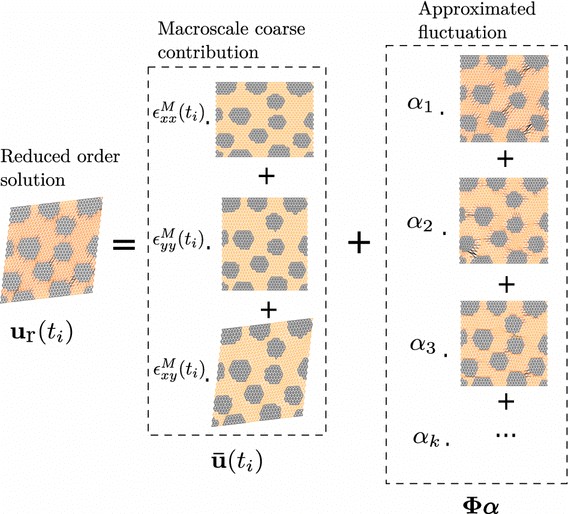 Fig.1 Surrogate model for the displacement field in the RVE. (Goury O, et al., 2016)
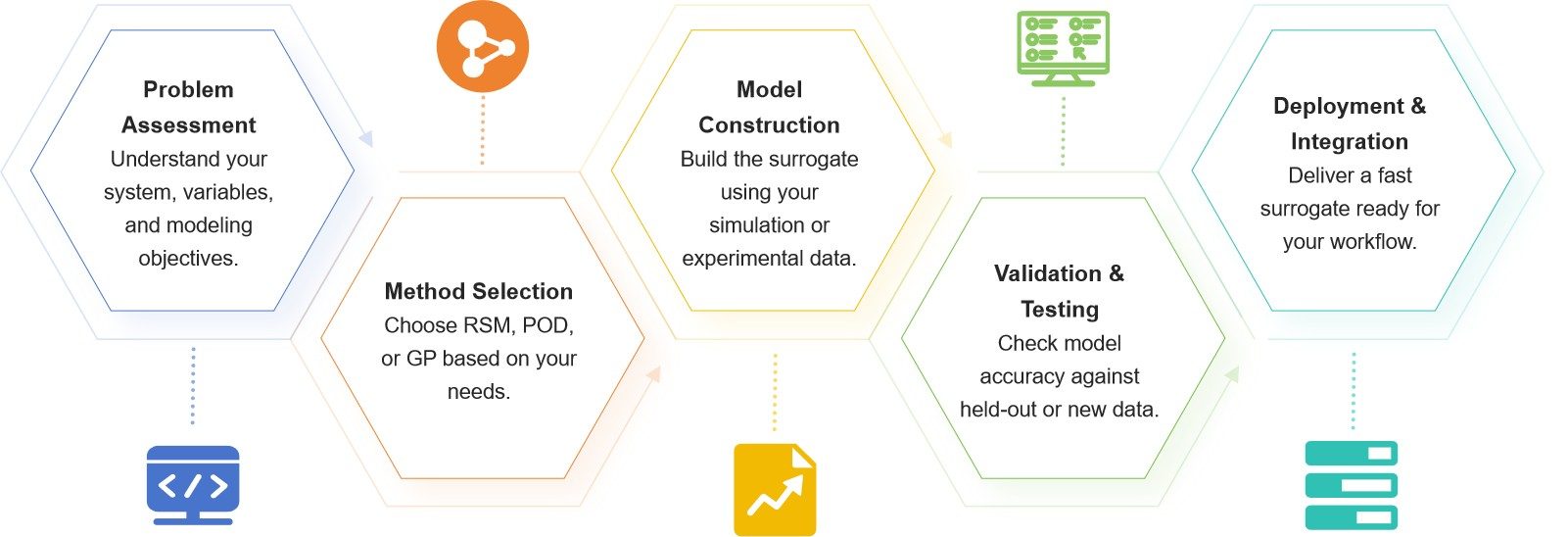
SysMathx delivers comprehensive surrogate and reduced-order modeling services tailored to each client's engineering or scientific challenges. From initial problem assessment and method selection to model construction, validation, and deployment, we ensure methodological rigor, predictive accuracy, and practical usability. The following services cover the three core approaches in our portfolio.

Response Surface Methodology (RSM) Services
RSM uses polynomial functions to approximate input-output relationships. This method is well-suited for problems with smooth responses, moderate nonlinearity, and a need for interpretable mathematical expressions. We provide experimental design, model fitting, diagnostics, and optimization support.
- Design of efficient experiments using space-filling or factorial designs.
- Fitting of first-order and second-order polynomial surrogate models.
- Model validation through residual analysis and cross-validation.
- Process optimization and design space exploration using the fitted surface.
Proper Orthogonal Decomposition (POD) Services
POD reduces the dimensionality of high-dimensional field outputs, such as simulation results on meshes or grids. This method extracts dominant spatial or temporal basis functions, allowing full-field solutions to be approximated using a small number of coefficients. We provide POD basis generation, projection, and reconstruction services.
- Extraction of dominant spatial modes from simulation or experimental data.
- Projection of high-fidelity solutions onto low-dimensional subspaces.
- Fast reconstruction of full-field outputs from reduced coefficients.
- Integration with other surrogate methods (POD-RSM, POD-GP) for parametric problems.
- For detailed information, see the full Proper Orthogonal Decomposition (POD) Services page.
Gaussian Process Surrogate Modeling Services
Gaussian Process surrogate modeling provides probabilistic predictions with built-in uncertainty quantification. This method is ideal for systems with limited data, highly nonlinear responses, or a need for risk-aware decision-making. We provide covariance function design, model training, validation, and Bayesian optimization support.
- Selection and design of covariance functions matched to system behavior.
- Hyperparameter optimization using principled likelihood-based methods.
- Probabilistic predictions with quantified uncertainty estimates.
- Active learning and Bayesian optimization for efficient exploration.
SysMathx seamlessly integrates high-fidelity simulation with real-time engineering decision-making. We provide comprehensive surrogate and reduced-order modeling services, managing everything from initial problem setup to final deployment. Our solutions ensure practical accuracy through rigorous validation and strict error control.
| Items | Contents |
|---|---|
| Surrogate Model Construction |
|
| Reduced-Order Modeling |
|
| Hybrid & Physics-Aware Approaches |
|
| Deployment & Uncertainty-Aware Use |
|
Surrogate and Reduced-Order Modeling Methods
SysMathx provides surrogate and reduced-order modeling services to efficiently approximate complex systems, reduce computational cost, and support prediction, optimization, and uncertainty-aware analysis. We apply the following methods based on system characteristics:
- Polynomial Response Surfaces: We utilize fitted polynomials to approximate system behavior, enabling rapid sensitivity analysis and design mapping.
- Modal Decomposition Methods: We implement dominant mode extraction to represent high-dimensional systems, streamlining structural and fluid dynamic analysis.
- Kernel-Based Probabilistic Models: We deploy Gaussian processes to learn nonlinear relationships while providing critical uncertainty estimates for risk-aware engineering.
- Expert Method Selection: We select the optimal approach based on your system complexity and data to ensure peak modeling efficiency.
Applications of Surrogate and Reduced-Order Modeling Services
Aerospace and Vehicle Design
Aerodynamic shape optimization relies on costly computational fluid dynamics (CFD) evaluations, while we use surrogate models trained on limited data to enable fast design exploration and optimization without repeated simulations.
Energy Systems and Battery Management
We leverage surrogate models to capture the interplay between battery performance, degradation, and thermal dynamics. This empowers us to predict untested conditions for precise state estimation and lifetime forecasting, enabling optimized charging protocols for enhanced longevity.
Manufacturing Process Control
We deploy surrogate models to map complex parameter relationships in injection molding and machining. This enables us to pinpoint optimal settings for quality improvement and defect reduction, achieving superior process control with significantly fewer physical trials.
Environmental and Climate Modeling
We implement surrogate models to bypass the high computational cost of climate and groundwater simulations. By harnessing fast approximations, this approach accelerates sensitivity analysis and uncertainty quantification across diverse environmental scenarios.
How We Work?
At SysMathx, we design, validate, and deploy surrogate or reduced-order models based on your data, accuracy needs, and computational constraints for optimization, analysis, control, and real-time prediction with quantified uncertainty.
Start Your Surrogate Modeling Project!
Have a system where high-fidelity simulations or experiments are too expensive for repeated evaluation? SysMathx provides surrogate and reduced-order modeling to enable fast prediction, optimization, and sensitivity analysis. Contact us with your inputs, outputs, data, and goals, and our team will recommend the best approach and explain trade-offs when needed.
FAQs
What types of problems can surrogate modeling solve?
It solves problems where high-fidelity simulations or experiments are too expensive to run repeatedly, such as design optimization and uncertainty quantification.
How do I choose between RSM, POD, and Gaussian Process methods?
The choice depends on your problem: RSM for smooth responses, POD for high-dimensional field outputs, and Gaussian Process for limited data or uncertainty needs.
How much data is required to build an accurate surrogate model?
Data requirements vary by method, ranging from dozens of points for RSM and GP to hundreds for POD.
Can surrogate models handle noisy or experimental data?
Yes, especially Gaussian Process methods which include built-in noise handling capabilities.
What is the typical timeline for a surrogate modeling project?
Timeline ranges from one to two weeks for simple RSM projects to three to six weeks for complex POD or GP projects.
Reference
- Goury O, et al. Automatised selection of load paths to construct reduced-order models in computational damage micromechanics: from dissipation-driven random selection to Bayesian optimization. Computational Mechanics. 2016, 58(2): 213-234.