
Stochastic Process Modeling Services
SysMathx provides stochastic process modeling services to capture randomness, uncertainty, and time-dependent behavior in engineering, financial, and scientific systems. We support the full workflow from data analysis and model selection to parameter estimation, simulation, and risk assessment based on probability theory and time series methods. Our capabilities include Gaussian processes, state-space models, Markov processes, and stochastic differential equations for applications such as predictive maintenance and financial forecasting.
What Problems Does Stochastic Process Modeling Solve?
Real-world systems are inherently uncertain due to noise, fluctuating conditions, and time-dependent randomness, which deterministic models often fail to capture. This can lead to overconfident predictions and unreliable decisions, especially for processes like degradation, markets, or weather. Stochastic process modeling addresses this by representing system behavior probabilistically, accounting for temporal dependence and evolving uncertainty.
- Quantified prediction uncertainty: Every prediction comes with confidence intervals or full probability distributions, enabling risk-aware decisions.
- Natural handling of noisy data: Models separate signal from noise and learn both the underlying trend and the error structure.
- Temporal dependence captured: Auto-correlation and evolving dynamics are explicitly modeled, unlike i.i.d. assumptions.
- Forecasting with confidence: Generate future trajectories with probabilistic bounds that widen appropriately as the prediction horizon increases.
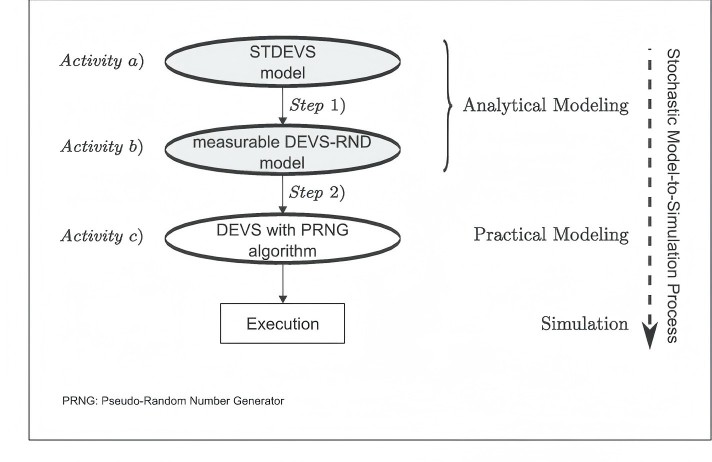 Fig.1 The diagram shows the steps and transitions from stochastic model to simulation. (Castro R, et al., 2010)
SysMathx provides end-to-end data modeling services to help you uncover patterns and make reliable predictions. Whether your data changes over time or across locations, we build models tailored to your needs and deliver clear insights, including uncertainty in the results. Our services cover everything from data analysis and model selection to parameter estimation, simulation, and deployment. We focus on clarity, reliability, and real-world usability so your models support better decision-making.
Time Series Analysis and Forecasting Services
We deliver advanced time-evolving data analytics to identify underlying patterns and generate dependable projections. By isolating trends, seasonal cycles, and volatility, our services enhance strategic planning by pairing precise predictions with a rigorous assessment of uncertainty.
- Detection of trends and seasonal patterns
- Support for stable and rapidly changing data
- Identification of anomalies and structural changes
- Forecast ranges to reflect uncertainty
- Applications in demand, finance, and operations
Markov Modeling and Simulation Services
We offer Markov modeling and simulation services that frame systems as a series of state transitions to track temporal evolution. By calculating transition dynamics and steady-state probabilities, this approach empowers strategic planning through scenario-based analysis and long-term outcome forecasting.
- Estimation of state transition behavior from data
- Analysis of long-term system stability
- Calculation of event probabilities and timing
- Scenario-based simulation for decision support
- Applications in operations, reliability, and user behavior
Stochastic Differential Equation Modeling Services
We specialize in stochastic differential equation modeling to represent systems governed by both deterministic paths and inherent randomness. By illustrating the continuous interplay between these forces, our services generate high-fidelity simulations that reveal critical insights into future risk and system volatility.
- Parameter estimation directly from observed data
- Simulation of future system paths
- Modeling of stable and mean-reverting behavior
- Representation of sudden and large changes
- Useful for finance, environment, and engineering
Predictive Maintenance and Reliability Modeling Services
We use stochastic process modeling to forecast equipment degradation and operational risks under uncertainty. By analyzing wear patterns, failure probabilities, and operating conditions, our services enable proactive maintenance, reduce downtime, and optimize asset performance.
- Estimation of remaining useful life
- Early detection of potential failures
- Optimization of maintenance schedules
- Simulation of degradation scenarios
- Applications in manufacturing, energy, and transportation
Stochastic Process Modeling Methods
SysMathx's stochastic process modeling methods provide a framework to analyze complex systems influenced by both deterministic trends and random variation. We apply techniques such as stochastic differential equations and probabilistic state-space modeling to capture system dynamics under uncertainty. Our workflow includes data characterization, model selection, parameter estimation, validation, and uncertainty-aware prediction, enabling robust simulation, forecasting, and decision-making.
Applications of Our Stochastic Process Modeling Services
Predictive Maintenance
We use our stochastic process modeling services in predictive maintenance to model equipment degradation under uncertainty, enabling remaining life estimation, early failure detection, and optimized maintenance planning.
Financial Risk Modeling
We apply our stochastic process modeling services in financial risk modeling to simulate system dynamics under uncertainty, enabling risk assessment, portfolio evaluation, and stress testing.
Environmental Monitoring
We employ our stochastic process modeling services in environmental monitoring to forecast temperature, wind, and pollution, capturing patterns and variability to support reliable prediction and resource planning.
Manufacturing Quality Control
We apply our stochastic process modeling services in manufacturing quality control to model output variability, enabling detection of deviations, anomalies, and process shifts to improve consistency and reduce defects.
Healthcare and Epidemiology
We use our stochastic process modeling services in healthcare and epidemiology to capture disease transmission variability, enabling scenario analysis, intervention planning, and public health decision support.
Autonomous Systems
We apply our stochastic process modeling services in autonomous systems to model uncertainty in sensors and dynamics, enabling state prediction, robust control, and safer real-time performance.
Why Choose Our Stochastic Process Modeling Services?
- Uncertainty Quantification: Every prediction includes confidence intervals or full distributions, supporting risk-informed decisions.
- Handles Real-world Data: Robust to noise, missing values, irregular sampling, and non-stationary behavior.
- Probabilistic Forecasts: Generate prediction intervals that widen appropriately with longer horizons.
- Interpretable Outputs: Clear reporting of model parameters, uncertainty sources, and validation metrics.
Start Your Stochastic Process Modeling Project Today!
Have noisy, uncertain, or time-dependent data that traditional models cannot handle effectively? We transform your observations into probabilistic models that capture variability, quantify uncertainty, and support reliable forecasting. Contact us with a brief description of your data and objectives to receive a tailored approach recommendation and a clear technical proposal.
FAQs
What types of data are suitable for stochastic process modeling?
Time series data, spatial field data, or any sequence of observations where randomness, temporal correlation, or measurement noise is present.
What is the difference between Gaussian process regression and traditional regression?
Gaussian processes provide full predictive distributions rather than just point predictions, naturally quantifying uncertainty even with sparse data.
Can stochastic models handle irregularly sampled time series?
Yes, Gaussian processes and state-space models handle irregular sampling naturally. For other methods, we preprocess data onto regular grids with appropriate uncertainty propagation.
How is model accuracy evaluated for stochastic processes?
Using probabilistic metrics such as log-likelihood, continuous ranked probability score (CRPS), calibration of prediction intervals, and out-of-sample forecast evaluation.
What if my data shows both deterministic patterns and random noise?
We combine deterministic components with stochastic residuals, capturing both predictable structure and irreducible uncertainty.
Reference
- Castro R, et al. A formal framework for stochastic discrete event system specification modeling and simulation. Simulation. 2010, 86(10): 587-611.