
Gaussian Process Surrogate Modeling Services
SysMathx provides gaussian process (GP) surrogate modeling that turns expensive simulations or limited experimental data into probabilistic predictions with quantified uncertainty for nonlinear and noisy systems. The service supports applications across aerospace, automotive, energy, materials science, and pharma, including covariance design, Bayesian optimization, and uncertainty analysis.
What Problems Does Gaussian Process Surrogate Modeling Solve?
In many engineering and scientific applications, high-fidelity simulations and experiments are computationally expensive, time-consuming, and difficult to scale, which limits efficient design exploration and real-time decision-making. These challenges are further amplified in nonlinear systems and data-scarce scenarios, where direct evaluation or repeated testing is impractical.
Gaussian process surrogate modeling addresses these issues by providing a data-efficient way to approximate complex system behaviors, enabling faster evaluation while reducing reliance on costly simulations and experiments.
- Reduce computational cost by replacing expensive simulations with fast surrogate models
- Capture nonlinear behavior and complex response surfaces
- Provide uncertainty-aware predictions with quantified confidence
- Improve data efficiency by extracting maximum information from limited data
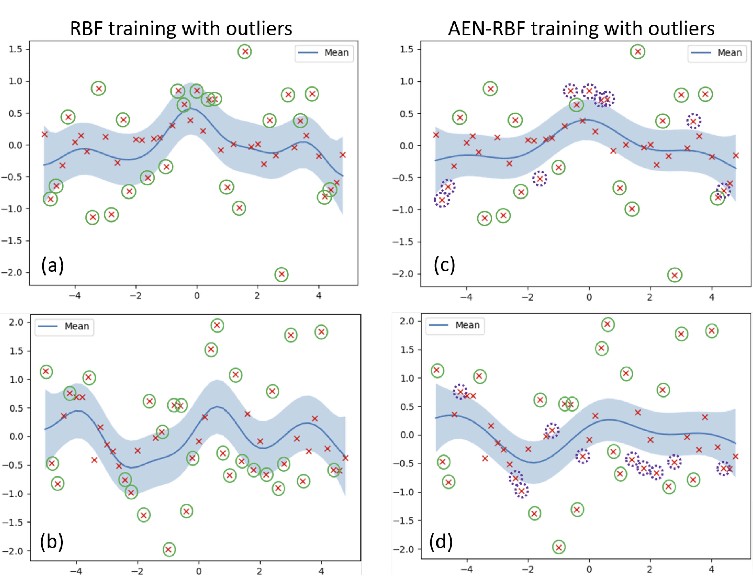 Fig.1 Gaussian process surrogate models in the presence of outliers. (AlBahar A, et al., 2021)
SysMathx delivers comprehensive gaussian process surrogate modeling services tailored to your engineering or scientific challenges. From kernel design and hyperparameter optimization to model validation and active learning, we transform simulation outputs or experimental measurements into rigorous probabilistic surrogates. Our approach ensures methodological soundness, quantified predictive uncertainty, and transparent processes that support risk-aware decision-making.

Experimental Design and Data Acquisition Support
Gaussian process models rely heavily on how well the training data covers the input space. Poorly distributed samples can lead to large uncertainty in critical regions or unnecessary computational cost. To address this, we design efficient data acquisition strategies that maximize information gain while minimizing the number of evaluations.
- Recommendation of initial experimental designs based on input dimensionality and available budget
- Space-filling sampling strategies such as Latin hypercube and Sobol sequences to ensure uniform coverage
- Sequential sampling approaches that prioritize informative regions based on predicted improvement or uncertainty
- Seamless integration with existing simulation or experimental workflows

Model Construction and Training Services
With data in place, we build gaussian process surrogate models by selecting suitable covariance functions and optimizing key parameters that control model behavior. The goal is to capture dominant system patterns while maintaining robustness and avoiding overfitting.
- Selection of covariance function types, including squared exponential, rational quadratic, periodic, or hybrid combinations
- Parameter optimization using gradient-based or sampling-based approaches
- Explicit treatment of measurement noise through dedicated noise components in the model

Model Validation and Uncertainty Diagnostics
The reliability of a gaussian process model depends not only on prediction accuracy but also on the quality of its uncertainty estimates. We apply rigorous validation techniques to ensure both aspects are well calibrated.
- Leave-one-out validation for small datasets to assess model consistency
- Diagnostic checks to evaluate whether predicted uncertainty aligns with observed errors
- Visualization of predicted values and confidence intervals compared with independent test data

Optimization and Analysis Under Uncertainty
A major advantage of gaussian process modeling is its ability to support efficient optimization and uncertainty-aware analysis. We help identify optimal input conditions with minimal evaluations and quantify how input variability affects outputs.
- Single-objective optimization using strategies that balance exploration and exploitation
- Multi-objective optimization with identification of trade-off solutions
- Propagation of input uncertainty through the model using sampling-based methods to estimate output variability
Gaussian Process Surrogate Modeling Methods
SysMathx provides gaussian process surrogate modeling services based on a probabilistic, non-parametric framework that uses data-driven function priors to approximate complex, nonlinear, and uncertain system behavior. This approach enables accurate modeling under limited observations while also quantifying predictive uncertainty, supporting reliable analysis and decision-making across diverse applications.
Applications of Gaussian Process Surrogate Modeling Services
Aerospace and Aerodynamic Design
We employ GP surrogate models to streamline wing shape and airfoil optimization under expensive CFD constraints. By leveraging probabilistic predictions, this framework empowers us to navigate complex aerodynamic trade-offs, reaching near-optimal, high-performance designs with significantly fewer high-fidelity simulations.
Materials Science and Discovery
We deploy GP surrogate models to predict properties across vast composition spaces using sparse experimental data, overcoming slow synthesis cycles. By harnessing predictive uncertainty, this approach enables us to bypass unpromising candidates and target high-potential materials, significantly accelerating the discovery timeline.
Pharmaceutical and Bioprocess Development
We harness GP surrogate models to characterize the nonlinear dynamics of cell culture and fermentation using sparse data. By integrating uncertainty quantification, this methodology enables us to guide risk-based scale-up and tech transfer, ensuring product quality while drastically reducing physical experiments.
Energy Systems and Battery Modeling
Energy systems such as batteries and fuel cells exhibit nonlinear behavior, while we use GP surrogate models trained on test data to estimate performance under new operating conditions with uncertainty awareness. This allows us to enable real-time performance evaluation, lifetime prediction, and operational optimization without costly experiments.
Why Choose Gaussian Process Surrogate Modeling Services?
- Probabilistic Predictions: Each prediction includes uncertainty, enabling risk-aware decisions and extrapolation awareness.
- Data Efficiency: GP models extract maximum value from limited, expensive evaluations without large datasets.
- Nonlinear Flexibility: Captures complex, irregular response surfaces beyond polynomial approximation.
- Active Learning Compatibility: Uncertainty guides sequential experiments toward the most informative regions.
Start Your Gaussian Process Surrogate Modeling Project!
If the system involves expensive evaluations, limited data, strong nonlinearity, or requires uncertainty-aware predictions, SysMathx can transform simulation or experimental data into an efficient surrogate model for analysis and optimization. By sharing key details such as input variables, data size, output type, and modeling goals, a tailored modeling strategy can be defined to match the application. Contact us to discuss the project and next steps.
FAQs
What data size is suitable for Gaussian Process modeling?
Gaussian Process modeling works well with small to medium datasets, typically from tens to a few thousand samples, especially when data is expensive to obtain.
How is model accuracy evaluated?
Accuracy is assessed using validation methods such as cross-validation and testing on unseen data, along with checks on whether predicted uncertainty matches actual errors.
Can noisy or experimental data be used directly?
Yes, the method explicitly accounts for noise, allowing reliable modeling even when measurements contain variability or uncertainty.
Is this approach suitable for real-time prediction?
Once trained, the model provides very fast predictions, making it suitable for real-time evaluation and integration into larger workflows.
Can the model be updated when new data becomes available?
Yes, the model can be incrementally improved by incorporating new data, enhancing both prediction accuracy and confidence over time.
Reference
- AlBahar A, et al. A robust asymmetric kernel function for Bayesian optimization, with application to image defect detection in manufacturing systems. IEEE Transactions on Automation Science and Engineering. 2021, 19(4): 3222-3233.